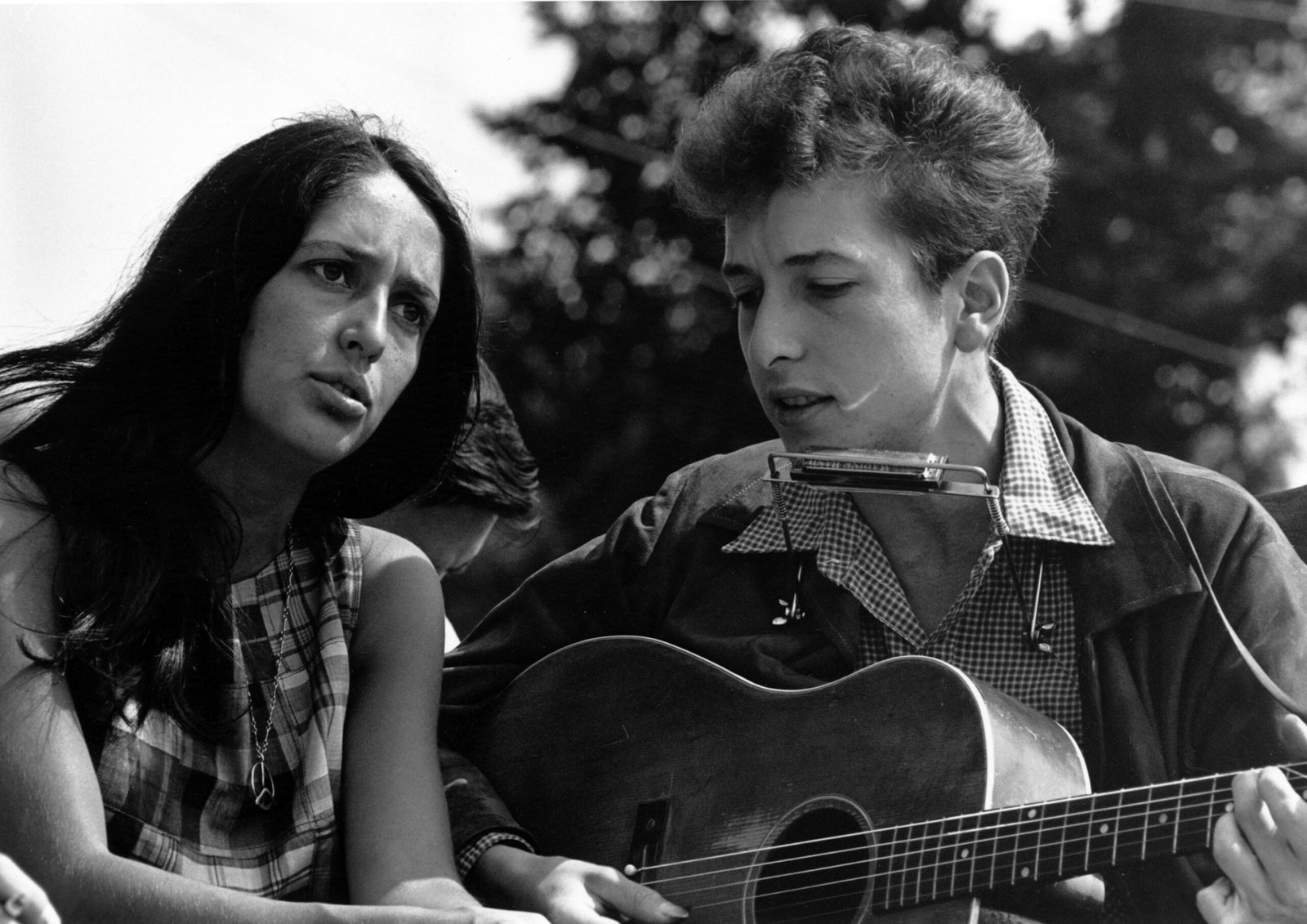
For more than sixty years, Bob Dylan has been the most famously unreadable man in popular music — a shape-shifter who answered questions with riddles, accepted a Nobel Prize with a shrug, and turned his own life into a hall of mirrors. But behind the masks, the disguises, and the deliberate mystery, there has always been a beating heart. It shows up in the most unexpected places: in a lullaby written in a single minute, in a marriage kept secret from the entire world, in a love affair that became someone else’s greatest song. This is the story of Dylan not as an icon, but as a man who loved, lost, and kept going.
The Girl on the Album Cover
In February 1963, photographer Don Hunstein captured one of the most beloved images in music history: a skinny young folksinger in a light jacket, arm in arm with a pretty dark-haired girl, walking down a snow-dusted street in Greenwich Village. The picture became the cover of “The Freewheelin’ Bob Dylan,” and the girl was Suze Rotolo — a seventeen-year-old art student, the daughter of Italian leftists, who had fallen in love with the scruffy kid from Minnesota before anyone else knew his name.
Suze was there at the very beginning, when Dylan was still inventing himself. She introduced him to French poetry and Brecht, to art and ideas beyond the folk songs he was absorbing, and she appears — unnamed but unmistakable — in some of his earliest love songs. She was his first great love and, in many ways, his first great loss — she left for Italy in 1962, came back, and finally ended the relationship in 1964, exhausted by the fame closing in around him and by his infidelities. Years later she wrote a memoir, “A Freewheelin’ Time,” remembering the boy before the legend with clear-eyed tenderness. She died in 2011, but every time that album cover catches the light in a record store, there they are: two kids in the snow, before the world got complicated.
“Forever Young”: A Father’s Prayer
By the early 1970s, the boy in the snow had become a father of four, living in near-seclusion in Woodstock. And fatherhood cracked him open in a way fame never had. In the winter of 1972, staying at a ranch north of Phoenix, Arizona, Dylan sat down in Tucson and wrote “Forever Young” — a blessing for his children that poured out of him, by his own account, in about a minute.
“I wrote it thinking about one of my boys and not wanting to be too sentimental,” he later wrote in the liner notes to his “Biograph” compilation. “The lines came to me; they were done in a minute.” Whether he was thinking of his eldest, Jesse, or his youngest, Jakob, hardly matters — the song is a father’s whole heart laid bare: wishes for courage, for truth, for joy, for a child to stay forever young in spirit. He recorded it twice for 1974’s “Planet Waves,” once slow like a lullaby and once fast like a celebration. It has since become one of the most beloved songs ever written about parenthood, covered by everyone from Joan Baez to Meat Loaf, recited on television, played at graduations and funerals. The man who wouldn’t explain himself to reporters had explained everything to his children in four minutes.
Sara: The Marriage He Hid From the World
If the public knew little about Dylan’s heart, it knew even less about his home life — because Dylan made sure of it. On November 22, 1965, at the absolute peak of his fame, he secretly married Sara Lownds, a former model and mother of a young daughter, Maria, whom Dylan adopted. Some of his closest friends didn’t even know it had happened; when one friend congratulated him, Dylan reportedly denied he was married at all.
For a decade, Sara was the still center of his storm. They had four children together — Jesse Byron, born in January 1966; Anna Lea; Samuel Isaac Abraham; and Jakob Luke, born in December 1969, who would grow up to lead the Wallflowers to stardom in the 1990s. The family retreated to Woodstock after Dylan’s 1966 motorcycle crash, living a deliberately ordinary life while the world outside argued about what Bob Dylan meant. The secrecy was extraordinary and deliberate. For years, the press and even many fans had no idea Dylan was married at all — he had constructed a wall between his public myth and his private life, and Sara and the children lived safely behind it. In an era before the internet made privacy impossible, Dylan achieved something almost no superstar has managed since: he kept his family his own.
But the marriage could not survive the seventies. The pressures of fame, the long absences, the temperamental distance — it all took its toll, and the couple divorced on June 29, 1977. The wreckage of that breakup became “Blood on the Tracks,” though Dylan would spend the rest of his life denying it. He married once more, to backup singer Carolyn Dennis, from 1986 to 1992 — another relationship kept almost entirely out of public view until long after it ended. If there is a pattern in Dylan’s romantic life, it is this: he loved deeply, privately, and at great cost.
Joan Baez: Diamonds and Rust
No account of Dylan’s heart is complete without Joan Baez. She was already the queen of folk music when the young Dylan arrived in Greenwich Village, and she did something extraordinary: she shared her stage, her audiences, and eventually her heart with him. They sang together, toured together, and for a time in the mid-1960s were the golden couple of the folk movement — two beautiful voices raised against war and injustice.
It didn’t last. Dylan’s restless ambition pulled him toward rock and roll and away from the folk world Baez embodied, and the romance faded into a complicated, lifelong friendship. But Baez got the last word, in the most beautiful way possible. In November 1974, she was working on a song when the phone rang — Dylan, calling from a phone booth in the Midwest while promoting “Blood on the Tracks,” reading her the lyrics to his new “Lily, Rosemary and the Jack of Hearts.” The call unlocked something in her, and the song became “Diamonds & Rust,” released in April 1975: a devastating, tender reckoning with their love affair, full of diamonds and rust — the shining memories and the corroded ones.
She once told Dylan, face to face during rehearsals for his Rolling Thunder Revue, that the song was about her ex-husband. He must have known better. Decades later, on BBC’s “Desert Island Discs,” Baez named “Diamonds & Rust” as the one song of her own she would take to a desert island — the song about the boy she had loved when they were both young and the world was new.
The Road That Never Ends
There is another love story in Dylan’s life, and it isn’t with a person at all. In 1988, Dylan began what fans call the Never Ending Tour — and he simply never stopped. Year after year, decade after decade, he has played somewhere around a hundred shows annually, crisscrossing the globe well into his eighties, long after any financial need vanished. The venues got smaller, the setlists got stranger, the voice got rougher — and the devotion of the audiences never wavered.
Why does he keep going? Dylan has never fully explained, but those close to him speak of a man who is most himself on a stage, in front of people, in the communion of a live song — a place where the masks fall away and only the music remains. The road is where he has always processed his life — the heartbreaks, the conversions, the confusions. For a man who guards his privacy so fiercely, the concert stage is paradoxically the most honest place he knows. Night after night, he stands before strangers and tells them the truth in the only language he fully trusts: the songs.
The Gospel Years: A Heart in Search of Answers
In the late 1970s, Dylan’s searching heart took its most startling turn. The man who had been raised Jewish, who had written the defining protest anthems of a generation, announced that he had become a born-again Christian. He recorded two gospel albums — “Slow Train Coming” in 1979 and “Saved” in 1980 — and toured playing almost nothing but religious songs, refusing to perform his old hits. Fans were baffled; some were furious.
Whatever one makes of the theology, the gospel period revealed something essential about Dylan: his heart has always been restless, always seeking, never satisfied with easy answers. He threw himself into faith with the same total commitment he had once given to folk music and rock and roll, preaching between songs and studying scripture with the intensity of a new convert. The fervor eventually cooled, but the spiritual hunger never left his work — it echoes through everything he has written since, in songs that wrestle with mortality, judgment, mercy, and grace. Friends from those years remember a man genuinely transformed, at peace in a way the fame-chased Dylan of the sixties had never been. The enigma, it turns out, was never empty. It was full of questions too big for interviews, questions he could only ask in song.
Beneath six decades of masks — the protest singer, the rock star, the recluse, the gospel preacher, the Nobel laureate who barely showed up — Bob Dylan’s story is, in the end, a deeply human one. He loved a girl in the snow in Greenwich Village and lost her to fame. He built a secret family and watched it break. He wrote his children a blessing in a minute and spent a lifetime trying to live up to it. He kept walking away from every identity the world offered him, searching for something truer underneath.
The heart behind the enigma never stopped beating, and never stopped singing. It just did both in private — and let the songs do the talking. For those willing to listen past the riddles, the tenderest voice in American music has been there all along, hiding in plain sight: a father who blessed his children in a minute-long prayer, a husband who guarded his family’s privacy like treasure, a lover whose memory became someone else’s masterpiece, a seeker who traded every certainty for the next question. Bob Dylan spent sixty years refusing to be known — and in the songs, told us everything. Forever young in the only way that matters: forever reaching for the next song.
Leave a Reply