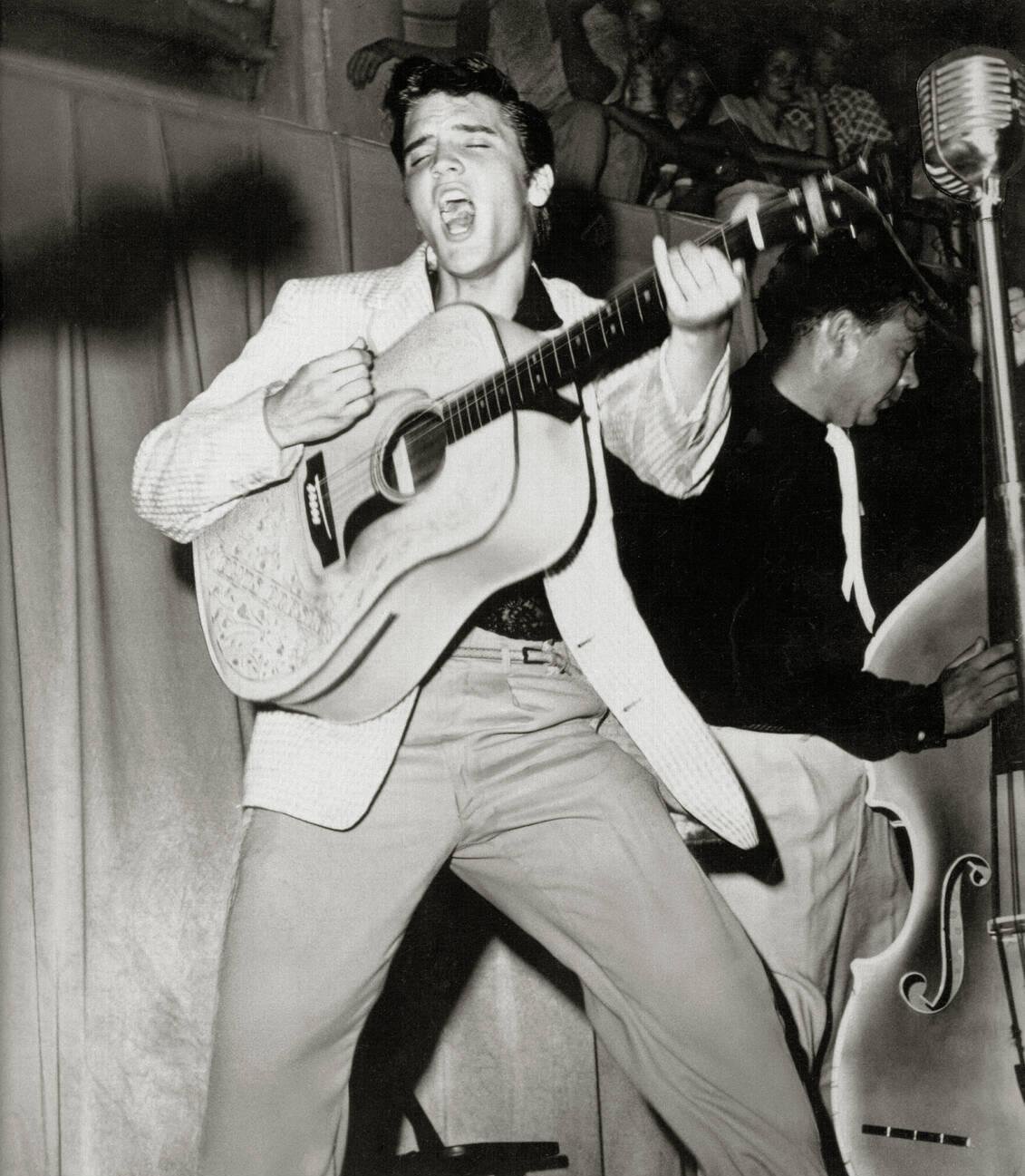
The world knew Elvis Presley as the King — the hips, the sneer, the voice that changed everything. But those who knew him best talk about something else entirely: a man of almost overwhelming tenderness, whose generosity was as legendary as his music, and whose deepest wounds never fully healed. Behind the rhinestones and the roar of the crowd was a boy from Tupelo who never got over losing his twin, who worshipped his mother, who gave away Cadillacs to strangers, who served his country without complaint, and who carried his grief all the way to Graceland’s gates. This is the Elvis the spotlight never quite captured.
The Twin Who Never Came Home
Elvis Presley’s story begins with a loss. On the morning of January 8, 1935, in a tiny two-room house in Tupelo, Mississippi, Gladys Presley gave birth to twin boys in the depths of the Great Depression. The first, Jesse Garon, was stillborn. The second, Elvis Aaron, survived — and grew up in the shadow of the brother who never lived. Gladys never got over it, and neither, in his way, did Elvis. He spoke of Jesse throughout his life, wondering aloud who his twin might have become.
The loss bound mother and son together with an intensity that shaped everything. Gladys poured all the love meant for two children into one, and Elvis — her miracle baby, her surviving twin — became the center of her universe. The Presleys were desperately poor, moving from house to house around Tupelo, but Gladys made sure her boy never doubted he was loved. Those who knew the family say Elvis carried a lifelong sense of survivor’s guilt, a feeling that he was living for two. It may explain the ferocity of his devotion to Gladys, and the bottomless generosity he showed the world: he had been given a life his brother never got, and he spent it giving.
His Best Girl
If Elvis had one great love, it wasn’t a sweetheart or a wife — it was his mother. When fame arrived, he set out to erase every hardship Gladys had ever known. He bought her a gleaming pink 1955 Cadillac Fleetwood — a car she had never learned to drive and never would — painted in a custom shade mixed by a neighbor that became known as “Elvis Rose.” He bought Graceland, the Memphis mansion, for $102,500 in March 1957, and built a chicken coop out back so Gladys could gather eggs like she had back in Mississippi. Mother and son even kept private nicknames for each other — “Satin” and “Satnin” — long after he became the most famous man on earth.
Then came the Army, and with it, the beginning of the end. During basic training at Fort Hood, Texas, in the brutal summer of 1958, Gladys’s health collapsed. She returned to Memphis in early August and was rushed to the hospital. Elvis was granted emergency leave and flew home on August 12, keeping a near-constant vigil at her bedside. At 3:15 on the morning of August 14, 1958, Gladys Presley died of a heart attack. She was forty-six years old.
Elvis was inconsolable. “She’s all I ever lived for,” he wept. “She was always my best girl.” At the funeral, as gospel hymns filled the chapel, he threw himself across her casket, sobbing that everything he had worked for was gone. Friends said he was never quite the same afterward — that a light went out in him on August 14, 1958, that no applause could ever fully relight. Before returning to duty, he gave strict orders that nothing in his mother’s first-floor bedroom at Graceland should ever be touched — her clothes in the closet, her perfume on the vanity, exactly as she left them. And the pink Cadillac? It was parked under a carport at Graceland and never moved again. To this day, the most famous pink Cadillac in the world remains legally registered to Gladys Presley.
The Sergeant From Memphis
Elvis’s Army years — from his induction in March 1958 to his discharge in March 1960 — are often treated as a footnote, but they reveal the man’s character. He could have taken the easy path: the Army offered him a cushy entertainment posting, performing for the troops. He refused. He insisted on serving as a regular GI, driving a jeep for the 3rd Armored Division in Germany, living in barracks, taking the same risks and routines as every other soldier. His fellow servicemen remembered him as unassuming and hardworking — just another guy in uniform who happened to be the most famous person on the planet. It cost him two years at the peak of his fame, and he never complained. If anything, those who knew him say the Army grounded him, giving him a taste of ordinary life he had lost at nineteen and would never fully regain.
It was in Germany, in September 1959, that he met Priscilla Beaulieu — a fourteen-year-old schoolgirl, the stepdaughter of an Air Force officer, introduced to him at a party at his rented home in Bad Nauheim. Elvis was twenty-four, lonely, and still grieving his mother, and the two formed an unlikely connection built on long conversations and mutual understanding. Priscilla has always maintained that Elvis respected her youth and that their early bond was emotional rather than romantic. What began as an unlikely friendship across the distance of years would, after Priscilla moved to Graceland in 1963, become one of the most famous romances in the world. They married in Las Vegas on May 1, 1967, and their daughter, Lisa Marie, was born on February 1, 1968. The marriage ended in divorce on October 9, 1973, but Elvis remained a devoted father, and he and Priscilla stayed close until his death.
Love, Loss, and Lisa Marie
When Lisa Marie Presley was born on February 1, 1968, Elvis was transformed. Friends say fatherhood softened him in a way nothing else had — the hardened performer melted into a doting dad who spoiled his little girl outrageously. He bought her ponies and golf carts, flew her on the private jet, and kept her close whenever his schedule allowed — the center of his world. Those who saw them together describe a tenderness that the stage never showed: the King on the floor, playing with his daughter, completely unguarded.
The divorce from Priscilla in October 1973 devastated him — many of his saddest later recordings are widely heard as meditations on that lost love. But through it all, he remained devoted to Lisa Marie, and she to him. After his death, she would spend her life guarding his legacy at Graceland, keeping the flame he had lit. The boy who lost his twin and his mother poured everything he had left into being the father he wished the world had been kinder to.
The Giver
Ask anyone who knew Elvis about his defining trait, and the word comes back again and again: generous. Not performatively, not for publicity — compulsively, joyfully, almost recklessly generous. He gave away hundreds of cars over his lifetime: Cadillacs to friends, to backup singers, to total strangers who admired one in a parking lot. He paid off mortgages, covered medical bills, handed out jewelry and cash with a grin. It was as if he couldn’t stand the thought of anyone wanting something he could provide.
The most famous example of his big-hearted showmanship came on March 25, 1961, at the Bloch Arena in Pearl Harbor, Hawaii. Elvis performed a benefit concert for the USS Arizona Memorial — the monument to the sailors killed at Pearl Harbor, which was struggling to raise funds for completion. Elvis bought the first ticket himself, for $100, and his performance helped raise more than $60,000 — well beyond the $50,000 goal. The memorial was dedicated the following year, on May 30, 1962, and Elvis’s contribution is still remembered in Hawaii with genuine affection. He didn’t do it for headlines. He did it because someone asked, and because his heart told him to.
The stories are endless and they all sound the same: Elvis hearing about a family in need and quietly paying their bills. Elvis spotting a stranger admiring his car and handing over the keys on the spot. Elvis tipping enormously, remembering every employee’s name, treating the Graceland staff like family. He gave the way he sang — without holding anything back, and without ever asking for applause in return.
The Discipline of a Warrior
There was another side to Elvis that fans rarely saw: the martial artist. He took up karate during his Army years in Germany and pursued it with characteristic intensity for the rest of his life, eventually earning a black belt. He studied Kenpo karate seriously, incorporating its discipline into his stage moves — those famous karate-style kicks and poses weren’t just showmanship, they were the real thing. Friends said the dojo gave him something fame couldn’t: a place where he was judged on effort and skill, not celebrity. In a life where everyone wanted a piece of him, the discipline of karate was one of the few things that was entirely his own.
It fit the pattern of the man. Elvis approached everything he loved with total commitment — music, his mother, his daughter, his friends, his art, his country. The karate, the generosity, the grief he carried for Jesse and Gladys: they were all expressions of the same enormous, unguarded heart. He felt everything deeply, and he never learned to protect himself from feeling it.
The Boy From Tupelo
In the end, the truest measure of Elvis Presley isn’t the records sold or the crowds screamed for — it’s the trail of kindness he left behind. The musicians he lifted up. The strangers he surprised with cars and cash. The memorial in Pearl Harbor that stands, in part, because he cared. The pink Cadillac that never moved, guarding the memory of a mother who never learned to drive it. The daughter he adored, who kept his flame burning at Graceland for the rest of her life.
The King died at Graceland in 1977, but the heart behind the King had been showing itself all along — in every gift given, every hand shaken, every tear shed for the twin who never came home and the mother who left too soon. Elvis Presley was the biggest star the world had ever seen. He was also, by every account that matters, one of the kindest — a man who never forgot where he came from and never stopped trying to lift others up with him. And of all his legacies, that may be the one that shines the longest.
Leave a Reply