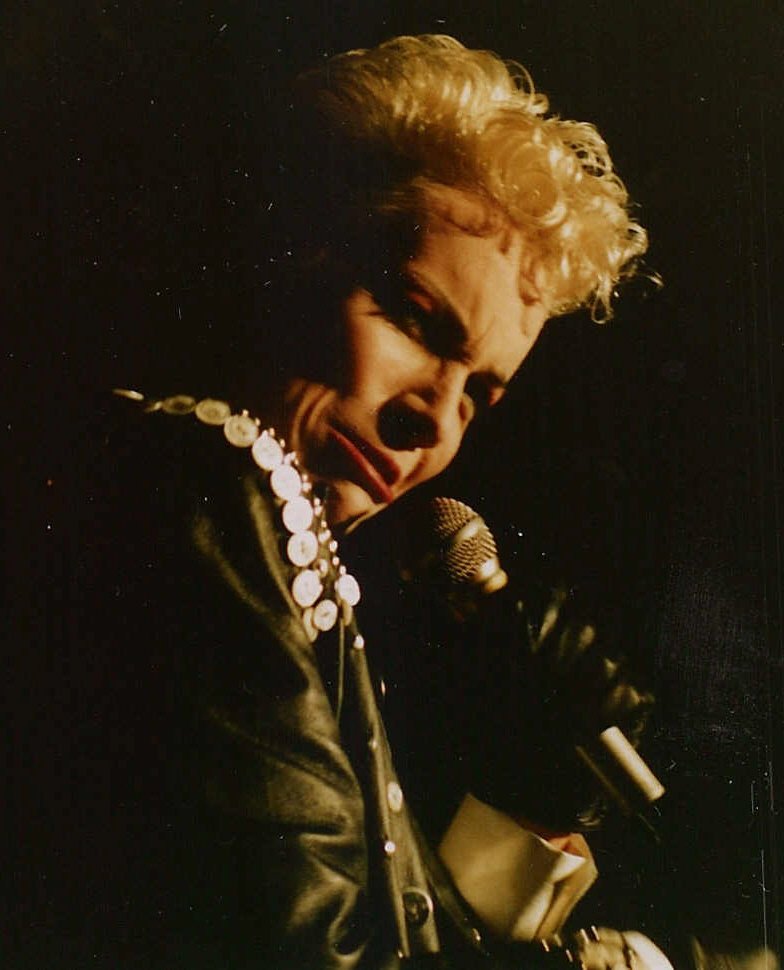
On stage, Eurythmics were the coolest thing in eighties pop: Annie Lennox with her cropped orange hair and tailored suits, staring down the camera like an android with a soul voice, and Dave Stewart beside her, the quiet architect with a guitar. The image was all control, all ice. Off stage, the reality was far warmer and far more wounded: a stillborn son, three marriages, four children, decades of activism for the dying and the forgotten, and a creative partnership between two ex-lovers that somehow never broke. This is the story of the hearts behind the ice-cool image.
The Loss That Changed Everything
In December 1988, at the absolute height of Eurythmics’ fame, Annie Lennox suffered the loss that would reshape her life. Her first child, a son named Daniel, was stillborn. She was thirty-four, newly married, and one of the most famous women in the world, and none of it mattered. “When you lose a child,” she said years later, “you have to carry on with life without them being a continuing part of it. It changes the entire way you see everything.”
The grief redirected her compass. Motherhood, when it came again, became the center of her universe. She has described becoming a mother as one of the real turning points of her life, the experience that turned her attention toward vulnerable women and children with an urgency her fame had never given her. And she wrote about it the way she had always processed the unprocessable: in song. “Precious,” from her solo debut “Diva,” began as a lullaby of profound gratitude for her daughter Lola, born safely in 1990, and its dedication eventually extended to both her daughters. A song about treasuring what survives, written by a woman who knew exactly what it meant to lose.
Annie’s Three Marriages
Lennox’s romantic life has been as unconventional as her art. In February 1984, while on tour in Germany, she met Radha Raman, a devotee of the Hare Krishna movement. Drawn to his spirituality and his indifference to the material world, she married him within weeks. It was a whirlwind union between a pop star at her peak and a man who wanted nothing to do with stardom, and it lasted fourteen months. The divorce, when it came, was as swift as the wedding.
In 1988 she married Uri Fruchtmann, an Israeli documentary filmmaker and producer, and this time she built a family. Their daughters Lola, born in 1990, and Tali, born in 1993, became the center of her world. She has said that parenthood reorganized her entire existence; she didn’t even learn to drive until she was thirty-eight, taking lessons for the sole purpose of ferrying her children to nursery school. The marriage lasted twelve years, ending in 2000, but the family it created endured.
Her third marriage, in 2012, was to Dr. Mitch Besser, an American physician who founded a charity dedicated to treating AIDS in Africa. It was, in its way, the perfect match for the woman Lennox had become: a partnership built not on pop stardom but on shared humanitarian purpose, two people who had both decided that a comfortable life meant little unless it was spent in service of something larger. She had gone from marrying a monk to marrying a doctor who fights plagues, and the trajectory tells you everything about her evolution from icon to activist.
The Daughters
If Daniel’s loss redirected Lennox’s life, her daughters gave it its center. Lola, born in 1990, inherited the family trade, becoming a singer and songwriter in her own right, while Tali, born in 1993, pursued modeling and visual art. Lennox has spoken of both with fierce maternal pride, and of the particular gratitude of a mother who knows how fragile the gift of a child is. The agnostic feminist who became a vegetarian at twenty-nine, who describes herself as an outsider by temperament, found her deepest belonging not on stage but at home.
Watching her daughters grow into artists has been, by her own account, one of the great satisfactions of her life, a joy made sharper by the knowledge of how easily it might never have happened. The woman who once sang about sweet dreams as a kind of beautiful menace got to watch the next generation dream their own versions, on their own terms. It is the happiest coda imaginable to the saddest chapter.
Dave’s Family
Dave Stewart’s personal life has been quieter but no less full. Before Eurythmics, he was married to Pamela Wilkinson, a union that ended in the late seventies as his music career was taking shape. In 1987, at the height of the duo’s fame, he married Siobhan Fahey, the Bananarama singer who would go on to form Shakespears Sister. The marriage was a genuine pop-power union, and it was creatively fruitful: Stewart co-wrote Shakespears Sister’s massive hit “Stay” with Fahey, hiding behind the pseudonym Jean Guiot. They had two sons, Sam and Django, before divorcing in 1996.
In 2001, Stewart married Dutch photographer Anoushka Fisz, with whom he has two daughters, Kaya and Indya. Kaya has followed her father into music as a singer-songwriter. The family relocated to Hollywood in 2004 as Stewart’s career shifted toward film and soundtrack work. Through three marriages and four children, Stewart has remained what he always was in Eurythmics: the steady one, the collaborator, the man who builds things, whether bands, songs, or families, and keeps them standing.
The Producer Who Never Stopped
While Lennox was becoming an activist, Stewart was becoming an institution. He won Best British Producer at the Brit Awards three times, in 1986, 1987, and 1990, a streak that confirmed what the Eurythmics records had already proven: the quiet man with the guitar heard things other people didn’t. His production and songwriting credits read like a history of modern pop, from Tom Petty to Stevie Nicks to Mick Jagger to Bob Dylan, and he kept working at a pace that would have exhausted men half his age.
It is worth pausing on what that means for the Eurythmics story. The duo’s alchemy was never just Lennox’s voice, incandescent as it was. It was Stewart’s studio imagination, his ability to build entire worlds out of synthesizers and atmosphere, that gave her voice its landscape. The ice-cool Eurythmics sound was, in large part, the sound of Dave Stewart thinking. That he spent the decades after the duo’s peak giving that gift to other artists, rather than hoarding it, says everything about the generosity at his core.
Stepping Out Alone
There is one more personal story worth telling: the courage it took for each of them to stand alone. When Eurythmics paused in 1990, Lennox faced the terrifying question of who she was without the duo’s armor. Her answer was “Diva,” the 1992 solo debut that entered the UK charts at No. 1 and gave the world “Why” and “Walking on Broken Glass.” Stripped of the androgynous image, she revealed a rawer, more vulnerable artist, and the public loved her for it. It was the riskiest move of her career, and it proved the voice had never needed the ice.
Stewart’s solo path was rockier, through the Spiritual Cowboys and years of relative quiet, but he rebuilt himself as something arguably more impressive: the collaborator everyone wanted. Where Lennox’s reinvention was about revealing herself, Stewart’s was about disappearing into other people’s music and making it better. Two ex-lovers, two opposite strategies, both successful. The partnership had taught them everything they needed, including how to survive without it.
The SING Campaign
If there is one thread that ties Lennox’s later life together, it is her refusal to look away from suffering. Her activism began early: she performed at the 1988 Nelson Mandela seventieth-birthday concert, recorded for the “Red Hot + Blue” AIDS benefit album in 1990, and she and Stewart donated all the profits from Eurythmics’ 1999 reunion tour to Amnesty International and Greenpeace. She has been a public supporter of both organizations for decades.
But her defining cause has been HIV/AIDS in Africa, and particularly its impact on women and children. In 2007, she launched the SING campaign, recording the song “Sing” with twenty-three of the most famous female voices on earth, from Madonna to Céline Dion to Joss Stone, to raise money and awareness for the Treatment Action Campaign in South Africa. The project was inspired by a CD from a group of South African activists called The Generics, whose music had moved her profoundly: here were women with almost nothing, singing with everything they had, and Lennox decided the world’s biggest voices should sing with them. She became a UNAIDS Goodwill Ambassador, using her fame as a lever to move policy and money, traveling, testifying, and refusing to let the crisis become background noise. In 2011, she was appointed an Officer of the Order of the British Empire for her humanitarian work. The ice queen of the eighties had become one of the warmest hearts in public life.
The Bond That Never Broke
Through all of it, the strangest and most beautiful relationship in the story has been the one between Lennox and Stewart themselves. They were lovers for three years in the late seventies, before Eurythmics existed. The romance ended. The music didn’t. They built one of the defining partnerships in pop history on the ruins of a love affair, and they did it without the partnership curdling into resentment.
They have reunited again and again: for the “Peace” album and its charity tour in 1999, for the “Ultimate Collection” in 2005, for a Beatles tribute performance in 2014, each time finding the old alchemy intact, as if no time had passed at all. In 2020 they entered the Songwriters Hall of Fame together; in 2022, the Rock and Roll Hall of Fame, the industry finally engraving what fans had always known. Through marriages, children, losses, and reinventions, they never stopped being each other’s most important collaborator. Plenty of ex-lovers can’t be in the same room. These two built a legacy in the same studio.
Annie Lennox and Dave Stewart sold tens of millions of records by looking like the future: sleek, distant, untouchable. The truth was always more interesting. Behind the suits and the synthesizers were two people who had loved and lost, married and divorced, buried a child and raised four, reinvented themselves alone and together, and decided to spend their fame on the people the world overlooks. The cool detachment was always a costume, and a brilliant one. The sweet dreams were never really about the image. They were about the hearts underneath it, and those hearts turned out to be the most human thing about the eighties.
Leave a Reply