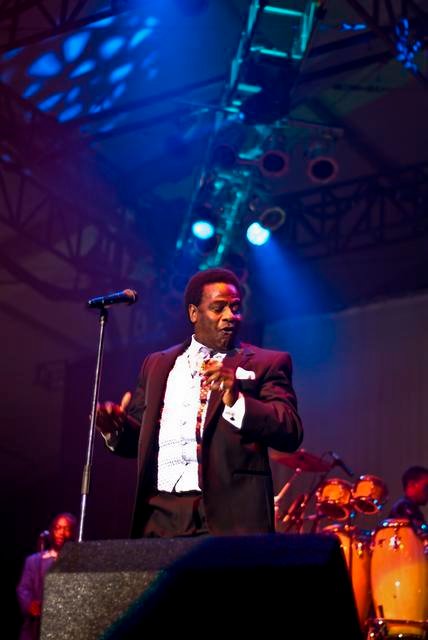
By 2006, Al Green had nothing left to prove and every reason to stay comfortable. He was the Reverend now, a pastor in Memphis, a Kennedy Center Honor waiting in his future, his place in the pantheon of soul secure since the day “Let’s Stay Together” first slid across the radio. He had already made one graceful return to secular music with producer Willie Mitchell, the man who had built the Hi Records sound with him in the 1970s. Most legends at that stage make tasteful, quiet records. Al Green, at sixty years old, decided to make a loud one — with a hip-hop drummer half his age.
A Reverend With Something to Prove
The spark, improbably enough, came from television. Green later told an interviewer that he had been watching MTV’s Spring Break with some kids, taking in the beach-party scene, and found himself struck by a thought: the young generation, for all its energy, was missing something he happened to specialize in. Soul. Real soul. The kind you could feel in your chest.
Around the same time, a different kind of fan was making his move. Ahmir “Questlove” Thompson, the drummer and musical director of the Roots, had been nursing a dream of working with Green, and his manager reached out to the singer’s camp about a collaboration. It could easily have gone nowhere — legends get such calls every week. But Green was intrigued. He knew who these young players were. He liked what they were doing. And somewhere in the back of his mind, that Spring Break afternoon was still nagging at him. Why not show the kids how it’s done?
The Drummer Who Did His Homework
Questlove did not walk into this casually. He understood exactly whose legacy he was handling, and he prepared the way a scholar prepares for an exam. “You really have to do your research,” he said. “I studied the engineering of every album, and I wanted to make every song that you hear on the album sound sonically natural. To expect a musician from thirty years ago to record the same way we record today just doesn’t feel right to me.”
That sentence tells you everything about why the collaboration worked. Questlove wasn’t trying to drag Al Green into hip-hop. He was trying to rebuild the room where Al Green had always sounded best — and then invite him inside. His partner in the project, keyboardist and producer James Poyser, a Grammy-winning writer and player known for his work with Erykah Badu, Mariah Carey, and Common, shared the philosophy. The two of them already knew the Hi Records sound by heart. As Poyser put it, they didn’t need to do homework on the music itself. What they needed was the right players and the right spirit.
The Long Courtship
Here’s the part of the story that reveals everything about Al Green the artist: he almost didn’t do it. Even after that electric first session, even with Questlove and Poyser practically begging, Green dragged his feet. He took his time. He prayed on it. He made the hottest production duo in R&B wait.
Questlove later admitted the courtship took the better part of a year and a half — eighteen months of phone calls, gentle pressure, and reassurance before Green fully committed. It wasn’t arrogance. It was the caution of a man who had spent decades protecting something sacred — his voice, his ministry, his peace — and wasn’t about to hand it over to just anyone. Questlove understood. He’d grown up idolizing Green; he knew he was asking a legend to trust him with the family jewels. So he waited. And when Green finally said yes — all the way yes — Questlove was ready with a studio, a band, and a plan.
What finally tipped the balance, Green later suggested, was that Spring Break afternoon: watching the young generation have its fun and feeling the old competitive fire stir. He still had something to prove — not to the industry, but to himself. The kids were missing something. He knew what it was. And for the first time in years, he wanted back in the game badly enough to risk it.
Eight Songs in One Night at Electric Lady
It all began in 2006 with a get-acquainted session at Electric Lady Studios in Manhattan’s Greenwich Village — the studio Jimi Hendrix built, a room soaked in history. Green remembered it vividly afterward. “That was such a session,” he said. “We sketched out eight songs and really started the project. We were just spitting out songs right and left; there’s no possible way I could write them all out. I was writing the verses to this one, the bridge to that one. Everybody contributed and that’s why it feels so good. There were no big ‘I’s and little ‘you’s in there. All of us dreamed it up together.”
That single date provided the basic tracks for nine of the album’s eleven tunes. Over the next two years, the team reconvened whenever schedules allowed, each session recreating the loose, joyful feel of the first. Two years is a long time to make an album, but nobody was in a hurry — Green had his congregation, Questlove had the Roots, and “Lay It Down” grew the way good things grow: slowly, in stolen weeks, each reunion rekindling the spark of that first night. Players swapped ideas, grabbed pads and pencils to scribble lyrics, sang out fragments of melody, passed riffs back and forth. Green himself vocalized many of the parts the strings and horns would later play, singing horn lines the way a man who hears whole arrangements in his head naturally does.
No Synthesizers, Just Soul
The guiding rule of the sessions was simplicity. “We wanted to keep the sound organic,” Poyser explained. “We didn’t use any synthesizers, we just used live instruments. We just went into the room and began playing.” Questlove played drums on nearly every track. The Dap-King Horns — the Brooklyn brass section famous for their work with Sharon Jones and Amy Winehouse — brought the punch. Guitarist Chalmers “Spanky” Alford and bassist Adam Blackstone filled out a band that could have held its own in any era.
It was a deliberate rejection of the Pro Tools era’s cut-and-paste perfection. Everything was played face to face, heart to heart, the way records used to be made — the way, not coincidentally, Willie Mitchell used to make them at Royal Studios in Memphis. In an era of Auto-Tune and quantized beats, it was practically a radical act — and Green, hearing those live horns punch through the studio air, must have felt thirty-five years fall away.
The Guests Who Came to Learn
Green had a wish list of younger artists he wanted on the record, and one by one they showed up — not as ornaments, but as students. Anthony Hamilton, the gritty soul traditionalist, brought his church-trained growl. Corinne Bailey Rae, the English songbird, brought lightness. And John Legend arrived with his laptop, ready to write.
Legend’s visit became one of the album’s best stories. He had come in to sing on one track the band had worked up, but then he heard an unfinished version of “Stay With Me (By the Sea),” a song Green had been developing with Bailey Rae — and everything changed. Green laughed about it later: Legend “brought his computer along but he didn’t get to write much on it! He was a great guy, a charm to work with, he has a real loving spirit.” The kid with the laptop ended up simply singing, the old-fashioned way, and the result won them both a Grammy.
Just Like the Hi Records Days
What moved Green most about the whole experience was how familiar it felt. Working with Thompson and Poyser, he said, “was similar to how we did the sessions with Willie Mitchell. We ate together, worked together. I remember when the guys would play half a song and I would start smiling… and they looked at each other and said, ‘he loves it!’ We went over the songs just like we used to at Hi Records.”
Think about that for a moment. Thirty-five years after the golden run at Royal Studios, in a different century, in a different city, with musicians born after his biggest hits, Al Green found himself back in the feeling he thought he’d left behind in Memphis. The food, the laughter, the half-songs that made him smile before they were finished. You can’t engineer that. You can only recognize it when it happens — and Green recognized it.
The Payoff
“Lay It Down” arrived on May 27, 2008, on Blue Note Records, Green’s third album for the label and his twenty-ninth studio album overall. The precedent had been set five years earlier: 2003’s “I Can’t Stop,” cut at Royal Studios with Mitchell and the surviving Hi Records session men, had peaked at number 53 on the Billboard 200 and number 9 on the R&B chart — a remarkable showing for a man who hadn’t made a secular record in decades. The critics had swooned; Robert Christgau declared it proof that Green had lost nothing, neither the vocal power nor the guile to deploy it. “Lay It Down” took that restoration and pushed it further — not a recreation of the past, but a conversation between the past and the present. The reception was rapturous. Critics called it his most satisfying record in decades, his best and most authentic soul recording since the Hi Records heyday. It debuted at number nine on the Billboard album chart — his first top-ten album since the early 1970s, a gap of more than three decades.
Then came the Grammys. At the 51st Annual Grammy Awards, “Stay With Me (By the Sea)” won Best R&B Performance by a Duo or Group with Vocals for Green and John Legend. “You’ve Got the Love I Need” won Best Traditional R&B Vocal Performance for Green and Anthony Hamilton. The album itself was nominated for Best R&B Album, losing only to Jennifer Hudson’s blockbuster debut. For a sixty-two-year-old pastor making a record with a hip-hop drummer, that is not a bad haul.
There is a lesson in “Lay It Down” that goes beyond music. Al Green could have spent his later years guarding his legacy, playing the hits for the faithful, letting the legend calcify. Instead he walked into a room full of young admirers, let them study him, let them challenge him, and let himself be surprised. He went in hoping to teach a generation about soul, and came out having learned that soul, real soul, doesn’t belong to any generation at all. Questlove got the masterclass he’d dreamed of since childhood. Green got something rarer: proof that the thing he did best still mattered, still moved people, still belonged on the radio. Everybody won. It just needs a room, a groove, and a voice that still means every word. Nearly twenty years on, “Lay It Down” still sounds like what it was: a risk that paid off. And the Reverend still has all three.
Leave a Reply