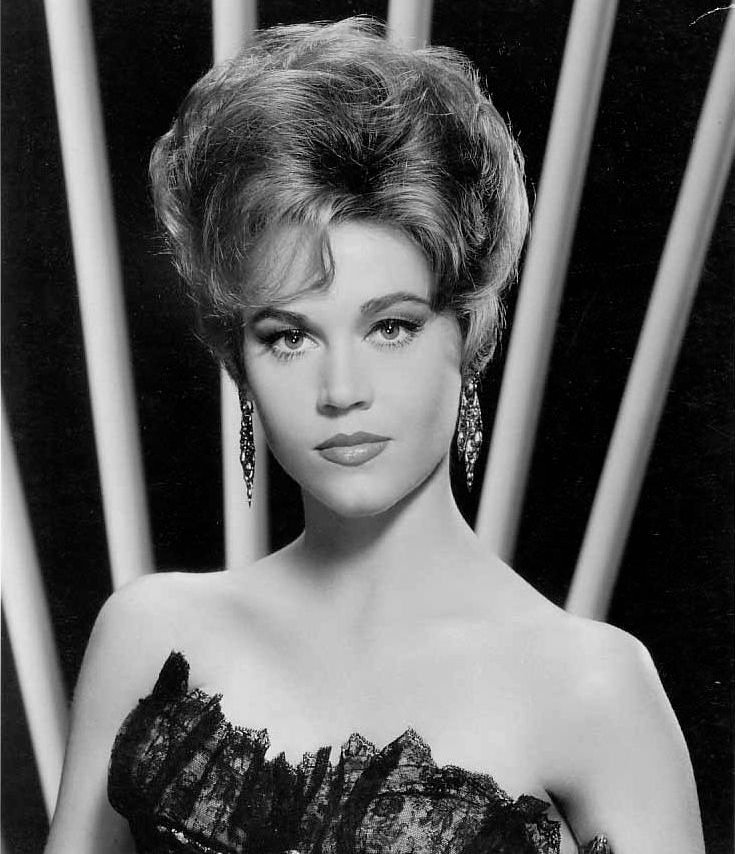
How many lives can one woman live? Jane Fonda has been a Hollywood princess, a French sex symbol, the most hated woman in America, the most beloved fitness guru on the planet, a three-time wife of famous men, a two-time Oscar winner, and — in her eighties — a repeat arrestee on the steps of the U.S. Capitol. She has been famous for more than six decades, and she has spent almost all of them refusing to be the person anyone expected her to be.
Henry Fonda’s Daughter
She was born Jane Seymour Fonda on December 21, 1937, in New York City, into American acting royalty. Her father, Henry Fonda, was already a star; her younger brother, Peter, would become one too. But the Fonda household was not the warm hearth the public imagined. Henry was a distant, emotionally withholding father, and Jane’s mother, Frances Ford Seymour, died by suicide in 1950, when Jane was twelve. Jane was told at the time that her mother had suffered a heart attack; she learned the truth later. She has spent a lifetime, she says, trying to understand both of her parents — and herself.
She didn’t plan on acting. She studied art, worked as a model, and only drifted toward the stage in her early twenties, studying under Lee Strasberg at the Actors Studio. Her film debut came in 1960 with Tall Story, and through the early sixties she built a career as a charming comedienne — Period of Adjustment, Sunday in New York, Cat Ballou (1965), Barefoot in the Park (1967). Then, in 1968, her French director husband Roger Vadim — whom she had married in 1965 — put her in a metal bikini and launched her into orbit as Barbarella, the intergalactic sex kitten. It made her a global pin-up. It also, in her telling, made her realize how little control she had over her own image. She was ready for a reckoning — with Hollywood, with her father, with herself.
The French Education
The reckoning began in France. Married to Roger Vadim from 1965 to 1973, Fonda lived in Paris during the most politically explosive years of the decade — the 1968 student uprisings, the ferment of the French left — and it changed her. Vadim had made her a sex symbol; France made her a citizen. She has described those years as her political awakening: for the first time, she was reading, arguing, and seeing the Vietnam War not as distant news but as a moral emergency.
She returned to America at the turn of the decade a different person from the comedienne who had left. The bubbly star of Barefoot in the Park was gone; in her place was a woman who’d begun to wonder what her fame was for. The answer she found — activism — would nearly destroy her career and ultimately define her life. But first, there was the small matter of becoming the finest actress of her generation.
The Mugshot
The reckoning arrived fast. By the late sixties, Fonda had thrown herself into the anti-Vietnam War movement with characteristic total commitment. She toured the country speaking at colleges, raised money for the Black Panthers and GI coffeehouses, and drew the furious attention of the Nixon administration.
On November 3, 1970, returning from a speaking engagement in Canada, she was arrested at Cleveland Hopkins Airport. Customs agents seized her luggage and found little plastic envelopes of pills marked in red nail polish with “B,” “L,” and “D” — breakfast, lunch, dinner: her vitamins. They arrested her anyway, for drug smuggling and assaulting an officer. She spent the night in the Cuyahoga County Jail, and when they marched her past the cameras in handcuffs, she slipped one slender, double-jointed wrist free and raised a fist in the air. The resulting mugshot — defiant eyes, uneven Klute-era bangs, power-to-the-people fist — became one of the most famous arrest photos in American history. The charges were eventually dismissed; every pill tested as vitamins. Fonda has said the arresting officer told her the orders came from the Nixon White House.
It was, in retrospect, a preview. The establishment had decided she was dangerous. She decided to prove them right.
“Hanoi Jane”
In 1971, fresh from filming Klute, Fonda and her co-star Donald Sutherland took a ragtag troupe of performers on the road with the FTA Show — “Free the Army,” or in its earthier version, “Fuck the Army” — a traveling anti-war revue for GIs at bases across America and the Pacific. Part vaudeville, part protest, it infuriated the Pentagon and delighted enlisted audiences. A documentary of the tour, F.T.A. (1972), was pulled from theaters within a week of release.
Then came July 1972, and the two weeks that would define her public image for half a century. Fonda traveled to North Vietnam, where she toured bomb-damaged dikes, villages, hospitals, and schools, met with a small group of American POWs (carrying messages home to their families), and recorded a series of broadcasts on Radio Hanoi denouncing U.S. bombing policy and urging American servicemen to reconsider the war. And then there was the photograph: Jane Fonda, smiling, seated at a North Vietnamese anti-aircraft gun, wearing an enemy helmet.
The image detonated. To millions of Americans with loved ones fighting in Vietnam, it looked like a movie star siding with the enemy — and the nickname “Hanoi Jane” stuck like a brand. Veterans’ groups denounced her for decades; she received death threats; her films were boycotted in some quarters.
What should be said, factually and plainly, is this. The photograph was real, and Fonda has repeatedly apologized for it — calling it, in her 2005 memoir and a 60 Minutes interview, “the largest lapse of judgment that I can even imagine” and “a betrayal” of American servicemen. She has said she was manipulated into the pose and horrified once she understood its meaning, but she does not regret the trip itself or her opposition to the war. The wilder stories that circulated for years — that she spat on POWs, or handed their secret messages to captors — have been investigated repeatedly and debunked; the POWs named in those chain emails denied ever meeting her, and no reliable evidence has ever supported the claims. She was never charged with treason.
Whatever one thinks of the visit, it is worth noting what it cost her and what it revealed about her: a 34-year-old woman willing to torch her own popularity for a cause. Hollywood has never quite known what to do with that kind of fearlessness.
Three Husbands, Two Oscars, One On Golden Pond
Fonda’s personal life unfolded as dramatically as her politics. Her marriage to Roger Vadim ended in 1973; that same year she married activist and politician Tom Hayden, with whom she had a son, Troy. With Hayden she co-founded the Campaign for Economic Democracy, and it was to fund that work that she would eventually build her fitness empire.
Her acting, meanwhile, reached its peak. She won her second Academy Award for Coming Home (1978), playing a military wife radicalized by the war’s human cost — a role that felt like the artistic expression of everything she’d lived. She earned further nominations for Julia, The China Syndrome, On Golden Pond, and The Morning After, bringing her total to seven Oscar nominations. On Golden Pond (1981) gave her the chance to act opposite her own father, Henry Fonda, as his on-screen daughter — a role she bought the rights to specifically so they could work together before it was too late. He won his only competitive Oscar for it; he died months later. Watching the film now, the scenes between them carry the weight of a real, complicated reconciliation.
In 1991, she married media mogul Ted Turner, founder of CNN. The marriage lasted a decade, ending in 2001. She has said that each of her marriages taught her something different about power — who holds it, and what it costs to give it away.
The Producer Hollywood Didn’t See Coming
Somewhere between the activism and the marriages, Fonda quietly became one of the most consequential producers in Hollywood — a lane almost no actress of her generation had dared to enter. In the 1970s she founded her own production company, IPC Films, determined to make movies about subjects the studios considered box-office poison. She produced Coming Home herself, shepherding Hal Ashby’s difficult, tender film about paralyzed Vietnam veterans to the screen and to her second Oscar. She produced The China Syndrome (1979), the thriller about a nuclear-plant cover-up that became eerily, coincidentally urgent when the Three Mile Island accident occurred just twelve days after its release. And she produced 9 to 5 (1980), the workplace revenge comedy she developed with Lily Tomlin and Dolly Parton, which became one of the biggest hits of the year and a beloved feminist landmark.
It is easy to forget how radical that was: a woman in 1970s Hollywood green-lighting her own pictures, choosing the material, hiring the directors. The industry’s boys’ club barely knew what had happened until the box-office returns came in.
Feel the Burn
And then, the most unexpected reinvention of all. In 1982, at an age when Hollywood was already writing off actresses, Jane Fonda released a home exercise video. Jane Fonda’s Workout — leg warmers, leotards, throbbing synth-pop, and her famous command to “feel the burn” — became the best-selling VHS tape of all time, eventually selling some 17 million copies and generating over $100 million. It didn’t just make her rich; it practically invented the home-fitness industry, drove VCR sales, and dragged aerobics — and women’s strength training — into the mainstream. She released more than twenty workout tapes over the next decade, and funneled much of the fortune into Hayden’s political campaigns and her own activism.
Think about the arc: the sex symbol of Barbarella became, at 45, the woman telling millions of other women to get strong. It was feminism in leg warmers, and it worked.
The Fires Still Burn
Fonda never really retired from anything. From 2015 to 2022 she starred opposite Lily Tomlin in Grace and Frankie, playing a cosmetics mogul navigating divorce and aging with raunchy comic brio — and earning some of the best reviews of her late career. She collected lifetime achievement honors, including the AFI Life Achievement Award.
And then, at 81, she went back to the barricades. Inspired by Greta Thunberg and Naomi Klein’s writing on the climate emergency, Fonda moved temporarily to Washington, D.C., in the fall of 2019 and launched “Fire Drill Fridays” — weekly civil-disobedience rallies on the steps of the U.S. Capitol demanding an end to new fossil-fuel projects. She was arrested five times, spent a night in jail, and did it all wearing a bright red coat she announced would be the last item of clothing she would ever buy. Co-stars like Sam Waterston got arrested alongside her. It was Hanoi Jane energy, half a century later, redirected at the planet itself.
Love her or loathe her — and America has done both, sometimes in the same week — Jane Fonda has never lived a small life. She has apologized where she felt she owed it, refused to apologize where she didn’t, and kept moving: actress, activist, mogul, icon, inmate, inspiration. At an age when most legends are content to be remembered, she is still insisting on being heard.
Leave a Reply