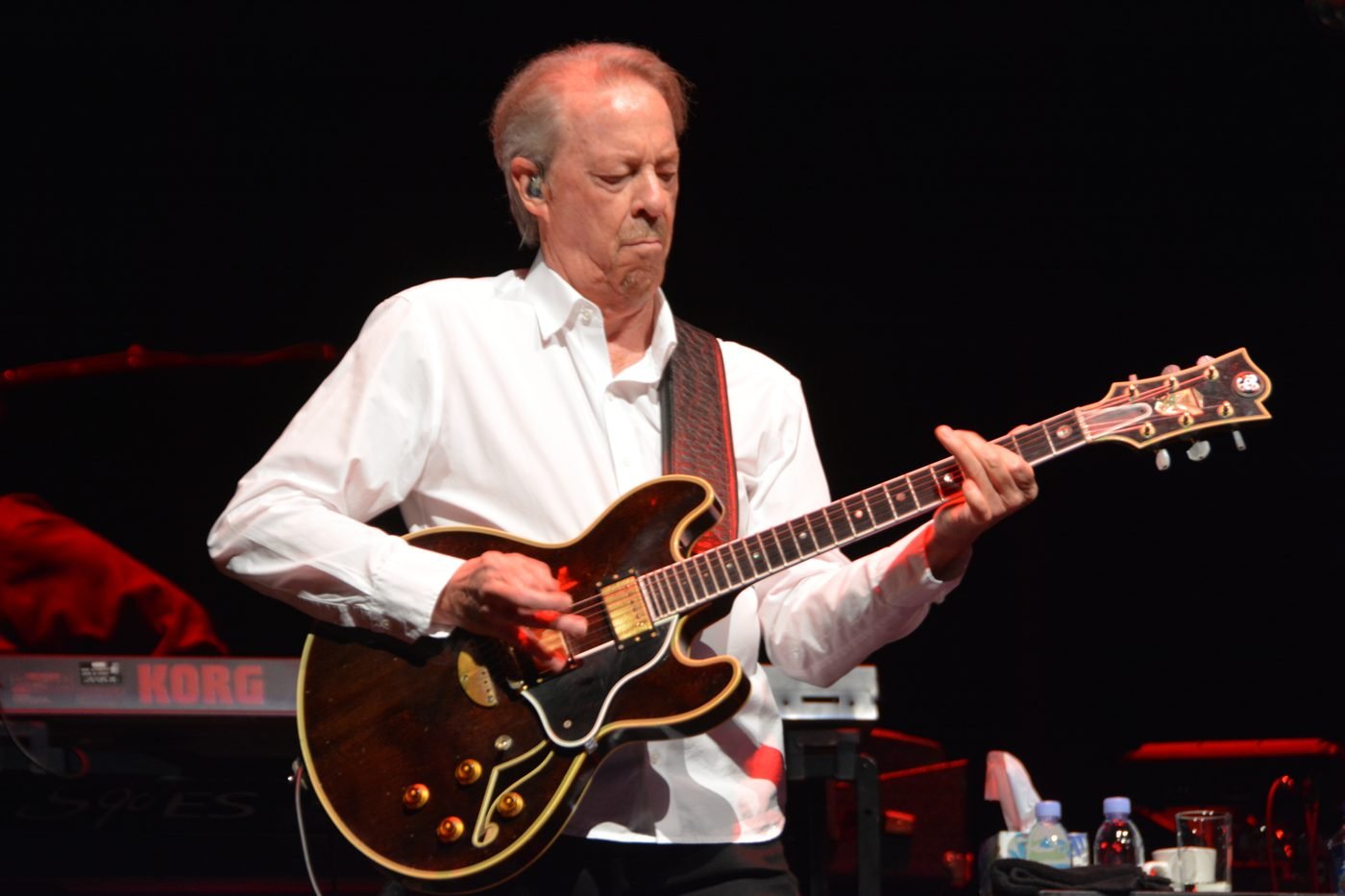
When “Silk Degrees” exploded in 1976 — five million copies, four hit singles, a Grammy — America met what looked like a brand-new star: a silky-voiced Texan in a white suit, crooning about the lowdown and the lido shuffle. What nobody realized was that Boz Scaggs had already been at it for more than a decade. He had busked on European street corners, played psychedelic rock with the Steve Miller Band, cut a record in Sweden that nobody bought, and watched a bluesman successfully sue him over a songwriting credit. The “overnight sensation” of 1976 was eleven years in the making. This is the story of the long road to silk.
From “Bosley” to Boz
He was born William Royce Scaggs on June 8, 1944, in Canton, Ohio, the eldest child of a traveling salesman who had flown in the Army Air Corps during World War II. The family drifted — Ohio to Oklahoma to Plano, Texas, then a farm town north of Dallas — and young William learned his first instrument, the cello, at age nine. A scholarship took him to St. Mark’s School of Texas, an elite private school in Dallas, where two things happened that would define his life: he met a guitar-obsessed schoolmate named Steve Miller, who taught the twelve-year-old to play guitar, and a classmate decided he needed a weirder nickname.
It started as “Bosley.” Then it morphed to “Boswell,” then “Bosworth,” each sillier than the last. Eventually it got shortened to “Boz” — and it stuck so hard that William Royce Scaggs essentially disappeared. There is something perfect about one of the smoothest names in pop music originating as a schoolyard joke. By 1959, the fifteen-year-old Boz was singing in Miller’s band, the Marksmen. The two would follow each other from Texas to the University of Wisconsin, playing blues in bands with names like the Ardells and the Fabulous Knight Trains, two kids mainlining Chicago blues in the frozen Midwest.
The Postcard From San Francisco
In 1963, Scaggs left school to chase music full time, signing up for the Army Reserve and forming an R&B band called the Wigs. The Wigs decamped to London, caught the edge of the British R&B boom, and promptly fell apart. Most musicians would have gone home. Scaggs went busking. He drifted through Europe singing on street corners, landed in Stockholm, Sweden, and in 1965 recorded his first solo album, “Boz,” for a local label. It failed commercially — one more obscure record in a decade full of them.
Then came the postcard. Steve Miller, now building a band in San Francisco at the epicenter of the psychedelic explosion, wrote to his old school friend: come join us. Scaggs arrived in 1967 and played guitar and sang on the Steve Miller Band’s first two albums, “Children of the Future” and “Sailor.” But the partnership curdled. Musical tastes diverged, tensions flared between the two old friends, and Scaggs walked away from a band that was about to become huge. It was a brave move and a costly one — he was trading a rising psychedelic hit machine for the great unknown, again.
Muscle Shoals and the Lawsuit
Salvation came from an unlikely champion: Jann Wenner, the young founder of Rolling Stone magazine, who took a personal interest in Scaggs and helped him land a solo deal with Atlantic Records. Wenner even produced the sessions himself. Atlantic’s Jerry Wexler suggested recording in the South, and after weighing Memphis and Macon, they chose the brand-new Muscle Shoals Sound Studio in Alabama — the rhythm section fresh out of FAME Studios, and, crucially, a young session guitarist named Duane Allman.
The 1969 album “Boz Scaggs” is a cult classic now, and its centerpiece is “Loan Me a Dime,” a nearly thirteen-minute blues epic with Allman’s slide guitar soaring over Scaggs’s weary vocal. It remains one of the great lost performances of the era. But the song carried a sting: bluesman Fenton Robinson sued for the writing credit — and won. Scaggs had learned a hard lesson about the difference between arranging a blues and owning one. The album earned glowing reviews and sold almost nothing. Two more records for Columbia — “Moments” and “Boz Scaggs & Band,” produced by Glyn Johns — fared no better. By the mid-seventies, Scaggs was a critical darling with a commercial record best described as dismal.
The Slow Dancer Finds His Groove
The turn began with 1974’s “Slow Dancer,” produced by former Motown man Johnny Bristol. For the first time, Scaggs leaned all the way into the soul and R&B he’d been absorbing since those late nights listening to faraway radio stations as a Texas kid. The album went gold — modest, but it was momentum. More importantly, it taught Scaggs a lesson he would carry into his masterpiece: he didn’t need a touring band in the studio. He needed the best session players alive.
For his next record, Scaggs and producer Joe Wissert — a Columbia staff producer with a sharp ear — started auditioning the young guns of the Los Angeles session scene. Wissert had been hearing about three kids who played together constantly: drummer Jeff Porcaro, keyboardist David Paich, and bassist David Hungate. They got together for a trial session. It worked instantly. Paich, barely into his twenties, became Scaggs’s writing partner, the two of them disappearing to a getaway house outside Los Angeles with a piano, staying up all night hammering out ideas. One of those nights produced “Lowdown.”
The Weekend That Wrote “Lowdown”
“Lowdown” almost didn’t happen as a single. The first single from “Silk Degrees” was “It’s Over,” which stalled at a modest number 38. Then a DJ in Cleveland started playing “Lowdown” straight off the album, and the phones lit up. Columbia rushed it out as a single, and it climbed to number three on the Hot 100, selling over a million copies. Then came the Grammy for Best R&B Song — making Scaggs the first white artist ever to win the award.
The song’s afterlife is a story in itself. The producers of “Saturday Night Fever” wanted “Lowdown” for the film — John Travolta had even choreographed his famous dance routine to it, and would later say that in the beginning, before the Bee Gees were involved, he was dancing to Stevie Wonder and Boz Scaggs. But Scaggs’s camp turned the film down in favor of another disco movie, “Looking for Mr. Goodbar.” “Saturday Night Fever” became one of the best-selling soundtracks of all time. It’s one of the great what-ifs in pop history — though given that “Silk Degrees” sold five million copies anyway, Scaggs probably doesn’t lose sleep over it.
The Band That Became Toto
Here is the footnote that became a headline: those young session players on “Silk Degrees” — Paich, Porcaro, Hungate — were already dreaming of their own band. Touring with Scaggs solidified the plan. Columbia offered the new group a contract without even an audition, and Toto was born. Paich himself has said he’s not sure Toto would have happened as soon, or quite the same way, without “Silk Degrees.” So the silkiest album of 1976 didn’t just make Boz Scaggs a star; it accidentally launched one of the biggest bands of the eighties. Not bad for a session.
“Silk Degrees” peaked at number two on the Billboard 200, spent an astonishing 115 weeks on the chart, went five-times platinum, and earned a Grammy nomination for Album of the Year. Its singles — “It’s Over,” “Lowdown,” “What Can I Say,” “Lido Shuffle” — were inescapable. And there was one more: “We’re All Alone,” a Scaggs ballad the label never released as a single, which A&M chief Jerry Moss heard and declared perfect for a woman’s voice. He talked Rita Coolidge into recording it. Her version went top ten on both sides of the Atlantic in 1977. Scaggs had written a hit he never even had to sing.
Blackout at Avery Fisher Hall
Fame brought its share of surreal moments. In the summer of 1977, at the height of “Silk Degrees” mania, Scaggs was on stage at Avery Fisher Hall in New York’s Lincoln Center — about fifteen minutes into the concert — when the lights went out. It was July 13, 1977: the infamous New York City blackout. Scaggs stood in the dark and told the audience to save their ticket stubs; he’d do a repeat concert on Friday night. He kept his word. It’s the kind of story that sounds apocryphal until you realize the blackout really did hit mid-show, and the singer really did come back and play it again.
The follow-ups kept the streak alive: “Down Two Then Left” and 1980’s “Middle Man,” with its top-twenty hits “Breakdown Dead Ahead” and “Jojo” (featuring a young Carlos Santana on guitar), plus “Look What You’ve Done to Me” from the “Urban Cowboy” soundtrack and “Miss Sun” — which was, deliciously, an unreleased Toto demo that Scaggs finished and took to number fourteen. Then, exhausted, feeling that music had become a “career” and that the music had “left him,” Scaggs walked away for most of the eighties.
The Long Second Act
He didn’t disappear, exactly — in 1988 he opened Slim’s, a beloved San Francisco nightclub he would own for over thirty years — but recording stopped until 1988’s “Other Roads.” The decades since have been a slow, dignified ramble through American roots music: the Dukes of September tours with Donald Fagen and Michael McDonald, jazz standards albums that topped the jazz charts, 2013’s “Memphis” cut at Willie Mitchell’s Royal Studios, a Napa Valley vineyard planted with his wife Dominique in 1996. There were poignant full-circle moments, too. In 1992, Scaggs performed at Toto’s tribute concert for their late drummer Jeff Porcaro, sharing the stage with Don Henley, Eddie Van Halen, George Harrison, and Michael McDonald — a reunion of the extended family his 1976 sessions had helped create. And “Heart of Mine,” from 1988’s “Other Roads,” became his last top-forty hit, a quiet farewell to the charts from a man who’d never really chased them in the first place.
Life hasn’t spared him. His son Oscar died of a heroin overdose in 1998. In October 2017, while the couple was on tour, the Northern California wildfires burned their home to the ground — vineyard, cars, and decades of legal pads and cocktail napkins covered in lyrics, all gone. And his 2001 album “Dig” was released on September 11, 2001, surely the worst release date in recording history. Through it all, Scaggs kept touring, kept singing, kept that voice in fighting trim. In 2025, at eighty-one, he released “Detour” — still recording, still on the road, still the silkiest voice in the room.
The Untold Story of Boz Scaggs is really a story about patience. Six failed albums. A busking tour of Europe. A lawsuit, a walkout, a blackout, a burned-down house. Most careers would have ended a dozen times over. Scaggs just kept going until the world caught up — and when it did, he was ready with the smoothest record of the decade. Overnight sensations are rarely overnight. His took eleven years, and it was worth every one.
Leave a Reply