
The Room Leans In
There is a particular silence that falls when a great piano player sits down to work — the held breath of a room that knows something is about to happen. Leon Russell could create that silence with a single chord. He only needed to put his hands on the keys.
For sixty years, Russell played like a man who had made a private bargain with music. Given a body that did not cooperate easily, and a right hand that would not do what other pianists’ hands could do, he turned that fact into a language — lurching and churchy, gospel mixed with rock and roll learned after midnight in Tulsa. Nobody else played quite like him, because nobody else had needed to invent a way of playing quite like his.
He was born Claude Russell Bridges on April 2, 1942, in Lawton, Oklahoma. He died on November 13, 2016, at his home in Mt. Juliet, Tennessee. He was seventy-four. Between those dates lies one of the most quietly extraordinary careers in American music: session pianist, songwriter, bandleader, label founder, hitmaker, and sideman, who at last became a star. He recorded thirty-three albums and four hundred and thirty songs, earned six gold records, and received two Grammy Awards from seven nominations. In 1973, Billboard named him the Top Concert Attraction in the World. In 2011, he entered both the Rock and Roll Hall of Fame and the Songwriters Hall of Fame. Yet for much of his life, the public knew his songs better than his name.
A Hymn at Four
Russell was born with what he called “spastic paralysis,” now known as cerebral palsy. An injury at birth damaged his second and third vertebrae, causing a slight paralysis on the right side of his body. It most noticeably affected three fingers of his right hand. It also left him with a limp once thought to be the result of polio. Most people would have understood if music had remained a closed door. Russell walked through it anyway.
“My chops have always been sort of weak,” he said later. “I have damaged nerve endings on the right side, so my piano style comes from designing stuff I can play with my right hand.” He did not pretend the weakness was not there. He designed around it. He favoured his left hand and developed the signature left-hand-dominant style that became instantly recognisable: deep, rolling, and rhythmic, full of gospel weight, with the right hand darting in for colour and a sudden bright phrase.
He was honest about the cost. “I felt like the world had cheated me big time,” he said — then added: “If I hadn’t had the problem, I probably wouldn’t have gotten into music at all and would have been an ex-football player, selling insurance in Des Moines.” The wound, in his telling, was also the opening.
Both of his parents played upright piano. When he was four, his mother heard him picking out “Trust and Obey,” a hymn he had heard at church. He had not been taught it; he had simply listened, then found it on the keys. Piano lessons followed in Anadarko, a thirty-eight-mile trip each way. He also learned alto saxophone, cornet, and baritone horn, and in the fifth grade joined the high school marching band.
He studied classical music for perhaps ten years, and concluded: “I realized, finally, I was never going to have the hands to play that stuff. It was too complicated. I invented ways to play in a classical style that was not the real deal.” He was not a pianist who settled for less. He invented more: new voicings, new rhythms, new ways of letting the left hand do the talking.
Tulsa Nights and a Borrowed Name
Russell attended Will Rogers High School in Tulsa. His classmates included Elvin Bishop, Gailard Sartain, Anita Bryant, and David Gates. His first record appearance came in 1957, when he was fifteen, playing piano on “Jo-Baby,” written by sixteen-year-old Gates. It was released on Tulsa’s Perspective Sound label, then re-released nationally by Marty Robbins on Robbins Records as “David Gates & the Accents.” Performing while underage, Russell assumed the name “Leon Russell” from a fake ID he used to enter clubs. At the time, Oklahoma was a “dry” state, so teenagers could perform in clubs ordinarily open only to those over twenty-one. The name stuck. It began as a practical fiction, a way through a door. Like so much in his life, a workaround became an identity.
Still in high school, Russell performed with his group the Starlighters, alongside J. J. Cale, Leo Feathers, Johnny Williams, and Chuck Blackwell. Blackwell said Russell was “especially good at playing Erroll Garner-style jazz during dinner, but then, after everybody got through eating, he’d break into Jerry Lee Lewis.” He also backed Ronnie Hawkins and the Hawks, often until early morning. “I worked six or seven nights a week till I left Tulsa at 17,” he said. “I’d work 6 to 11 [pm] at a beer joint, then 1 to 5 [am] at an after-hours club…. I slept in English a lot.” Offered a chance to tour with Jerry Lee Lewis after graduating, he chose the road over college. He left Tulsa for Los Angeles.
Los Angeles and the Wrecking Crew
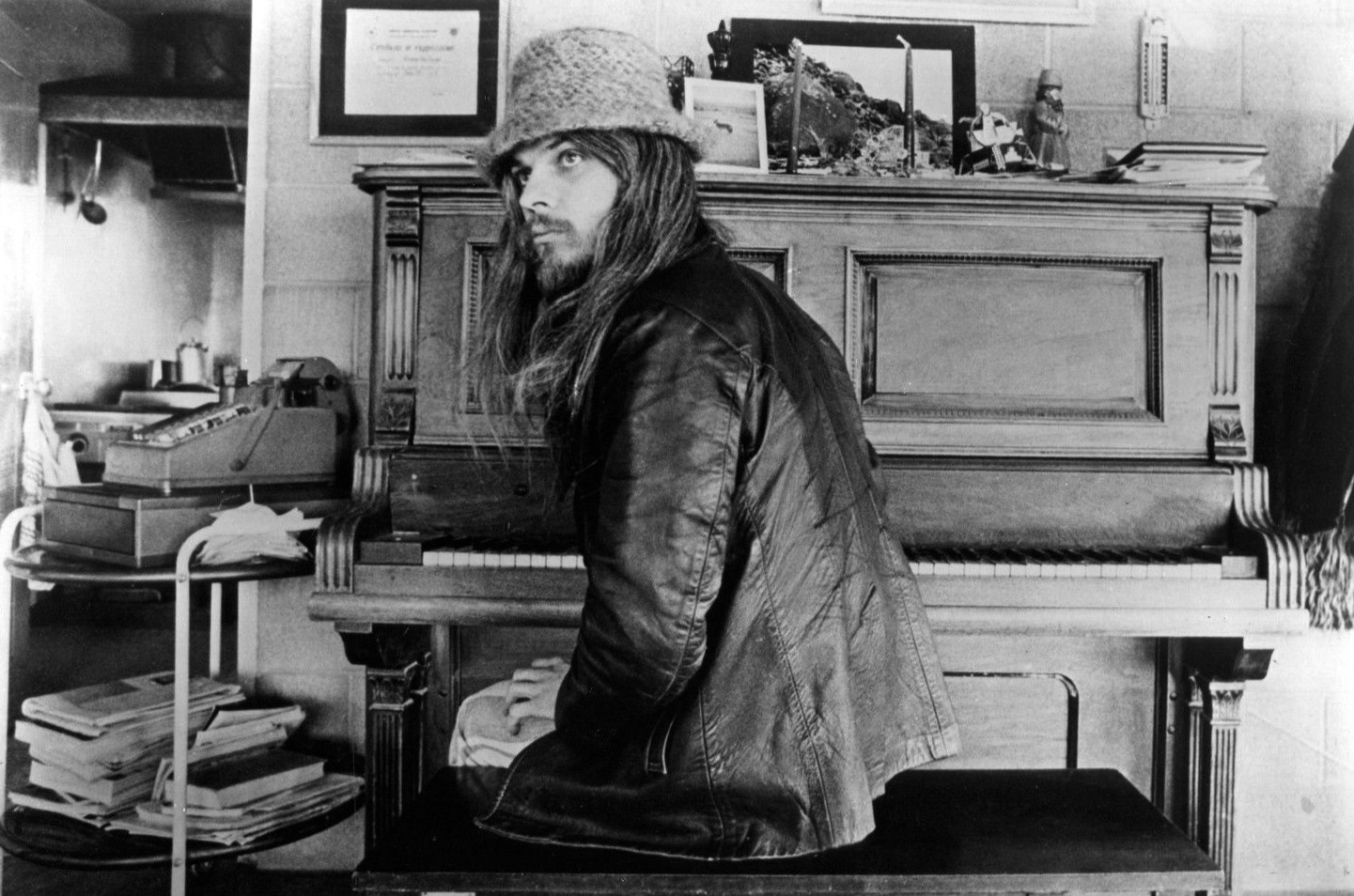
Los Angeles was harder at first. “I got out to California, and they were more serious about their liquor laws. I about starved to death because it was so much harder to find work at my age,” Russell said. He studied guitar with James Burton. Then the work came in a flood. As a session pianist with the Wrecking Crew, the loose, legendary group of Los Angeles studio players, he played in his early years on albums by the Beach Boys, the Ventures, Dick Dale, and Jan and Dean.
The artists he played for and with read like a map of American popular music: the Beach Boys, Frank Sinatra, Ray Charles, Bob Dylan, Eric Clapton, George Harrison, Ringo Starr, Barbra Streisand, Willie Nelson, B. B. King, J. J. Cale, Joe Cocker, and the Rolling Stones, among many others. He played piano on Phil Spector productions for the Ronettes, the Crystals, and Darlene Love, and on the 1963 album A Christmas Gift for You from Phil Spector.
Herb Alpert remembered: “Leon was on several sessions that I produced with the Tijuana Brass… He would sit at the piano and he would always say, ‘I don’t know what to play’… Well, he would always chime in with something special and affect the groove in a very Leon Russell way that was always unique.”
In 1962, Russell appeared on Los Angeles station KCOP leading the Leon Russell Trio on Stepping Out, and in the 1964 concert film T.A.M.I. Show with the Wrecking Crew, with short, slicked-back hair — in contrast to his later long hair, beard, and top hat.
He was not only a player. In the mid-1960s he wrote two hits for Gary Lewis and the Playboys: “Everybody Loves a Clown” (No. 4) and “She’s Just My Style” (No. 3). Hired by Snuff Garrett, he worked as a production assistant, arranger, and creative developer at Snuff Garrett Productions, formed in 1964, and played on number-one singles including “This Diamond Ring.” Two years later, Garrett and Russell started Viva Records. He also played in the Shindogs, the house band on ABC’s Shindig! In 1965, he built his first studio, Skyhill Studios, inside his Hollywood Hills home, hiring fellow Tulsan J. J. Cale as manager. In 1968, he formed the Asylum Choir with Marc Benno. Russell was no longer content to be the man at the piano in somebody else’s session.
Shelter Records and “Delta Lady”
In 1969, Russell and producer Denny Cordell established Shelter Records (1969–1981, Los Angeles and Tulsa). Shelter released “Duppy Conqueror,” Bob Marley’s first American single, and later records by Freddie King, J. J. Cale, Tom Petty & the Heartbreakers, and the Gap Band. It was Russell’s declaration of independence: his own label, his own terms.
Russell performed with Delaney & Bonnie and Friends in 1969 and 1970. Through this group, he met George Harrison. With Bonnie Bramlett, he co-wrote “Superstar,” originally a Delaney & Bonnie B-side in 1969 as “Groupie (Superstar).” It was later recorded by Rita Coolidge for Cocker’s Mad Dogs & Englishmen, and by the Carpenters for a 1971 single that peaked at No. 2 on the Hot 100.
Russell was co-producer, arranger, songwriter, and performer on Joe Cocker’s 1969 LP Joe Cocker! He wrote “Delta Lady” for the album, which reached number 11 on the Billboard 200. “Delta Lady” sounded as if it had always existed — warm, rolling, and soulful, built for Cocker’s gravel voice and Russell’s gospel piano.
Mad Dogs & Englishmen

In March 1970, Russell was hired by Joe Cocker to mount a concert band and rehearse a forty-eight-date tour. Cocker said immigration authorities had told him he had to perform “right away” or lose his visa and be deported. Russell had only a week to locate, audition, hire, and rehearse a ten-piece band and the Space Choir, ten backup singers. It was, by any measure, an impossible assignment. Russell did it anyway, hiring many musicians from Delaney and Bonnie Bramlett’s band. He both conducted and performed, playing piano or lead guitar.
Singer Claudia Lennear said Russell could fuse “White gospel and Black gospel.” Cocker, Russell said, “was pretty wrecked when we started out.” When Russell asked, “Does it sound good to you?” Cocker answered, “It never sounds right to me.” Russell recalled, “I said, ‘Shit, I’ll just do whatever I want.’” What he wanted was a big, joyous travelling show — a tent revival and a rock and roll circus at once.
After watching the Mad Dogs & Englishmen concert film, Elton John said, “There are some people who are born to be leaders of musicians and he is. It was Leon I was watching. He had the feel for that music. Joe was an amazing singer. But you could tell it was Leon’s band.” Russell bought the top hat and Holy Trinity basketball jersey shirt he wore on the tour at a used clothing store near Skyhill Studios. “I’m an actor — I was just trying to make a show,” he explained. The top hat became part of the legend. “The Letter,” performed by Cocker with Leon Russell & the Shelter People, peaked at No. 7 on the Hot 100 on May 30, 1970 — Russell’s first hit as a performer in his own right.
“A Song for You”
Russell released his 1970 solo album, Leon Russell, on Shelter during the Mad Dogs tour. Recorded at Sunset Sound, it featured Eric Clapton, George Harrison, Mick Jagger, Keith Richards, Ringo Starr, and Joe Cocker, and included two future standards, “A Song for You” and “Delta Lady.”
“A Song for You” is one of the great songs of the twentieth century. Russell explained: “I was in my studio in Hollywood and actually I was trying to write a standard. I was trying to write a blues song that Frank Sinatra and Ray Charles both could sing…. I wrote it in 10 minutes…. Sometimes they’re very quick. It’s almost as if one is not writing them, you know? Like they’re coming from another place.”
Ten minutes. A song recorded by more than two hundred artists, including the Carpenters, Ray Charles, Donny Hathaway, Peggy Lee, Willie Nelson, and the Temptations. Both the Carpenters and the Temptations named an album after it. Ray Charles’s version won the 1994 Grammy for Best Male R&B Vocal Performance, and the song entered the Grammy Hall of Fame in 2018. Russell wrote it in ten minutes, but he had been preparing for a lifetime: the hymn at four, the Tulsa clubs, the Los Angeles sessions, the gospel and the blues, all flowing into a single melody.
In November 1970, Russell performed at the Fillmore East, with Elton John on the same bill. In December 1970, Rolling Stone described his sound as “those driving, lurchy, churchy rock and roll songs.” He produced tracks for Bob Dylan in March 1971, including “Watching the River Flow” and “When I Paint My Masterpiece.” In 1971, Leon Russell and the Shelter People became his first U.S. gold album.
Bangladesh and the Top of the World

On August 1, 1971, Russell performed at the Concert for Bangladesh at Madison Square Garden in New York, playing piano, vocals, bass, and backing vocals at the two shows. He performed a medley of “Jumpin’ Jack Flash” and “Young Blood” and sang a verse on Harrison’s “Beware of Darkness.” Bob Dylan surprised him by asking him to play bass for part of Dylan’s set. The benefit album, released in late 1971, won the Grammy Award for Album of the Year in March 1973.
For Russell, Bangladesh was a hinge moment. He was no longer only the session man, or the man behind Joe Cocker. He was on stage at Madison Square Garden, playing with Harrison, Dylan, and Clapton, and his medley was one of the high points: Oklahoma tent-revival energy in a solemn benefit concert.
The hits followed in his own name. In 1972, Carney peaked at number two on the Billboard 200, featuring “Tight Rope” and “This Masquerade” as the A and B sides of a single, and became his second gold album. “Tight Rope” reached No. 11 on the Hot 100. A 1972 performance at Long Beach Arena was released in 1973 as Leon Live, his third gold album; Billboard reported the 1972 tour gross at almost $3 million. “Lady Blue,” from Will o’ the Wisp, reached No. 14 in 1975, and that album was his fourth gold album.
“This Masquerade,” the B-side of “Tight Rope,” was recorded by more than seventy-five artists. George Benson’s version reached number 10 on the Hot 100 and won Record of the Year at the 1977 Grammys; Russell was nominated for Song of the Year. In 1973, Billboard named Russell the Top Concert Attraction in the World. He had come from a Tulsa beer joint to the top of the concert world, without pretending to be anyone other than himself.
Hank Wilson and the Church Studio

Russell never stayed in one place, musically, for long. He helped blues guitarist Freddie King revive his career, collaborating on three of King’s albums for Shelter in the early 1970s. He also recorded and performed as Hank Wilson, and was a regular at Gilley’s Club, a honky-tonk in Pasadena, Texas, made famous by Urban Cowboy.
In 1973, he created the fictional personality Hank Wilson and recorded Hank Wilson’s Back Vol. I at Owen Bradley’s Bradley’s Barn in Nashville, after buying country tapes at a truck stop on a drive home to Tulsa. The album reached No. 28 on the Billboard chart. A BBC review in 2010 called it “one of the most joyful sidebars of his career.” He returned to Hank Wilson again — in 1984, 1998, and 2001.
In 1972, Russell bought the historic Church Studio, on 3rd Street and Trenton in Tulsa. The Church was also home to Shelter Records, where Willie Nelson, Eric Clapton, Bonnie Raitt, J. J. Cale, the Gap Band, Freddie King, and Peter Tosh recorded. Tom Petty, with Mudcrutch, signed his first Shelter deal there. Russell had come home to Tulsa, and built a studio in a church — fitting, for a man for whom music had always been both worship and work.
He helped the Gap Band, a trio of Tulsa brothers, kick off their chart success in 1974. In 1976, he and Barbra Streisand wrote “Lost Inside of You” for A Star Is Born, and he left Shelter to start Paradise Records. In 1979, he and Willie Nelson had a No. 1 country hit with “Heartbreak Hotel,” and released One for the Road, his fifth gold album.
The Long Middle Years

The years after the mid-1970s were quieter, commercially, but Russell never stopped touring and recording. He toured with the New Grass Revival in 1980 and 1981, released Anything Can Happen on Virgin Records in 1991, produced by Bruce Hornsby, and started Leon Russell Records in 1995. In 2001, he won a Grammy for Best Country Instrumental Performance for “Foggy Mountain Breakdown,” and in 2006 he was inducted into the Oklahoma Music Hall of Fame. Elvis Costello said, “I first saw Leon Russell in 1971 or 1972. Then, as now, Leon made everything happen when he took the stage.”
The Union
The moment the world remembered him properly came through Elton John. John had once been Russell’s opening act, and called him his “biggest influence as a piano player, a singer and a songwriter.” In November 2009, Russell worked with John and Bernie Taupin on The Union, a double album credited equally to both men. Produced by T Bone Burnett, it was released on October 19, 2010, and became Russell’s sixth gold album. The recordings were interrupted in January 2010 when Russell underwent surgery for a brain fluid leak, as well as treatment for heart failure and pneumonia. In October 2010, they embarked on The Union Tour, and in 2011 Cameron Crowe’s documentary The Union was released.
Russell wrote “In the Hands of Angels” for the album, thanking Mr. John — “the guv’ner” in the lyrics. “I wanted to give Elton something,” he said. “But what do you give a guy who has six fully stocked houses? So I thought the only thing I could give him is a song.”
In 2011, Russell was inducted into both the Rock and Roll Hall of Fame — as the first recipient of the Award for Musical Excellence, on March 14, 2011 — and the Songwriters Hall of Fame. After Russell’s death, Elton John said: “My darling Leon Russell passed away last night. He was a mentor, inspiration and so kind to me. I loved him and always will.”
The Last Years

Russell kept working. In 2014, Life Journey was released on Universal Records, working with Tommy LiPuma. On March 16, 2015, a restored version of Les Blank’s previously unreleased 1974 documentary, A Poem Is a Naked Person, was screened at South by Southwest. Russell had refused to allow it to be shown for forty years, saying, “This film will never be seen in public.” After Blank died, his son Harrod offered to recut and digitise it, and Russell changed his mind.
On September 11, 2015, he joined Rita Coolidge, Claudia Lennear, Chris Stainton, and other members of the 1970 Mad Dogs tour for a tribute concert to Joe Cocker organised by the Tedeschi Trucks Band. He toured nationwide in 2016 and was planning to tour into 2017. On a Distant Shore, recorded in 2016, was released posthumously in September 2017, with twelve songs by Russell and backing vocals by his daughters Coco Bridges and Sugaree Noel Bridges.
In July 2016, he suffered a heart attack and underwent heart bypass surgery. He died in his sleep at his Mt. Juliet, Tennessee, home on November 13, 2016, at seventy-four. His funeral was on November 18 at Victory Baptist Church in Mt. Juliet, and a public memorial was held on November 20 in Tulsa. His body is interred at Memorial Park Cemetery in Tulsa.
Why the Sound Still Matters
Why, ten years on, should we still listen? First, because the songs are that good. “A Song for You” is a standard: a song singers return to because it gives them something true to say. “This Masquerade,” “Delta Lady,” “Tight Rope,” “Lady Blue,” “Superstar” — songs that outlived their moment, because they were about love, about masks, about longing.
Second, because the playing is that distinctive. Put on a Leon Russell record and you know it is him within seconds: the left hand rolling like a gospel train, the rough, warm, Southern voice. His music encompassed rock, country, gospel, bluegrass, rhythm and blues, and the Tulsa sound. He played them all, at once.
Third, because the story matters. A limitation is not always a dead end. Sometimes it is a doorway, if you walk through it sideways, inventing as you go. He could have been an ex-football player selling insurance in Des Moines. Instead, he became the Master of Space and Time — one of his signature nicknames — a musician credited on 408 albums, by one count listed on Wikipedia. He built a label, built a studio in a church, built a band in a week, and built a career that lasted sixty years.
Closing: Play It Again, Leon
Ten years ago, Leon Russell died quietly in his sleep at home in Mt. Juliet, Tennessee, aged seventy-four. The tributes came from every corner of music, all saying the same thing: he was one of a kind, and the music will not sound the same without him.
It does not sound the same. It cannot. But it still sounds. Put on “A Song for You” and listen: the left hand, deep and sure, carrying the melody like a river carries a boat; the right hand, darting in, bright and spare. That is the sound he made out of a weakness. That is the sound no one else could make.
He turned a weakness into a sound, a borrowed name into a legend, and a hymn learned at four into a lifetime of music.
Play it again, Leon. We are still listening.
Leave a Reply