
Photo: Lori (Flickr). CC BY 2.0, via Wikimedia Commons.
The Bride on the Cover
In the autumn of 1984, a record sleeve stopped people in their tracks. It showed a young woman lying on a satin bed, dressed for a wedding that had clearly not gone the way weddings are supposed to go. The dress was white, the gloves reached her elbows, and her hair was a deliberate mess. Around her waist sat a belt buckle that read “Boy Toy.”
The woman was Madonna, twenty-six years old, from Michigan, and the album was her second. Her debut record, released the year before, had already made her one of the most talked-about new artists of the decade. Yet the cover of Like a Virgin announced something the debut had only hinted at: this time, the artist in the photograph was the one making the decisions. Forty-two years later, the album has sold more than twenty-one million copies around the world, gave Madonna her first number-one album and her first number-one single, and in 2023 was chosen by the Library of Congress for the National Recording Registry. But the song that gave the album its name almost did not make it onto the record at all.
A Debut That Was Not Quite Hers
Madonna’s first album, released in 1983, had done its job. Singles such as “Holiday,” “Lucky Star” and “Borderline” had carried her from the dance floors of New York clubs onto the radio and into the charts. But the singer herself was not entirely happy with how that first record had turned out.
She wanted the follow-up to sound different — less polished, more her own. Speaking to the British music magazine NME, she said the production on the next album would not be so slick, adding plainly, “I want a sound that’s mine.” What she really wanted was to produce the album herself, and she asked her label, Sire Records, to let her do it. The answer came back at once: no.
Madonna did not hide her anger. In interviews she described her bosses as a “hierarchy of old men” and called the label a “chauvinistic environment to be working in because I’m treated like this sexy little girl.” The executives at Sire made a compromise: she could not produce the album herself, but she could work with any producer she chose. That concession changed everything. Madonna did not pick the safe option. She picked Nile Rodgers.
Choosing Nile Rodgers

Photo: Philip Romano. CC BY-SA 4.0, via Wikimedia Commons.
Rodgers was the co-founder of the disco band Chic, and the producer behind David Bowie’s Let’s Dance (1983), one of Madonna’s favourite records of the moment. Madonna wanted a sound like that for herself — sharp, danceable and radio-ready, without sanding away her edge.
Rodgers already knew who she was. He had seen her perform at a nightclub in New York and had been struck by her presence on stage. “I kept thinking to myself, ‘Damn, is she a star,’” he recalled, “but she wasn’t at that time. I always wanted to work with her and this seemed like the perfect opportunity.”
Even so, he hesitated at first: people had warned him she was a “totally self-centered bitch” and a “pain in the ass to work with.” When the two finally sat down together, the warnings fell apart, and Rodgers quickly decided she was great, a “true professional.”
She set herself one condition, and held to it: she would choose every song on the album. She had been writing songs and making demos with her former boyfriend and collaborator Stephen Bray since early in 1984. In the end she wrote five of its songs, four of them with Bray, and the rest were written by other songwriters and chosen by her. When she first met Rodgers, she reportedly told him, “If you don’t love these songs we can’t work together.” His answer was pure producer’s confidence: “I don’t love them now, but I will when I’ve finished working on them!”
The Song That Almost Wasn’t
The most famous of those chosen songs arrived almost by accident. Billy Steinberg and Tom Kelly were songwriters pitching material to artists. Steinberg had recently begun a new relationship, and the feeling of it — of being made new by love — gave him the words to a song. He drove through the vineyards of California’s desert country in his red pickup truck, turning the idea over in his mind, and brought the lyrics to Kelly, who wrote the music.
Kelly took the demo to Michael Ostin, an A&R executive at Warner Bros., who thought the song was perfect for Madonna and happened to be meeting her the next day. The demo reached her, and she loved it right away. Her producer did not. Rodgers thought the song was “really queer,” and he did not think much of its central line. The phrase “like a virgin” was not, in his judgement, a terrific hook. For a moment, it looked as though the title track of one of the biggest albums of the decade would be left behind before recording had even begun.
Four days later, though, the song was still stuck in his head. “It grew on me,” he admitted. “I really started to like it.” He went back to Madonna, handed her his apology, and said, in effect, if a song is that catchy, it must be something. “So let’s do it.” It was a small moment of humility that changed pop history: the song Madonna had loved at first hearing became the album’s lead single, her first number-one on the Billboard Hot 100, and the first of her signature songs.
Ostin proved useful in other ways, too. He brought Madonna “Material Girl,” written by Peter Brown and Robert Rans for another Warner Bros. singer. And it was Ostin who suggested the album’s ballad: driving into work one morning, he heard Rose Royce’s 1978 record “Love Don’t Live Here Anymore” on the radio and rang the studio with an idea — why not record a version of it? Both Rodgers and Madonna were reluctant at first, but in the end they decided a ballad would bring diversity to the album.
The last song to be written for the record was “Dress You Up.” Rodgers had asked the songwriters Andrea LaRusso and Peggy Stanziale to write a song for Madonna in the style of Chic, but other commitments slowed the work down. When the lyrics finally arrived, Rodgers turned them down — he felt there was no time left to compose a melody and record the track. Madonna liked the words, though, and she talked him round.
There was one more song in the story, though it did not appear on the original American album at all. “Into the Groove” was written and produced by Madonna and Stephen Bray, and recorded at Sigma Sound Studios. It was inspired by the dance floor, and by a Puerto Rican boy the singer was attracted to, and she used it in the film Desperately Seeking Susan, directed by Susan Seidelman, in which she starred. The song had originally been written for Cheyne, the fifteen-year-old protégée of Mark Kamins — the man who had discovered Madonna’s debut single “Everybody” in 1982 and taken her to Sire Records. Madonna decided to record the track herself, much to Kamins’ dismay. When the album was reissued outside North America in August 1985, “Into the Groove” was added to it; by then it had sold more than a million copies and reached number one in the United Kingdom.
Inside the Power Station
Recording took place at the Power Station studio in New York City, in April and May 1984. Rodgers had listened to Madonna’s demos and concluded they sounded too much like her debut: heavily sequenced, led by synthesisers. He wanted a more streetwise sound, and he wanted to get it by recording with a live band. So he put together a rhythm section drawn from his own world: himself on guitar, with Bernard Edwards on bass and Tony Thompson on drums, both his former bandmates from Chic. The sessions ran in the afternoons, because Rodgers was in the habit of attending late-night parties and was not used to working in the mornings.
The album’s engineer, Jason Corsaro, persuaded Rodgers to record digitally, a new technique he believed was going to be the future of recording, bringing in a Sony 3324 twenty-four-track digital tape recorder and a Sony F1 two-track machine for the mixing. Madonna’s vocals were captured in the studio’s small, wooden, high-ceilinged piano room at the back, with gobos placed around her and a stereo AKG C24 tube microphone overhead. “That was part of the Power Station way,” Corsaro recalled — “nothing was subtle and everything had a particular sound.”
Madonna herself was there for all of it. She was not required to attend every minute of the recording and the mixing, but she did. “Nile was there most of the time,” Corsaro said, “but she was there all of the time. She never left.” After hearing the finished album, her manager at the time, Freddy DeMann, pressed her to put a little more bass on the record and make it sound like Michael Jackson’s Thriller (1982). Madonna wrote the words “Bass Up” on the record’s box — and changed nothing at all.
The Cover: A Bride Who Talks Back
The album takes its name from its title song, and Madonna herself found the phrase “ironic and provocative.” “How can you be like a virgin?” she asked. “I liked the play on words.” The writer Graham Thompson saw a provocative link in the title between the singer’s religious name and the Christian idea of the virgin birth.
The cover photograph was shot by Steven Meisel in a suite at the St. Regis New York. Tinted sepia, it shows Madonna lying on a satin bed in a wedding dress, with a tight-fitting bustier, full-length gloves, and the belt buckle reading “Boy Toy.” Heavy makeup, messy hair, and she looks directly at the camera.
People who saw the image understood it in different ways, and that was the point. Her stylist and designer Maripol described the look as that of a “bride of Satan,” while Matthew Rettenmund, author of Encyclopedia Madonnica, wrote that the cover communicates the conflicted views of what a wedding dress is supposed to represent — virginity — and what it actually represents here: sexual knowingness. The writer Graham Thompson added that the image shows the singer “not just as an object of desire, but also as a desiring female subject.”
Madonna herself put it more bluntly. She called the photograph “a statement of independence, if you wanna be a virgin, you are welcome. But if you wanna be a whore, it’s your fucking right to be so.” It was a sentence that could have come from no other pop star in 1984. Billboard would later name it her second-best album cover.
The album was finished by the beginning of May, but its release was held back: “Borderline” had become a hit out of the blue, and her first album was still selling, having passed a million copies in the United States. “We finished [Like a Virgin],” Rodgers recalled, “but Madonna [the album] was still the focus… then ‘Borderline’ hit out of the clear blue sky. We didn’t expect that.” In the end, Like a Virgin was officially released on November 12, 1984, on Sire Records.
A Cake, a Fall, and the Night the Video Awards Changed
Madonna did not wait for the album to come out before she started performing its songs. On May 16, 1984, after recording was complete, she sang “Like a Virgin” and “Dress You Up” at a party hosted by the artist Keith Haring at New York’s Paradise Garage. Four months later came the performance that would define the era. On September 14, 1984, Madonna opened the first ever MTV Video Music Awards with “Like a Virgin,” emerging from a seventeen-foot wedding cake in the same wedding dress from the album cover. During the number she slithered across the floor, her dress riding up and showing her underwear. She later explained that none of it was planned: one of her shoes had come off at the start, and she had simply tried to reach for it. “I thought, ‘Well, I’ll just pretend I meant to do this,’” she recalled, “and I dove on the floor and I rolled around.”
The audience, and the cameras, did not know whether it was an accident or a performance. MTV’s Jessie Peterson later said the appearance put Madonna “on the map as Queen of Pop Music,” and established the Video Music Awards as “the place where water-cooler moments happen.”
The Songs, Track by Track
The album runs for thirty-eight minutes and thirty-four seconds. The Guardian’s Alexis Petridis described its sound as a cocktail of post-disco dance music, with a dash of hip-hop and a surprisingly large shot of choppy, angular new-wave rock. Others have called it a dance-pop record in a new-wave style, blending disco, rock, sixties pop and synthesiser-led electronic music.
It opens with “Material Girl,” a synth-pop song with disco and new-wave elements, and a tongue-in-cheek satire on the superficiality and materialism of the decade: Madonna sings in a shrill voice about refusing men who cannot provide wealth and luxuries, because “we are living in a material world,” while a robotic male voice repeats the hook. The video, directed by Mary Lambert, paid homage to Marilyn Monroe in the 1953 film Gentlemen Prefer Blondes.
“Angel” follows, opening with twinkling synthesisers and giggles — an ode to heavenly love built on an ascending three-chord hook.
Then comes the title track, a mildly titillating dance-rock song in which the singer describes how true love can make a girl feel “shiny and new.” Its bass line reworks the Four Tops’ 1965 hit “I Can’t Help Myself (Sugar Pie Honey Bunch),” and Madonna sings in what has been called a “little girl lost” voice: “I made it through the wilderness / Somehow, I made it through / Didn’t know how lost I was until I found you.” Tony Thompson’s drums give the track, in the words of the writer Rikky Rooksby, “far more wallop than a drum machine ever could.” The video, also directed by Lambert, shows Madonna sailing down the canals of Venice in a gondola and roaming around a castle in a white wedding dress.
The rest of the record shows its range. “Over and Over” is a song about determination — “I get up again, over and over” — set to a sparse production built around a “silky” guitar. “Love Don’t Live Here Anymore,” the album’s only ballad and its most soulful track, looks back to Philadelphia soul: acoustic guitar and synthesiser strings carry the first half, and the lyric tells of a woman abandoned and emptied of love, sung in a tearful, anguished tone as the strings swell. “Dress You Up,” the last song added, is a drum-machine-driven dance song with a nu-disco beat and a guitar solo on its bridge, in which Madonna sings about draping her lover in clothes and covering him with “velvet kisses.” The album closes with “Shoo-Bee-Doo,” a piano ballad turned bouncy doo-wop tune, “Pretender,” a synth-pop song about seduction, and “Stay,” whose hook repeats “stay, darling” over and over.
From Number Seventy to Number One
When Like a Virgin was released, the critics were divided. Rodgers’ production was widely praised; Madonna’s voice was the thing most often criticised. Brian Chin of Billboard called it a fine second album, even though Madonna “does no searching whatsoever in her singing.” Stephen Holden of The New York Times was pleased with the “handsomely produced” record and with a voice he felt echoed the rock-and-roll girl-group tradition that came before the Beatles — except that Madonna’s point of view was decidedly more self-interested than theirs. Debby Miller of Rolling Stone wrote that despite Madonna’s little-girl voice, “there’s an undercurrent of ambition that makes her more than the latest Betty Boop.” Q magazine called the record “smart, funny, sexy and irresistible.”
Not everyone was convinced. Pete Bishop of The Pittsburgh Press wrote that Madonna “sort of hum-de-dums her way through a lot of simple love lyrics over a lot of lightweight, pop-style fun-rock,” and concluded the record “does not establish Madonna as anything special.” People magazine dismissed the record as a “tolerable bit of fluff” with “primitive” lyrics.
The public, however, had already made up its mind. The album entered the Billboard 200 at number seventy on December 1, 1984, climbed to number ten the following week, and reached the top on February 9, 1985, staying there for three weeks. It became Madonna’s first number-one album, and the first album by a female artist to sell more than five million copies in the United States. The Recording Industry Association of America later certified it diamond, for shipments of ten million units. Around the world it reached number one in Germany, the Netherlands, New Zealand, Spain, Italy and the United Kingdom, and with sales of more than twenty-one million copies it remains one of the best-selling albums of all time.
The singles told the same story. The title track, released on October 31, 1984 in the United States, became her first number-one single on the Billboard Hot 100. “Material Girl” reached number two on the Hot 100 and number three on the UK Singles Chart. “Angel,” released on April 10, 1985, became her fifth consecutive top-five single on the Hot 100. “Dress You Up,” released in July 1985, reached number five on both the Hot 100 and the UK Singles Chart — despite being named to the Parents Music Resource Center’s “Filthy Fifteen” list for perceived sexual innuendo in its lyrics. All four singles released from the album in the United States reached the top five of the Hot 100. “Into the Groove,” never released as a single in America, was issued there as the B-side of the twelve-inch single of “Angel,” and the pairing reached number one on the Dance Club Songs chart.
The Tour, the Video, and the Look That Took Over

Photo: Joseph N. Walles, St. Petersburg Times (Tampa Bay Times), 11 May 1985. Public domain, via Wikimedia Commons.
The album was promoted on Madonna’s first concert tour, the Virgin Tour, which visited cities in the United States and Canada from April through June 1985. The tour received mixed reviews from critics, but it was a commercial success: Billboard reported a gross of 3.3 million dollars, and all 17,672 tickets for the concert at New York City’s Radio City Music Hall sold out in thirty-four minutes.
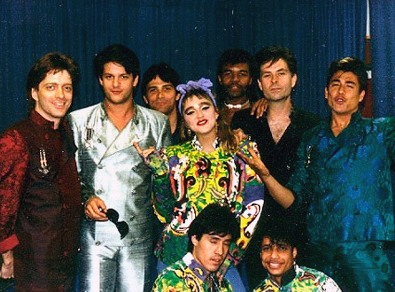
Photo: Bill Lanphier. CC BY 3.0, via Wikimedia Commons.
The video age was arriving, and Madonna was one of its first true stars. A VHS compilation titled Madonna was released in December 1984, including the videos for “Borderline,” “Burning Up,” “Like a Virgin” and an extended mix of “Lucky Star.” It topped Billboard’s Music Videocassette chart from April 13 to November 9, 1985, and was the year’s best-selling music videocassette. To promote it, a launch party at Chicago’s Cabaret Metro on February 9, 1985 — “The Virgin Party” — drew around 1,200 people, encouraged to wear white.
Beyond the charts, the album changed how Madonna was seen — and how she was copied. Like a Virgin is credited with establishing her as a superstar and proving she was not a one-hit wonder. Her fashion during this era — the wedding dress, the lace, the “Boy Toy” belt, the messy hair — was widely imitated by teenagers and young women.
Forty-Two Years On
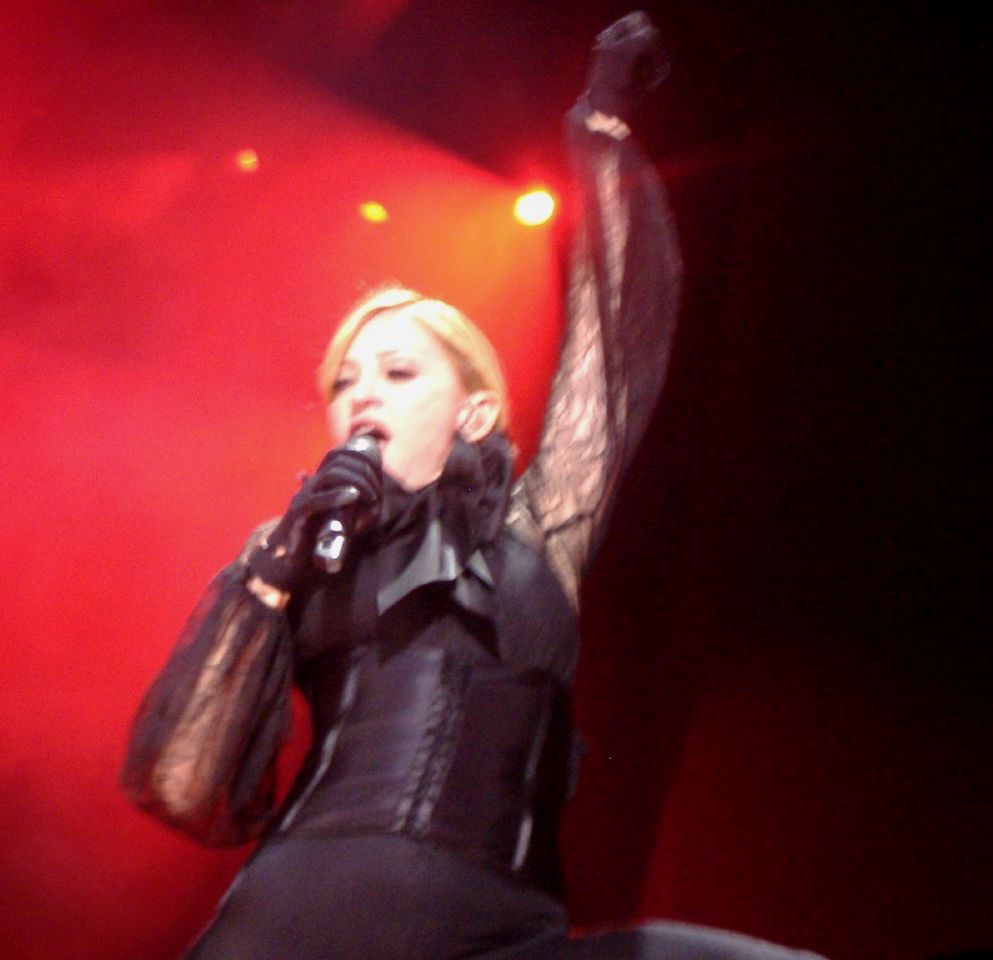
Photo: Madonnafan_dusseldorf (Flickr). CC BY 2.0, via Wikimedia Commons.
Looking back from 2026, it is easy to forget how much of this was a gamble. A twenty-six-year-old singer had argued with her label, refused to accept a sound that was not hers, and bet her second album on songs she had chosen herself. The producer she chose had doubted the very song that would become the album’s centrepiece, and had needed four days to hear what she had heard at once. The most famous performance of the era had begun with a lost shoe.
And yet the pieces held together. The record made in the spring of 1984 at the Power Station became the album that turned a promising new artist into a superstar — four top-five singles in America, a number-one album on both sides of the Atlantic, and a new template for pop: the female star as the author of her own image, choosing her songs, her producer and her look, and daring the audience to keep up.
The Library of Congress understood that when it selected the album for the National Recording Registry in 2023, citing its cultural, historical and aesthetic significance — the formal language for something simpler: this record mattered, and it still does.

Photo: Supermariolxpt. CC BY-SA 2.0, via Wikimedia Commons.
But the heart of the story is smaller and quieter than any of that. It is a singer in a small wooden room at the back of a New York studio, singing take after take while her producer’s band plays behind the glass. It is a songwriter driving through the vineyards in a red pickup truck, working out how it feels to be made new by love. It is a producer listening to a demo he dislikes, and four days later admitting that he cannot get it out of his head. Like a Virgin endures because it was made by people who argued about it, doubted it, fought for it — and, in the end, got it right.
Leave a Reply