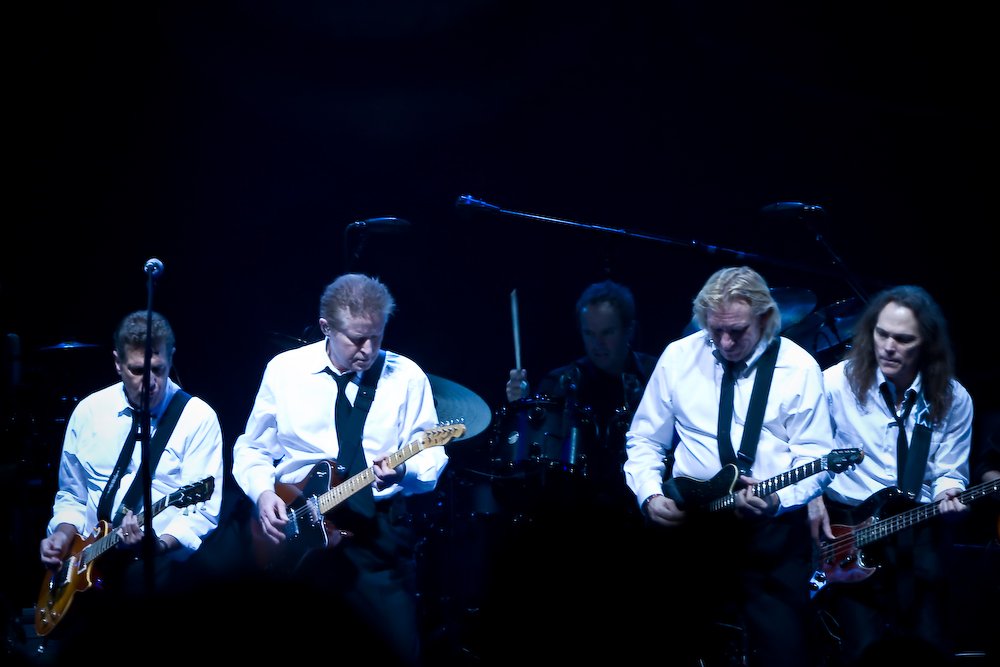
It was never released as a single. It stalled at number forty-one on the album chart. And yet “Desperado” — the title track of the Eagles’ 1973 concept album — became the song that defined the band for half a century, the closer at nearly every concert they ever played, and one of the most beloved ballads in rock history, covered by dozens of artists across every genre imaginable. It was born from a book about gunfighters, recorded in London with a Beatle-era producer, and popularized by a woman who wasn’t even in the band. This is the story of how the Eagles’ greatest song almost wasn’t.
The Book of Gunfighters
In 1972, the Eagles were the hottest new band in America — four harmony-singing Californians with a smash debut, a hit single in “Take It Easy,” and the wind at their backs. But Don Henley and Glenn Frey, the band’s twin engines, were already thinking bigger. They wanted their second album to be a statement, a concept record in the grand tradition of the era — the kind of album that said: we’re not just a singles band. We’re artists.
The concept arrived as a birthday present. Singer-songwriter Jackson Browne — their friend, mentor, and neighbor in the Laurel Canyon scene, the man whose band they had once been — gave Henley and Frey a book about the gunfighters of the Old West, a gift from singer Ned Doheny. The two pored over its tales of the Doolin-Dalton gang, the last of the great outlaw bands, riding through Oklahoma in the 1890s — young, doomed, romantic, famous for being famous — and something clicked. The outlaws’ story felt like their own: young men on the run, living by their own code, celebrated and hunted in equal measure, doomed by the very life they had chosen. Rock stars as desperadoes. The metaphor was almost too perfect to resist.
Henley and Frey threw themselves into the concept. They co-wrote eight of the album’s eleven tracks, building a song cycle about the Dalton gang that doubled as a meditation on fame, freedom, and the price of the outlaw life — the first time the band had tried to say something bigger than a love song. And at its center, they placed the song that would outlive them all.
The Ballad at the Heart of It
“Desperado” the song came first as a piano ballad — Henley’s aching melody, Frey’s romantic fatalism, a lyric that addressed the outlaw directly: you with your pain and your hunger, riding fences and chasing freedom, building walls to keep the world out, when what you really need is to come in from the cold and let yourself be loved. It was a love song disguised as a western, or a western disguised as a love song — either way, it was the most beautiful thing the young band had ever written, and the most vulnerable. For a group of tough young men playing at being outlaws, it was a startling confession: the toughest thing isn’t riding out. It’s coming home.
They knew it, too. In the studio, the song got the full treatment: Henley’s vocal front and center, strings swelling underneath, the band’s harmonies hovering like ghosts. It was the emotional climax of the album, the moment the concept stopped being clever and started being true. Whatever else “Desperado” the album would be, “Desperado” the song was already a classic. The band just didn’t know it yet.
London With Glyn Johns
For the album, the Eagles returned to the producer of their debut: Glyn Johns, the legendary British engineer-producer who had worked with the Beatles, the Rolling Stones, the Who, and Led Zeppelin. Recording took place at Island Studios in London — four California boys in the grey English winter, making a record about the American West.
Johns was the perfect shepherd for the concept: disciplined, old-school, allergic to excess, a man who had tamed the biggest egos in rock. He kept the arrangements lean and the performances honest, and he understood that the album’s power lay in its restraint — that a whisper about outlaws lands harder than a shout. The title track, in his hands, became a study in dynamics — quiet verses, swelling choruses, Henley’s voice carrying the whole weight of the outlaw myth on a bed of strings. It sounded like nothing else on the radio in 1973, which was precisely the problem and precisely the glory.
The Cover Shoot at Paramount Ranch
If the music was understated, the packaging was pure Hollywood. For the album cover, the band hired photographer Henry Diltz — the man who had shot the Laurel Canyon scene better than anyone — and art director Gary Burden, and headed to the Paramount Ranch in Malibu Canyon, the old movie-set western town where countless films and TV shows had been shot.
The front cover showed the four Eagles dressed as outlaws, squinting into the frontier sun — Henley, Frey, Bernie Leadon, and Randy Meisner, young and impossibly cool. The back cover was the punchline: the band laid out “dead,” surrounded by their posse — Jackson Browne and J.D. Souther among the mourners, producer Glyn Johns in a white hat, manager John Hartmann, and Burden himself, all standing over the bodies with mock solemnity. It was a joke, a tribute, and a mission statement all at once: we are the Dalton gang, and this is our last stand. The cover became one of the most famous in rock history — and it sold a fantasy the music only half-believed, the way all the best album covers do.
The Flop That Wasn’t
“Desperado” was released on April 17, 1973, on Asylum Records — and it flopped. Or at least, it flopped by the standards of a band coming off a smash debut. The album peaked at number forty-one on the Billboard 200. Its singles, “Tequila Sunrise” and “Outlaw Man,” both missed the Top 40. The title track wasn’t even released as a single. Critics were respectful but puzzled; radio didn’t know what to do with a western concept album in the age of glam rock.
The band was stung. They had poured their ambitions into this record — the concept, the costumes, the London sessions — and the public had shrugged. Henley and Frey, never ones to forget a slight, carried the lesson forward: never be that self-indulgent again, never let the concept outrun the songs, never give radio a reason to say no. The next album, “On the Border,” would be leaner, tougher, and stuffed with hits. “Desperado” the album became the beautiful failure that taught the Eagles how to be the Eagles — the necessary stumble before the sprint.
The Woman Who Saved the Song
But “Desperado” the song refused to die — thanks to a woman who wasn’t in the band. Linda Ronstadt, the reigning queen of California rock and the Eagles’ great champion (they had, after all, started as her backing band before flying solo), recorded “Desperado” for her 1973 album “Don’t Cry Now.” Her version — tender, aching, definitive in its own way — introduced the song to millions who had missed the Eagles’ album, carried on the pure power of her voice.
Henley has always credited Ronstadt with popularizing the song, and he’s right to. Her cover did what the Eagles’ original couldn’t: it made “Desperado” a standard, a song that belonged to everyone, not just to a concept album about the Dalton gang. Soon radio was playing it, other artists were recording it, and the song the label hadn’t bothered to release as a single was becoming the band’s signature. It was the sweetest irony of the Eagles’ career: their greatest song needed someone else to make it famous — and the woman who did it was the one who had given them their start.
The Song That Belongs to Everyone
What happened next is what happens to true standards: “Desperado” escaped its authors. It became a wedding song, a funeral song, a karaoke staple, a campfire song — the rare rock ballad that works in every setting because its emotion is universal. The outlaw in the lyric could be anyone who ever built walls: the lover afraid to commit, the drifter afraid to stop, the kid from the provinces afraid to come home. Henley and Frey had written about the Dalton gang. The world heard itself.
That universality is why the song survived every fashion change in rock. Punk couldn’t kill it. Disco couldn’t kill it. Grunge couldn’t kill it. It was too simple, too true, too beautifully made — a melody that feels like it always existed, waiting for someone to write it down. The Eagles would go on to sell a hundred million more records, but they would never write anything that belonged to the world the way “Desperado” does.
The Closer, for Forty Years
From then on, “Desperado” became sacred — the one song that was never rotated out, never shortened, never treated casually. The Eagles played it at nearly every concert for the next four decades — often as the closer, the last song of the night, with Henley at the piano and sixty thousand people singing along to every word, holding up lighters and then phones, couples holding each other. It outlasted the breakups, the reunions, the changing lineups, the feuds. When Glenn Frey died in 2016, the song became an elegy — Henley singing his old partner’s co-written farewell, night after night. When the band played its farewell tours, “Desperado” was the goodbye, and there wasn’t a dry eye in the house.
In April 2023, the band gave the song its definitive visual document: an official 4K video, drawn from a November 2004 performance in Melbourne during the Farewell 1 Tour, released to mark the album’s fiftieth anniversary. It has been viewed more than twenty million times — a staggering number for a fifty-year-old album track that was never a single. The outlaw, it turns out, was immortal after all.
“Desperado” failed as an album and triumphed as a song — which might be the most Eagles story ever told. A concept too clever for its moment, a ballad too beautiful to stay buried, a cover version that did what the original couldn’t, and a band that spent forty years closing every show with the song the charts had ignored. Henley and Frey set out to write about the Dalton gang and ended up writing about themselves: young men chasing freedom, learning its price, and singing about it for the rest of their lives. The desperado came in from the cold. The song never will — it just keeps riding, forever young, forever free, forever playing somewhere in the world tonight.
Leave a Reply