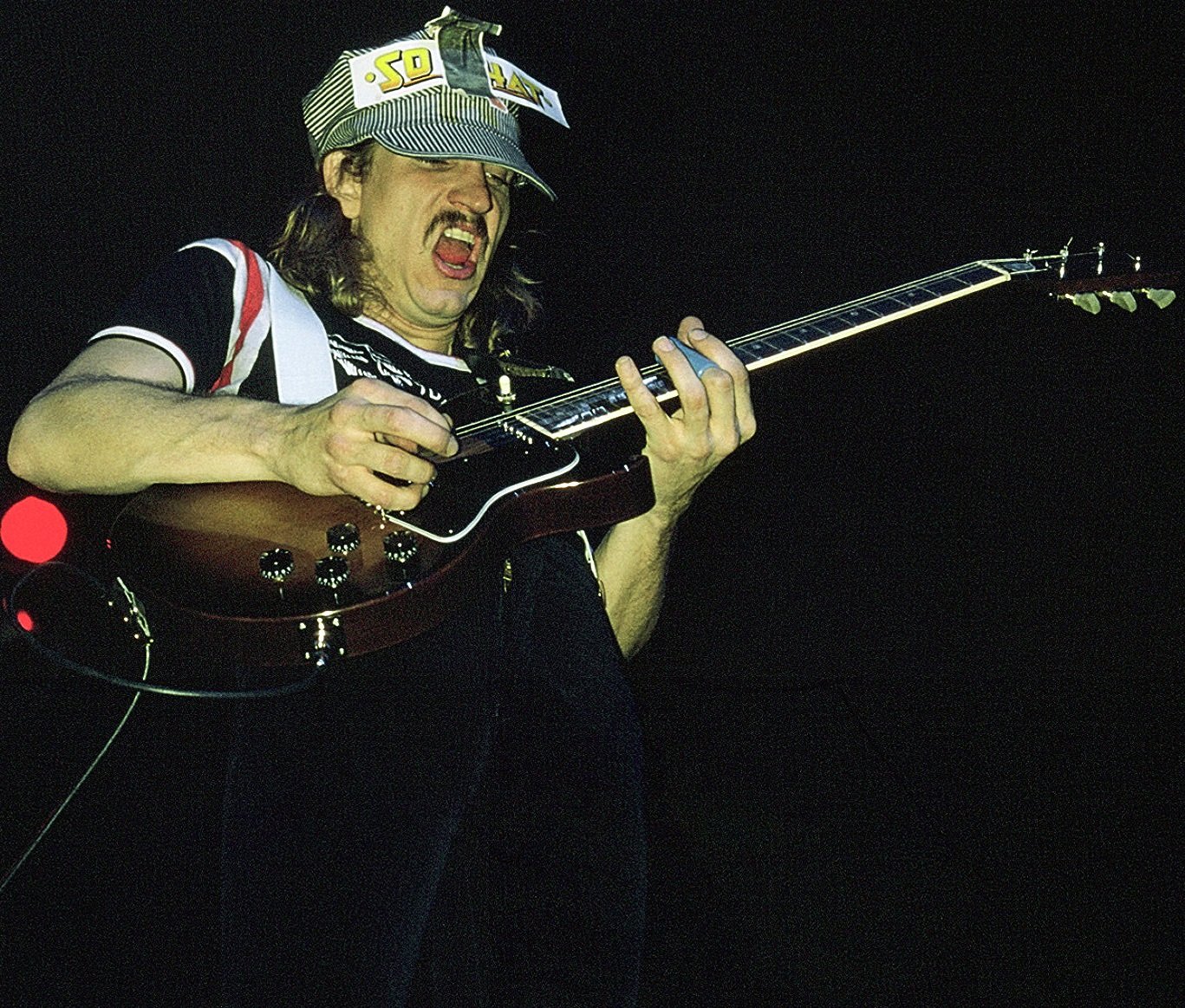
The Eagles sang about life in the fast lane, but they lived it — and paid for it, in ways the songs only hinted at. Behind the hundred million records and the sold-out stadiums lies one of rock’s most human stories: a founding genius gone too soon, a bassist who never recovered from the fame, a guitar hero who clawed his way back from addiction, a quiet singer who beat cancer, and the two survivors who kept the music alive for the next generation. This is the Eagles’ other story — not the hits, but the hearts that made them and the scars they carried.
The Night the Music Stopped: Glenn Frey
Glenn Frey was the Eagles’ spark plug — the Detroit kid with the endless drive, the co-writer of “Hotel California,” “Take It Easy,” “Lyin’ Eyes,” and a dozen other standards, the leader who pushed the band from barroom harmonies to world domination. He was also, by every account, the toughest man in the room: demanding, funny, relentless.
On January 18, 2016, Frey died in New York at sixty-seven, from complications of rheumatoid arthritis, acute ulcerative colitis, and pneumonia. The news hit like a thunderclap. The Eagles weren’t supposed to lose members — they were supposed to be immortal, bickering forever, reuniting every decade for another tour. Don Henley called him “the one who started it all,” and he was right: without Frey’s ambition, there is no Eagles. Beyond the band, Frey had built a formidable solo career in the eighties — “The Heat Is On,” “Smuggler’s Blues,” “You Belong to the City” — and even a second act as an actor on “Miami Vice.” He was a star in every medium he touched, and the engine never idled.
The tributes poured in, but the most moving came from the band itself. At the Grammy Awards that February, Henley and the surviving Eagles performed “Take It Easy” with Jackson Browne — the song Frey had co-written, the song that started everything — and the arena wept. It felt like the end. It wasn’t.
Deacon and Vince: The Next Generation
What do you do when your co-founder dies? Most bands quit. The Eagles did something braver: they went back on the road. In 2017, at the Classic West festival at Dodger Stadium, the band unveiled its new lineup — and at its heart was Deacon Frey, Glenn’s twenty-four-year-old son, stepping into his father’s impossible shoes.
It was a gamble that paid off beautifully. Deacon didn’t try to be Glenn; he just sang his father’s songs with love, and the audiences — tens of thousands of them, night after night — embraced him. Alongside him came Vince Gill, the country superstar and lifelong Eagles devotee, whose angelic tenor filled the harmonies and whose humility steadied the ship. Gill, a Country Music Hall of Famer with more CMA Awards than anyone in history, could have headlined any stage on earth; instead he chose to serve the songs, singing Frey’s parts with a reverence that moved even the skeptics. The message was clear: this isn’t a tribute act. This is a family, and families go on.
Deacon stepped away in 2022 to forge his own path, then returned in 2023 — the prodigal son coming home, to the delight of fans who had watched him grow up on stage. The Eagles had become something rare in rock: a multigenerational institution, a band that could lose its leader and still honor him by playing on, with his son carrying the torch and a country legend holding the harmony.
Randy Meisner: The High Harmony That Faded
If Glenn Frey was the band’s drive, Randy Meisner was its soul — the Nebraska farm boy whose soaring high harmonies lifted “Take It Easy” and “Peaceful Easy Feeling,” and whose “Take It to the Limit” gave the band its first true showcase for his heartbreaking tenor. He was the sweetest Eagle, and fame was the cruelest to him.
Meisner never wanted the spotlight. He was a bass player who sang like an angel and suffered like one, too — plagued by stage fright, exhausted by the band’s internal wars, and increasingly dependent on alcohol. He quit the Eagles in 1977, at the height of “Hotel California,” walking away from the biggest band in the world because the pressure was killing him. It was a brave decision that the industry treated as a disappearance. His solo career flickered — a couple of minor hits, including “Hearts on Fire” — but the machine had moved on, and his health declined, and his personal life unraveled.
The tragedies compounded. In 2015, a court placed Meisner under supervised care amid concerns about his health and well-being. On March 6, 2016 — less than two months after Frey’s death — his wife, Lana Rae, died in a shocking accident at their Studio City home, accidentally shooting herself while moving a rifle. Meisner, who had been diagnosed with bipolar disorder, was devastated. He declined to join the 2013 “History of the Eagles” tour, though he did appear at the band’s 1998 Rock and Roll Hall of Fame induction, singing “Take It Easy” and “Take It to the Limit” one last time with his old bandmates.
On July 26, 2023, Randy Meisner died of chronic obstructive pulmonary disease at seventy-seven. The tributes remembered the voice — that impossible, soaring tenor — and the gentle man behind it. The Eagles had lost their sweetest harmony.
Joe Walsh: One Day at a Time
Joe Walsh joined the Eagles in 1975 and nearly died being Joe Walsh. The guitar hero — “Rocky Mountain Way,” “Life’s Been Good,” the blazing solos on “Hotel California” — was also rock’s most cheerful self-destructor, a man who treated his body like a rental car. By the early nineties, the party had become a prison. He was drinking himself to death, and everyone knew it.
What saved him was an ultimatum. As the band prepared its 1994 reunion — the “Hell Freezes Over” tour, the one nobody thought would ever happen — Henley and Frey laid it out: get sober, or there’s no reunion. For Walsh, who loved the band like family, it was the only threat that could have worked. He chose the music. He got sober in 1994, and he has stayed sober for more than thirty years — one day at a time, as the saying goes, and as he tells it with characteristic humor and zero self-pity.
Sobriety didn’t dull him; it revealed him. The post-rehab Walsh became one of rock’s most beloved elder statesmen — funny, wise, generous, the guy who shows up for charity gigs and makes everyone laugh. He found a second act as a radio host, a philanthropist supporting veterans’ causes, and the Eagles’ resident wild man turned wise man. “Life’s Been Good” was a joke about excess, written from inside the whirlwind. The punchline, it turns out, was survival — and the second verse is still being written, one sober day at a time.
Timothy B. Schmit: The Quiet Survivor
Timothy B. Schmit has always been the Eagles’ quiet one — the bassist who replaced Meisner in 1977, the velvet voice on “I Can’t Tell You Why,” the peacemaker in a band of warriors. He sailed through the reunion years with characteristic grace, the least dramatic Eagle by a mile.
Then, in October 2012, came the diagnosis: cancer of the throat and neck. For a singer, there is no scarier news. Schmit underwent surgery shortly after a November 17, 2012 show in Las Vegas, and then came the anxious wait. The outcome, mercifully, was the best possible: the surgery was successful, and he emerged cancer-free. He was back on stage within months, his voice intact, his humor undimmed.
He rarely talks about it — that’s Schmit’s way — but those close to the band say the scare deepened his already profound gratitude for the music and the life it gave him. The quiet Eagle had faced the silence and won. He keeps singing, keeps smiling, keeps holding down the bottom end with that unmistakable velvet tone. Some survivals don’t need a press release. They just need a stage, a bass, and the next song.
Don Henley: The Keeper of the Flame
And then there’s Don Henley — the drummer who became the conscience, the Texan who outlasted them all. While his bandmates battled their demons in public, Henley built a parallel life of purpose: in 1990, he founded the Walden Woods Project to preserve the woods around Walden Pond in Massachusetts, the landscape of Thoreau; in 1992, he created the Caddo Lake Institute to protect the Texas wetlands of his youth.
It was never a vanity project. Henley poured millions of dollars and decades of effort into conservation, fighting developers and politicians with the same tenacity he once aimed at record executives. The man who sang “The Last Resort” — the Eagles’ great lament for the paved paradise — spent his off-tour years trying to save what was left of it.
Henley also became the band’s de facto leader after Frey’s death, the one who decided the Eagles would play on — and who had the solo catalog (“Boys of Summer,” “The End of the Innocence,” “The Heart of the Matter”) to prove he understood what a song could carry. It couldn’t have been easy — every show a reminder of his lost partner, every “Take It Easy” a eulogy. But he understood what Frey had understood: the music belongs to the people now. So he keeps the flame, night after night, year after year, the drummer still keeping time for the band he helped build in a Los Angeles living room half a century ago.
The Eagles were never just a band. They were a gang — five, then six, then seven strong — who lived the fast lane, survived it, and kept playing through everything the decades threw at them. They lost Glenn Frey, the leader. They lost Randy Meisner, the soul. They nearly lost Joe Walsh to the bottle and Timothy Schmit to cancer. But the music refused to die, because the people refused to let it: a son stepping into his father’s spotlight, a country star lending his voice, a drummer-turned-conservationist keeping the flame, a guitar hero counting his sober days like gold records. “Take It Easy” was the first song. It turned out to be the instruction manual — for the band, and for everyone who ever loved them. Through loss and survival, breakups and reunions, the Eagles took it easy — and kept going. The heart behind the hits was never the harmonies, perfect as they were. It was the humans — flawed, funny, fragile, and still standing.
Leave a Reply