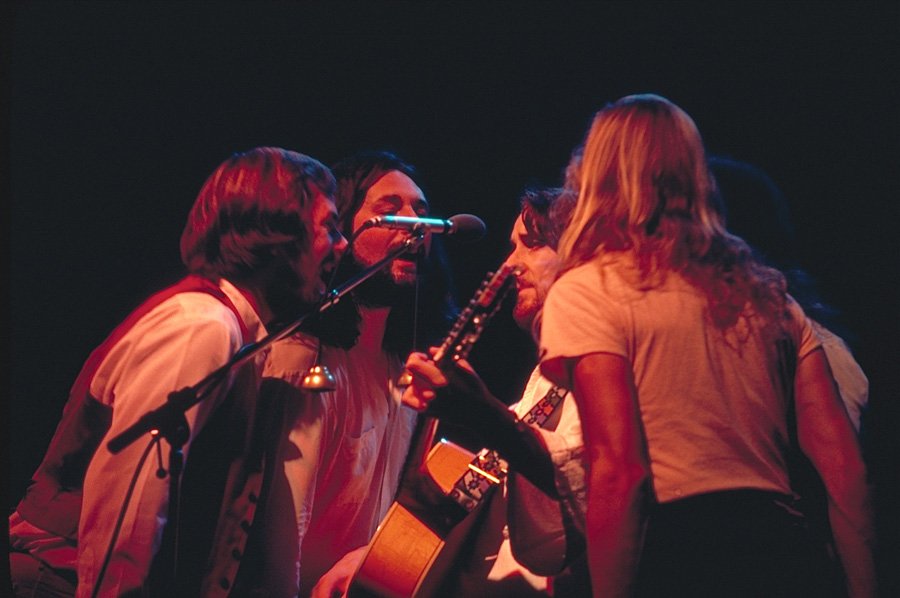
The most generous song Supertramp ever recorded began as a private homework assignment from a teenager who had just heard the Beatles sing All You Need Is Love on a global television broadcast and decided he wanted to write something that simple, that direct, and that true. Roger Hodgson was nineteen or twenty years old, not yet famous, not yet even in the band that would define his life. He strummed out a little acoustic song built on a plea so plain it barely qualifies as a lyric: give a little bit of your love to me, give a little bit of your life away. Then, remarkably, he put it away — and left it there for more than half a decade, while a band formed around him, collapsed, re-formed, and slowly became one of the biggest acts in the world.
When Give a Little Bit finally emerged in 1977 as the opening track of Even in the Quietest Moments…, it sounded like the least calculated thing Supertramp had ever done: twelve-string guitar, handclaps of sunshine, a saxophone grin from John Helliwell, and a melody a child could hum after one hearing. America agreed. The single climbed to number 15 on the Billboard Hot 100 and gave the band its American breakthrough, proof that a song written in adolescent earnestness could survive the long, cynical road to the charts without losing its innocence.
A Teenager Answers the Beatles
Hodgson has never hidden the song’s origin. The Beatles’ All You Need Is Love, beamed around the world by satellite in the summer of 1967, landed on the young English musician like a challenge. “I think I’ve been very affected by the Beatles at that time,” he recalled. “If I have to think about one song that really touched me and made me realize yet again the power of music and how it could change the world, it was All You Need Is Love.” His response, written a couple of years later during his late-sixties days with the band Argosy, was deliberately modeled on it — not the chords or the melody, but the method: take one huge, unembarrassed idea and say it so simply that nobody can hide from it. He sang it for friends, believed in it completely, and then — inexplicably, even to himself in later years — simply kept hold of it.
The sixties idealism was the point. Hodgson has described the era as “very idealistic,” a time when the dream was still alive, and he has said the song’s simplicity came naturally because, at that age, he simply didn’t overthink things. In 2023 he summed it up: “Even at an unwizened young age when I wrote this song, I saw that the world needed love. I believed in love — it was always for love — and I just felt that was the most important thing in life.” The song is basically saying, as he puts it, “just show you care.”
Six Years in the Drawer
What happened next is the strange part: nothing. Hodgson held the song back for five or six years. Supertramp formed in 1969, burned through lineups and two failed albums, rebuilt itself around Hodgson and Rick Davies, and finally broke through with Crime of the Century in 1974. Through all of it, Give a Little Bit stayed in the drawer. Hodgson has said he was waiting — for the band to be ready, for the moment to be right, perhaps for himself to believe that a major rock act in the irony-soaked mid-seventies could release a song this sincere without being laughed off the stage.
When he finally brought it to the band, it carried the usual Supertramp paperwork: like everything from that era, it was credited jointly to Davies and Hodgson, the partnership credit the two men used from 1974 until Hodgson’s departure in 1983, though everyone involved knew whose song it was. That shared-credit arrangement, a handshake meant to keep the peace between two very different writers, would matter enormously to the band’s later history. For now, it simply meant the song could go to work.
A Barn High in the Rockies
Supertramp recorded Even in the Quietest Moments… in the winter of 1976–77 largely at Caribou Ranch, the famous studio built inside a converted barn in the Rocky Mountains near Nederland, Colorado, with finishing work in Los Angeles. The setting suited the material: snow outside, wood beams overhead, and a band deliberately stripping back the prog-rock architecture of its earlier records toward something warmer and more direct.
Give a Little Bit opens the album, and its construction is a masterclass in restraint. Hodgson’s strummed twelve-string guitar carries the track, his high, yearning tenor sits completely exposed, and the arrangement builds by addition rather than force — rhythm section, handclap-simple groove, and finally Helliwell’s saxophone, which answers the vocal like an old friend finishing a sentence. Nothing in the song is difficult, and that is precisely the achievement: five seasoned musicians, several of them virtuosos, all agreeing to play the simplest thing that could possibly work, because the teenager who wrote it had understood something they might otherwise have arranged away.
The Breakthrough
Released as a single on May 27, 1977, with Davies’s Downstream tucked on its B-side, Give a Little Bit became Supertramp’s international calling card. It peaked at number 15 on the Billboard Pop Singles chart, reached number 8 in Canada and number 29 in the band’s native Britain — modest numbers, but a breakthrough for a group America had so far treated as an albums act. The parent album did even better, climbing to number 16 in the United States and topping the chart in Canada, and the band permanently relocated to Los Angeles on the strength of it. Two years before Breakfast in America made them superstars, Give a Little Bit taught American radio that Supertramp’s warmth was as real as their wizardry.
The album around it told the same story of a band at a turning point. Even in the Quietest Moments… — its title track conceived by Hodgson during a soundcheck before a show at Copenhagen’s Tivoli Gardens — reached the top five in multiple countries, topping the charts in Canada and the Netherlands. For Hodgson, the success carried a private confirmation: the sincere little song he’d been protecting since his teens had not needed protecting at all. Given a barn in the mountains, five sympathetic musicians, and the courage to stay simple, it had walked into the world entirely as itself.
The Song That Wouldn’t Stop Giving
The song’s afterlife has a way of literalizing its title. It was re-released in 1992 to raise funds for the ITV Telethon charity event. After Hodgson left Supertramp in 1983, it became the emotional centerpiece of his solo shows, the song audiences demanded and the one he has called possibly his favorite of everything he wrote — “such a timeless message,” as he puts it, and one he rates among the ten best songs of his career. In 2004 the Goo Goo Dolls took their own version to the top of the adult contemporary charts, introducing the chorus to a generation that had never heard of Caribou Ranch. Charity broadcasts reached for it after disasters; advertisers reached for it when they needed instant goodwill.
There is a pleasing symmetry in all of it. A song Hodgson wrote as a teenager, answering the Beatles, then hid away for six years out of something like shyness, turned out to be the most durable thing he ever made — not despite its simplicity but because of it. “This song has really taken on a life of its own,” Hodgson said in 2023, “and I think it’s even more relevant today than when I wrote it.” The drawer kept it safe. The world did the rest.
Leave a Reply