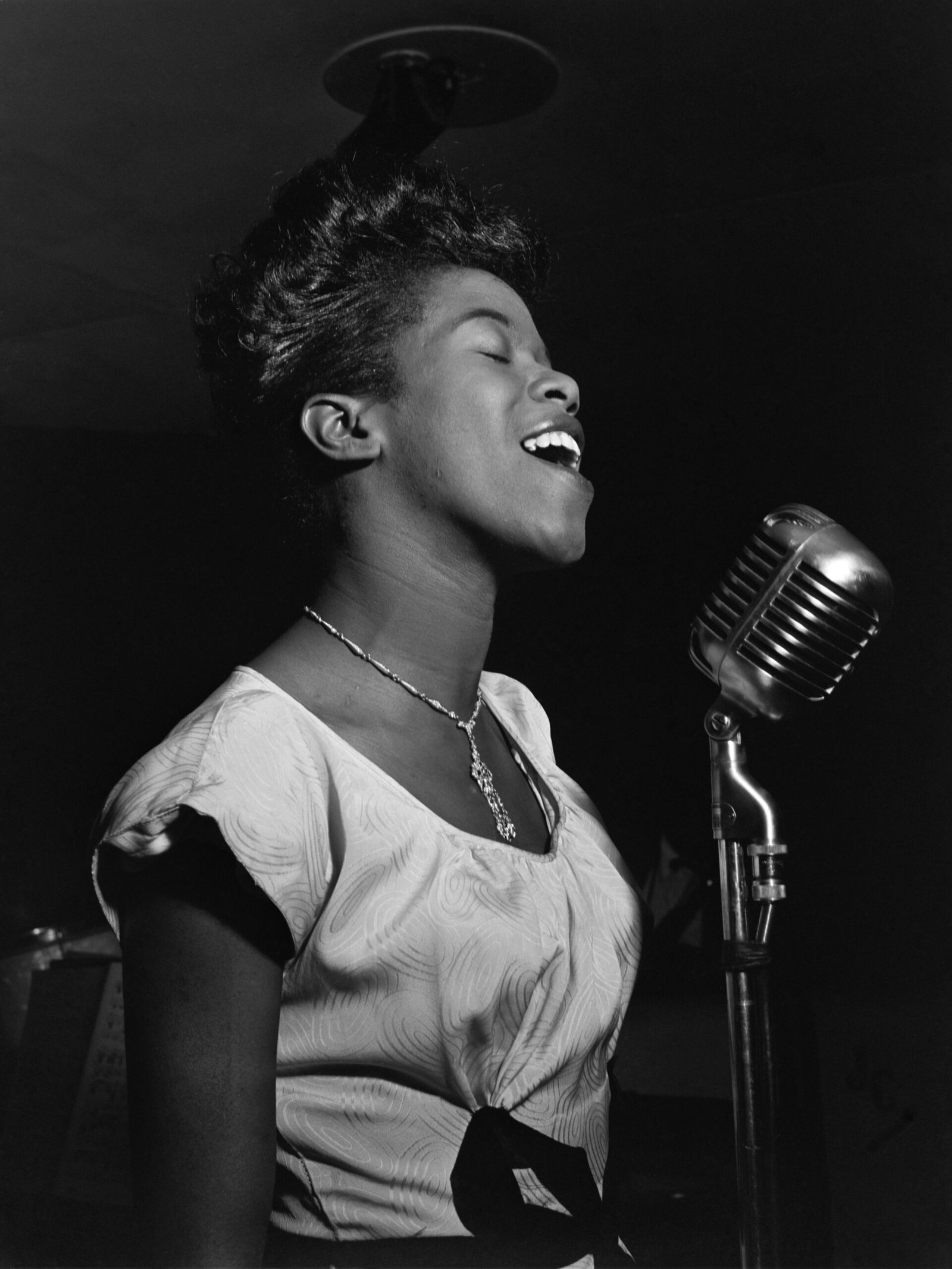

A church musician from Newark
Sarah Lois Vaughan was born on 27 March 1924 in Newark, New Jersey, to Asbury Vaughan, a carpenter, and Ada Vaughan, a laundress. Both parents were amateur musicians, and music was part of the household long before it became a profession. Vaughan learned piano and organ as a child, sang in her mother’s church choir, and grew up in a musical world where the keyboard came first and the voice followed close behind. That order matters for understanding everything she did later. She did not arrive in jazz as a singer who needed other people to explain harmony to her. She arrived as a musician who could play, who understood chords from the inside, and who could hear a line the way an instrumentalist hears it.
Newark in her childhood was close enough to New York to make the city feel reachable, and Vaughan began crossing the Hudson to hear music in Harlem. She visited the Savoy Ballroom and the Apollo Theatre, two rooms that shaped a generation of Black American musicians. She was still a teenager when she began playing piano in Newark nightclubs, learning the practical side of the trade: how to accompany, how to hold a room, how to listen to a band while keeping time. The glamour of a later career can make those early years look like a straight line, but they were really an apprenticeship. Vaughan was learning to be useful on a bandstand, and that usefulness would soon put her in rooms with the most adventurous musicians of her time.
One night at the Apollo
The turning point, as Vaughan herself later told it, was unplanned. She entered the Apollo Theatre’s amateur contest, singing a ballad called Body and Soul, and she won. The prize, as she recalled it, was ten dollars and a week’s engagement at the theatre, and at eighteen she was more struck by the ten dollars than by any thought of a career. The exact date of that winning night is uncertain in the published record, with different accounts placing it in 1942 or 1943, but the consequence is not in doubt. During her week at the Apollo she was heard by Billy Eckstine, then the male vocalist with Earl Hines’s orchestra, who recommended her to Hines. Within weeks, Vaughan was in show business.
That chain of events is worth pausing over, because it explains so much about the jazz world of the early 1940s. A contest at the Apollo was not a television talent show. The audience was famously demanding, and a singer who could not command the room would know about it at once. Vaughan won over that crowd with a slow, exposed ballad, not with novelty or volume. She sang with control, with a feeling for the melody, and with a voice that could move from low warmth to high brilliance without breaking its line. Eckstine, himself one of the great baritone voices of the era, recognised a fellow musician rather than a mere novelty act. He did not simply admire her; he went backstage and spoke for her.
Joining Earl Hines
Vaughan joined Earl Hines’s band in the spring of 1943, as a vocalist and second pianist, and she made her debut with the band at the Apollo on 23 April 1943. She was the only woman in the ensemble, sharing the vocal spotlight with Eckstine and often playing piano in duet settings with Hines. The band itself was one of the most forward-looking big bands of its day. Its personnel included trumpeter Dizzy Gillespie and saxophonist Charlie Parker, along with other modern players such as trumpeter Fats Navarro and trombonist J. J. Johnson. Those names now read like a roll call of bebop’s founders, but at the time they were young sidemen working out new ideas inside a working dance band.
The Hines band is often described as an incubator of bebop, and Vaughan was inside that incubator at exactly the right moment. Bebop, as it was taking shape in the early 1940s, moved jazz away from the smooth, danceable swing of the big-band era towards faster tempos, more complex harmonies, longer and more angular melodic lines, and a closer relationship between the soloist and the rhythm section. A singer in such a band could not simply float a pretty tune over the top. She had to hear the harmony changing underneath her, to phrase against the beat rather than merely on it, and to hold her own in a band full of instrumentalists who were rethinking their instruments. Vaughan, with her piano training, was unusually well equipped for that challenge.
There is, however, a frustration at the heart of the Hines period. Because of a dispute between the musicians’ union and the recording companies, the Hines band of this period made no commercial recordings. The sound that Vaughan was developing night after night on tour, in the company of Gillespie and Parker, was therefore not preserved on record at the time. Historians and listeners have to reconstruct it from later recordings, from memories, and from the musicians who were there. That absence makes the Hines years easy to understate. They left no hit record, but they gave Vaughan her education, her colleagues, and her musical language. When she did begin to record, the bebop phrasing was already in her voice.
The Eckstine orchestra
In 1944 Eckstine left Hines to form his own orchestra, and Vaughan went with him. The Billy Eckstine Orchestra became one of the most important bebop big bands of the era, a large ensemble that carried the new music to audiences who might never have set foot in a small bebop club. Gillespie served as its musical director, Parker played in its reed section, and the band also included saxophonists Dexter Gordon and Gene Ammons and pianist John Malachi. For a young singer, it was both a school and a test. The musicianship was demanding, the arrangements were modern, and the band’s identity was built around instrumental daring rather than around a singer standing in front of a conventional swing band.
Vaughan’s first recording came with this band. On 5 December 1944 she recorded I’ll Wait and Pray for the De Luxe label, backed by the Eckstine orchestra. It was a modest beginning in commercial terms, but it marked her arrival on record as part of a bebop orchestra, not as a pop singer borrowed for a single session. The Eckstine band also gave her a nickname that stayed with her for life. Band pianist John Malachi is credited with calling her singing style sassy, and the name Sassy stuck, first among colleagues and then with the press. Vaughan herself often spelled it Sassie in writing. The nickname captured something real about her presence: a directness, a confidence, and a refusal to be merely decorative on a bandstand full of strong personalities.
A voice like a horn
What made Vaughan different from other big-band singers of the time was the way she treated the voice as an instrument. Contemporary descriptions return to the same qualities: a wide vocal range that moved with ease between soprano and contralto registers, a sophisticated harmonic sense, and horn-like phrasing. She could sing a ballad straight, letting a melody unfold slowly and with great warmth, and she could also bend a line, delay a phrase, stretch a note, or slip a chromatic passing tone into a melody in the way a saxophonist might. That flexibility is the heart of her bebop singing. She was not imitating an instrument for effect. She was thinking melodically in the same language as the players around her.
That approach also changed what a jazz singer could be. In the 1940s, women singers in big bands were often treated as stage attractions rather than as full members of the musical ensemble. Vaughan, like Ella Fitzgerald before her, helped to change that expectation. She was not there to provide a vocal interlude between instrumental numbers. She was a musician in the band, someone whose choices of note and rhythm mattered to the performance as a whole. The respect she earned from Gillespie, Parker, and Eckstine was not polite praise for a singer. It was the respect of fellow improvisers for someone who could keep up with them.
Listening to her early work today, it is striking how much she already sounds like herself. Later recordings would refine her control and deepen her ballad singing, but the essentials are present in the mid-1940s: the richness of tone, the agility, the willingness to take a melodic risk, and the ability to land back on the melody with complete assurance. She was not a singer who learned bebop as a style to put on. She learned it as a language, in the company of the people who were inventing it.
Lover Man and the small bands of 1945
Vaughan left the Eckstine orchestra late in 1944 to pursue a solo career, although she remained close to Eckstine and would record and perform with him again over the years. The months that followed produced some of the most important recordings of her early career. On New Year’s Eve 1944 she recorded with Gillespie and Parker for the Continental label, including a piece called Interlude, an early version of what would become known as A Night in Tunisia. Then, on 11 May 1945, she recorded Lover Man for the Guild label with a quintet featuring Gillespie on trumpet and Parker on alto saxophone, with Al Haig on piano, Curly Russell on bass, and Sid Catlett on drums. Later that same month she recorded further sides with a slightly larger Gillespie and Parker group, including Mean to Me.
These small-band recordings matter because they strip away the big-band setting and place Vaughan directly beside the bebop innovators. There is nowhere to hide in a quintet. The singer must match the rhythmic energy of the horns, must find her place in a texture where every player is improvising, and must do it without losing the song. Vaughan does all of that, and the recordings show why she was already regarded as a leading jazz singer while still in her early twenties. Lover Man, in particular, became a signature piece for her, one she would return to throughout her career, and the 1945 version remains a document of a moment when bebop was still new and a young singer was helping to give it a vocal form.
The solo career that followed was built in the clubs of New York’s 52nd Street, the dense strip of jazz rooms that included the Three Deuces, the Famous Door, the Downbeat, and the Onyx Club. Vaughan freelanced in those rooms in 1945, working as a solo act and building a reputation among musicians and regular listeners. She also spent time at the Braddock Grill, next to the Apollo in Harlem. It was a working musician’s life, night after night, in small rooms, rather than a sudden leap to stardom. That grounding suited her. She was learning to carry an evening herself, to choose material, to pace a set, and to sing for an audience that was close enough to hear every detail.
John Kirby, Musicraft, and the road to a solo voice
Before settling fully into solo work, Vaughan spent a short period in the winter of 1945 with the sextet of bassist and trombonist John Kirby, and she performed as a solo act from 1946 onwards. In October 1945 she signed with the Musicraft label, and she recorded with jazz violinist Stuff Smith’s group in the same month. Her Musicraft recordings of 1946 and the years that followed became well known among jazz listeners and critics, and they show a singer who was broadening her range without abandoning her bebop roots. Her 1946 Musicraft recording of Tadd Dameron’s If You Could See Me Now, written and arranged by Dameron, is regarded as a modern classic, and her recording of Tenderly became an unexpected pop hit in late 1947.
These developments are important because they show that Vaughan’s bebop years were not a phase she left behind. They were the foundation on which a longer career was built. The ballad singing for which she later became famous did not replace her bebop phrasing. It grew out of the same musical intelligence: the same ear for harmony, the same control of tone, the same willingness to shape a phrase rather than simply deliver it. A singer who had learned to sing beside Parker and Gillespie could bring a different kind of depth to a popular ballad. She knew where the harmony was going, she knew how much space a melody could hold, and she knew how to use silence as well as sound.
Vaughan’s manager in these years was trumpeter George Treadwell, whom she met while performing at Cafe Society Downtown, an integrated club in New York’s Sheridan Square. Treadwell became her manager and took on many of the musical-director responsibilities for her recording sessions, leaving Vaughan free to concentrate on singing. The couple married in September 1946. That professional partnership helped to organise a career that had begun, almost by accident, at the Apollo, and it gave Vaughan a structure within which her solo work could develop. She was no longer a band singer waiting for her number. She was an artist choosing her own material and shaping her own records.
The Divine One
Around the end of the 1940s, Chicago disc jockey Dave Garroway gave Vaughan a second nickname that would follow her for the rest of her career: The Divine One. Garroway played her records repeatedly on the air, and the name caught on with listeners. It was a different kind of nickname from Sassy. Where Sassy described her personality and her punch on a bandstand, The Divine One described the effect of her voice itself: its beauty, its range, its seeming ease, and its ability to make a difficult musical idea sound natural. The two names together capture the two sides of Vaughan that the bebop years had formed. She could be direct and formidable, and she could be ravishing.
It is tempting to treat The Divine One as a later, grander title, separate from the bebop years, but it belongs to this story. The voice that Garroway was celebrating had been formed in the Hines and Eckstine bands, in the small clubs of 52nd Street, and in the recording studios of 1944 and 1945. The control that allowed her to sing a ballad with such apparent effortlessness was the same control that had allowed her to phrase beside Parker and Gillespie. The warmth that listeners heard in her later ballads was present, in a younger and more daring form, in her early recordings. Bebop gave her the technique; the ballad gave her the space to show what that technique could do when it was held in reserve.
Vaughan’s later career would take her much further, through the Columbia years from 1949, the Mercury years of the 1950s, a first million-selling record, and decades of concert and recording work that continued into the 1980s. She would win Grammy Awards, including a Lifetime Achievement Award, and she would be recognised as one of the greatest jazz singers of the twentieth century, ranked alongside Ella Fitzgerald and Billie Holiday. None of that later success, however, can be understood without the bebop years. They were the years in which she learned to be a musician among musicians, in which she found a voice that could do what a horn could do, and in which she proved that a singer could be at the centre of the most advanced jazz of her time.
Why the bebop years still matter
For a listener coming to Sarah Vaughan for the first time, the bebop years are the best place to understand why she mattered so much to other musicians. Start with the context: a teenage pianist and church singer from Newark, winning an Apollo contest, joining a big band that happened to contain the founders of bebop, and then stepping out on her own while still in her early twenties. Then listen to the recordings from 1944 and 1945, and notice how much is already there. The voice is not tentative. It is not a singer trying to copy a style she has only just heard. It is a musician who has absorbed a new language and is speaking it in her own accent.
The bebop years also matter because they remind us that jazz history is not only a history of instrumentalists. Singers are sometimes treated as interpreters of other people’s ideas, but Vaughan was a creator in her own right. She shaped melodies, she shaped rhythms, and she shaped the expectations of what a jazz vocalist could do. Later singers who phrase like instrumentalists, who take harmonic risks, and who treat a ballad as a piece of improvisation as well as a piece of interpretation, are working in a tradition that Vaughan helped to establish in the mid-1940s. That is a large claim, but it is supported by the company she kept and by the recordings she left behind.
Finally, the bebop years matter because they were, for Vaughan, a story of belonging. She was the only woman in the Hines band, a young singer in a world dominated by male instrumentalists, and she earned her place not by asking for special treatment but by being, quite simply, good enough to be there. The nicknames that followed her, Sassy and The Divine One, were not marketing inventions imposed from outside. They were names given by musicians and broadcasters who had heard her at close quarters and were trying to describe what they had heard. One described her spirit. The other described her sound. Together, they describe a singer who entered jazz through bebop and never left its lessons behind.
Image credit: Vintage NBC microphone, CC0 1.0, Daderot, via Wikimedia Commons (thematic image, not a photograph of Sarah Vaughan)
Sources / further reading
- Encyclopedia.com, Vaughan, Sarah 1924-1990: https://www.encyclopedia.com/education/news-wires-white-papers-and-books/vaughan-sarah-1924-1990
- BlackPast.org, Sarah Vaughan (1924-1990): https://blackpast.org/african-american-history/vaughan-sarah-1924-1990/
- Michael Minn, Sarah Vaughan Discography: Early Years: https://michaelminn.net/discographies/vaughan/early-years/index.html
- Jazz Standards, Lover Man (Oh, Where Can You Be?): https://www.jazzstandards.com/compositions-0/loverman.htm
- Jazz Journal, Sarah Vaughan: Lover Man: https://jazzjournal.co.uk/2019/06/15/sarah-vaughan-lover-man/
- YouTube, Sarah Vaughan – Lover Man (Oh, Where Can You Be): https://www.youtube.com/watch?v=vHdlrdM6OAU
Leave a Reply