
Few records announce themselves as boldly as “Be My Baby.” Before a voice is heard, there is a drum pattern — a sharp crack, a pause, then the same crack again — that has become one of the most recognised openings in all of pop music. Then the orchestra rushes in, the backing voices swell, and Veronica Bennett, later Ronnie Spector, begins to sing, her voice cutting through the sheer weight of sound around her with a clarity that makes the whole enormous production feel intimate. The record lasts less than three minutes. It has been played, copied, sampled, and quoted for more than sixty years, and it still sounds, on first hearing, like something arriving all at once, too big for a radio speaker and too tender to be only noise.
“Be My Baby,” released by the Ronettes in August 1963, was Phil Spector’s fullest realisation of what he called, or what others soon called for him, the Wall of Sound. It was also the record that made the Ronettes stars, that made Ronnie Spector one of the defining voices of the 1960s, and that set a standard for pop production which producers have been chasing, in one form or another, ever since. The story of the record is, at the same time, a story about three young women from New York, about a producer whose ambition was matched only by his need for control, and about a sound that was designed to overwhelm a small speaker — and ended up overwhelming a whole era.
Three voices from New York
The Ronettes were Veronica Bennett, known as Ronnie, her older sister Estelle Bennett, and their cousin Nedra Talley. They grew up in New York City, singing together from childhood, harmonising at family gatherings and at school events, and developing the close, streetwise blend that would later set them apart from the sweeter-sounding girl groups of the early 1960s. As teenagers they began performing in clubs, and they became regulars at the Peppermint Lounge in Manhattan, a nightspot famous as a home of the Twist, where they worked as singers and dancers. They were young, and they looked older than they were — heavy make-up, high hair, and clothes that borrowed from the style of the neighbourhood women they admired — and audiences noticed them before record companies did.
Their first records came in 1961, on the Colpix label, under the name the Ronettes. Those early singles did not chart, and the group continued to work the club circuit, including appearances in disc jockey Murray Kaufman’s rock-and-roll revues at the Brooklyn Fox Theater. It was during this period that they came to the attention of Phil Spector. In early 1963, Estelle Bennett contacted Spector, and the group auditioned for him. Spector, already a successful young producer with hits for the Crystals behind him, was struck above all by Ronnie’s voice. Accounts of the audition describe him stopping what he was doing when he heard her sing, convinced he had found the voice he had been looking for. He signed the Ronettes to his own label, Philles Records, in March 1963, and became their producer and manager.
Spector first recorded the group on a song called “Why Don’t They Let Us Fall in Love,” but he held the record back, feeling that the group needed more time to develop as a stage act. His patience, if that is the right word for a producer not known for patience, paid off a few months later, when he brought the group a new song he had written with the husband-and-wife songwriting team Jeff Barry and Ellie Greenwich. The song was “Be My Baby,” and Spector intended it to be something more than another girl-group single. He intended it to be a demonstration of everything he believed a pop record could be.
Gold Star, and a wall built from sound
The recording was made at Gold Star Studios in Hollywood, Spector’s favourite studio, on Santa Monica Boulevard. Gold Star was famous for its echo chamber, a small, tiled room that gave recordings a distinctive, reverberant warmth, and Spector used it as an instrument in its own right. For “Be My Baby,” he assembled a large group of session musicians, later known collectively as the Wrecking Crew, together with a full orchestra — the first time, it is generally said, that he had recorded with a full orchestra in the studio. The arranger was Jack Nitzsche, and the engineer was Larry Levine, both central figures in the Spector sound.
Spector’s method, which became known as the Wall of Sound, was based on a simple idea pursued to an extreme. Instead of recording each instrument separately and balancing them afterwards, he recorded many instruments playing the same parts together, in the same room, at the same time, so that their sounds blended into a single, massive texture. Several guitars might play the same chords, several pianos might play the same figures, and strings, brass, and percussion would be layered over them, all fed through Gold Star’s echo chamber and recorded, remarkably, on a three-track tape machine. The result was a sound that seemed to have no gaps in it: a wall, behind and around the singer, through which her voice had to cut, and did.
The session itself has become legendary, and some details vary from account to account. One widely repeated account says that the band rehearsed for hours before Spector was satisfied enough to record, and that the famous opening drum pattern, played by the session drummer Hal Blaine, began as an accident or an improvisation that Spector decided to keep. Another account, from a participant in the session, recalls dozens of run-throughs before the take that became the record. What is not in doubt is the care Spector took over Ronnie’s vocal. She flew to Los Angeles without her two groupmates to record the lead, and she rehearsed it intensively before the final vocal was laid down. On the finished record, Ronnie is the only Ronette who appears; the backing voices were provided by session singers, including members of the Blossoms and other regular Spector collaborators. That fact has sometimes surprised listeners who picture the three Ronettes singing together on their biggest hit, but it was characteristic of Spector’s method: the record, not the group photograph, was the work of art, and he built it from whatever voices and instruments served it best.
When the pieces came together, the effect was extraordinary. The record opens with Blaine’s drum figure, then the orchestra and the rhythm section enter as a single surge, and Ronnie’s voice arrives over the top, singing a simple, direct declaration of love. The arrangement never lets up, but it never drowns her either. That balance — enormous sound, intimate voice — is the whole trick of the Wall of Sound, and “Be My Baby” is its purest example. Listeners hearing it on a car radio, a transistor radio, or a jukebox in 1963 heard something that seemed bigger than the speaker it came from, which was exactly what Spector had intended. He often spoke of making “little symphonies” for teenagers, and “Be My Baby” was the closest he came to that ambition in a single record.
A hit, and a new kind of stardom
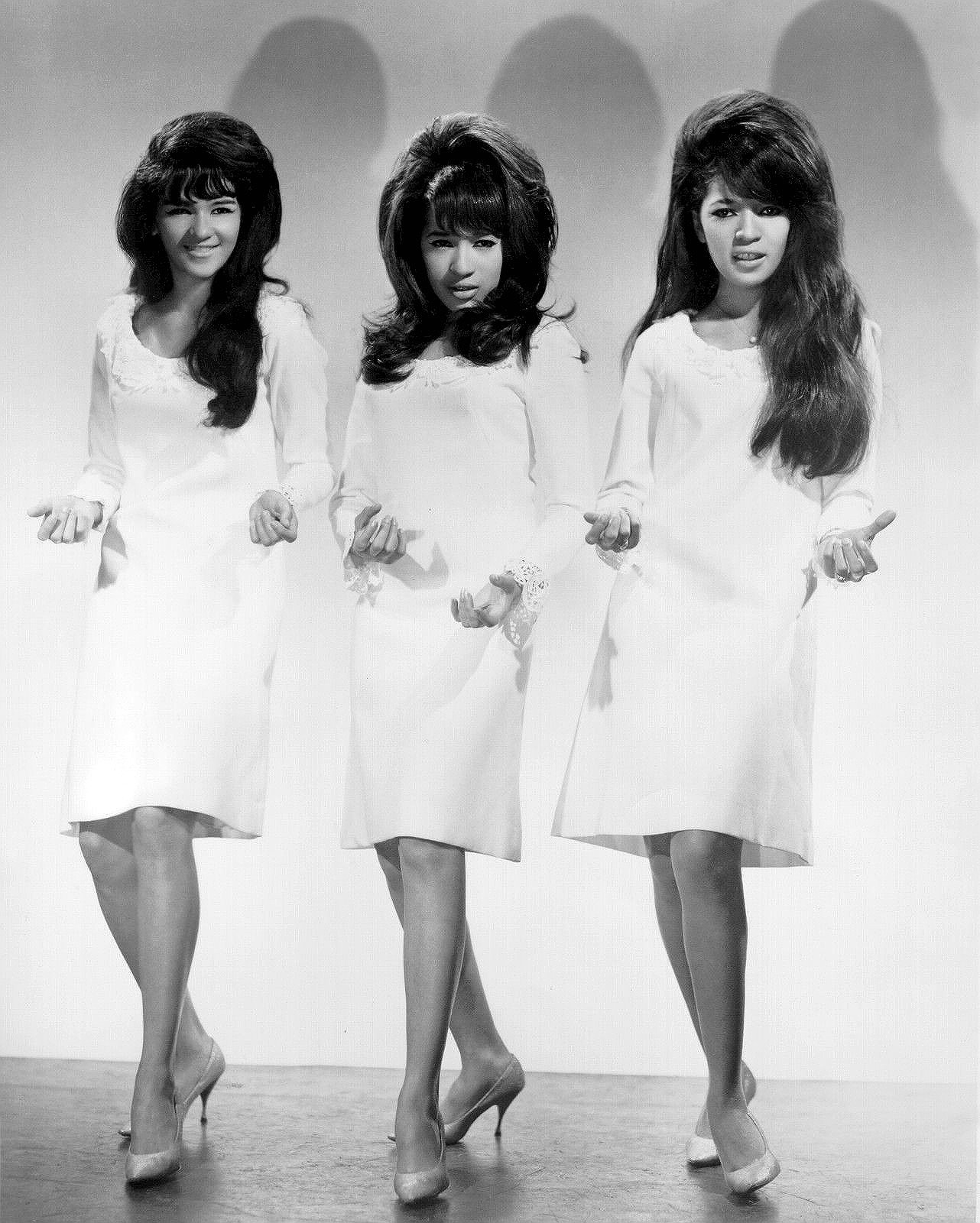
“Be My Baby” was released in August 1963 as the Ronettes’ debut single on Philles Records. It rose quickly, reaching number two on the Billboard Hot 100 in the United States and number four in the United Kingdom, and it became the group’s biggest hit. It appeared the following year on their only studio album, Presenting the Fabulous Ronettes, released in 1964. The record’s success transformed the group almost overnight. They were no longer a club act from New York; they were stars, with a look as distinctive as their sound. The beehive hair, the heavy eye make-up, the long eyelashes, and the tight skirts slit at the side were modelled, Ronnie later said, on the women of their own neighbourhood, and they gave the Ronettes an image that was tougher, sexier, and more streetwise than that of most girl groups of the time. Other groups wore matching dresses and smiled sweetly. The Ronettes looked as if they had somewhere else to be, and as if they knew more than they were saying.
That image, and that voice, made them favourites among other musicians. The Beatles and the Rolling Stones, who met the Ronettes during their British tours in 1964, were open admirers, and the Ronettes headlined bills over groups who would soon become far more famous than they were. In 1964, the Rolling Stones served as the Ronettes’ opening act on a British tour, a fact that still surprises listeners who think of the Stones only as headliners. The Ronettes’ later singles, including “Baby, I Love You,” “Walking in the Rain,” and “I Can Hear Music,” all reached the charts, and the group placed nine songs on the Billboard Hot 100 in total, six of them in the Top Forty. “Walking in the Rain,” with its opening sound effects of thunder and rain, showed that Spector’s production ideas could be extended beyond the Wall of Sound into something more atmospheric, and it remains one of the group’s most admired records.
The high point of their touring career came in 1966, when the Beatles personally requested that the Ronettes join them on their final American tour. It was, in one sense, the ultimate recognition: the biggest group in the world wanted the Ronettes on their bill. In another sense, it was a painful moment, because Phil Spector refused to allow Ronnie herself to tour with the group, and her cousin Elaine stood in for her on that tour. The decision was a sign of the control Spector was already exercising over Ronnie’s career and personal life, a control that would deepen in the years that followed. The Ronettes broke up in 1967, after a final European tour, and Ronnie married Spector in 1968. She later described the marriage as controlling, and said that Spector forbade her from performing and limited her movements. The marriage ended in divorce in 1974. Spector himself died in January 2021, at the age of eighty-one, after a later life overshadowed by a murder conviction. Those later events do not change what “Be My Baby” is, but they do change how we hear the story behind it: a record about young love, made by a young woman whose own love affair with its producer would become a cautionary tale.
Ronnie Spector’s second act
What makes Ronnie Spector’s story different from many stories of 1960s stars is what happened after the Ronettes ended. She did not disappear. In 1971, she released a single on Apple Records, “Try Some, Buy Some,” written and produced by George Harrison, with a backing band that included Harrison, John Lennon, and Ringo Starr — a measure of the esteem in which the Beatles held her, years after they had first heard “Be My Baby.” The single did not become a major hit, but it marked the beginning of a long, slow return to performing on her own terms. In the mid-1970s, she re-formed a version of the Ronettes with new members, and then began recording as a solo artist. In 1977, she recorded Billy Joel’s “Say Goodbye to Hollywood,” a song Joel had written as a tribute to her, with backing from Bruce Springsteen and the E Street Band.
Her most famous later appearance on another artist’s record came in 1986, when she sang the hook on Eddie Money’s hit “Take Me Home Tonight,” a song that deliberately quoted the chorus of “Be My Baby.” A year later, “Be My Baby” itself reached a new generation when it played over the opening credits of the film Dirty Dancing, a film set in 1963, for which the record was the perfect period signature. The song’s afterlife in films, advertisements, and television programmes has been long, and it has been covered and referenced by countless artists. Brian Wilson of the Beach Boys was famously devoted to it, and Bruce Springsteen and John Lennon both cited it as a formative influence. In 2017, Billboard named “Be My Baby” the greatest girl-group song of all time, a judgement that, whatever one thinks of such lists, captures the record’s standing among critics and musicians alike.
Ronnie Spector continued to perform for decades, releasing the album The Last of the Rock Stars in 2009 and presenting a biographical stage show, Beyond the Beehive, in New York in 2012. She also won, in 2000, after a long legal battle, a landmark court decision in New York that helped veteran artists of the 1950s and 1960s collect past-due royalties on their old recordings — a victory that mattered far beyond her own career, because it set a precedent for other artists who had signed away their rights in an era when young performers had little bargaining power. In 2006, “Be My Baby” was added to the National Recording Registry of the Library of Congress, preserved as a work of historical and cultural significance. In 2007, the Ronettes were inducted into the Rock and Roll Hall of Fame, introduced by Keith Richards. Ronnie Spector died on 12 January 2022, at the age of seventy-eight. The obituaries, almost without exception, led with “Be My Baby,” and they were right to do so. It was the record that defined her, and it was also, in a real sense, the record that defined an era of pop production.
Why the wall still stands
It is worth asking, sixty years on, why “Be My Baby” still sounds so immediate, when so many other records of 1963 sound dated. Part of the answer is technical. Spector’s Wall of Sound, for all its size, was built to survive bad speakers and noisy rooms: because the sound was already dense and blended, it did not fall apart when played on a small radio, the way a more delicate arrangement might. Part of the answer is musical. The song itself, written by Barry, Greenwich, and Spector, is a model of pop economy: a simple, memorable melody, a lyric that says one thing clearly and means it, and a structure that builds and releases tension without ever getting in its own way. And part of the answer is Ronnie Spector’s voice. She sings the song as if she means every word, with a mixture of toughness and vulnerability that no amount of orchestration can fake. The wall is impressive, but it is the voice in front of it that listeners remember.
The Wall of Sound also left a legacy that goes far beyond girl-group pop. Producers in the decades that followed — from Brian Wilson, who tried to outdo Spector with the Beach Boys’ Pet Sounds, to the makers of the dense, layered pop and rock of the 1970s and beyond — all worked in the shadow of “Be My Baby,” whether they acknowledged it or not. The idea that a pop record could be a constructed sound world, built in the studio rather than simply captured from a live performance, began, for most practical purposes, with Spector at Gold Star. Later producers had more tracks, more technology, and more freedom, but they were working with the same basic idea: that the studio itself is an instrument, and that a three-minute record can contain a whole orchestra, a whole room, and a whole feeling, if the producer knows how to put them together.
For the Ronettes themselves, the legacy is more personal. They were three young women from New York who, for a few years, were at the centre of pop music, and who left behind one record that has never really left the culture. Estelle Bennett and Nedra Talley, who did not sing on “Be My Baby” itself, were essential to the group’s live performances, its image, and its later singles, and their contribution should not be reduced to a footnote. But it is Ronnie’s voice, on that one record, that carries the group’s name into every new generation. When a teenager today hears “Be My Baby” for the first time, whether in a film, on a playlist, or on an oldies station, they are hearing, in effect, the same thing that listeners heard in August 1963: a drumbeat, a wall of sound, and a young woman asking, with complete confidence, to be loved. That the record still works, without explanation or apology, is the best measure of what Phil Spector, Jeff Barry, Ellie Greenwich, and, above all, Ronnie Spector achieved in a Hollywood studio in the summer of 1963.
Sources
- “Be My Baby,” chart and recording history — on the August 1963 release, Gold Star Studios, Philles Records, songwriters Jeff Barry, Ellie Greenwich, and Phil Spector, and the number two United States and number four United Kingdom peaks
- Far Out Magazine, “How ‘Be My Baby’ birthed Phil Spector’s ‘Wall of Sound’” — on the full orchestra, the Wrecking Crew, the rehearsals, and the layered, unison method
- Uncut, “The making of The Ronettes’ ‘Be My Baby’: ‘It was pure everything’” — on Ronnie Bennett’s vocal, Jack Nitzsche’s arrangement, Gold Star’s echo chamber, and the August 1963 release
- Best Classic Bands, “Ronnie Spector tributes and obituary” (January 2022) — on the Colpix years, the Peppermint Lounge, the Beatles’ 1966 tour request, “Try Some, Buy Some,” the 2000 royalties decision, the 2006 National Recording Registry listing, and the 2007 Rock and Roll Hall of Fame induction
- Rock and Roll Paradise, “Ronnie Spector” — on the group’s formation, the 1966 tour without Ronnie, the break-up in 1967, and the later solo years
- Behind the Grooves, “On this day in music history: August 1963 — ‘Be My Baby’” — on the Philles debut, the backing singers, the chart peaks, the Grammy Hall of Fame induction in 1999, and the National Recording Registry listing in 2006
Image credit: Image: Ana Madeleine Uribe via Pexels, free licence (thematic female singer in stage light, not a photograph of The Ronettes).
Leave a Reply