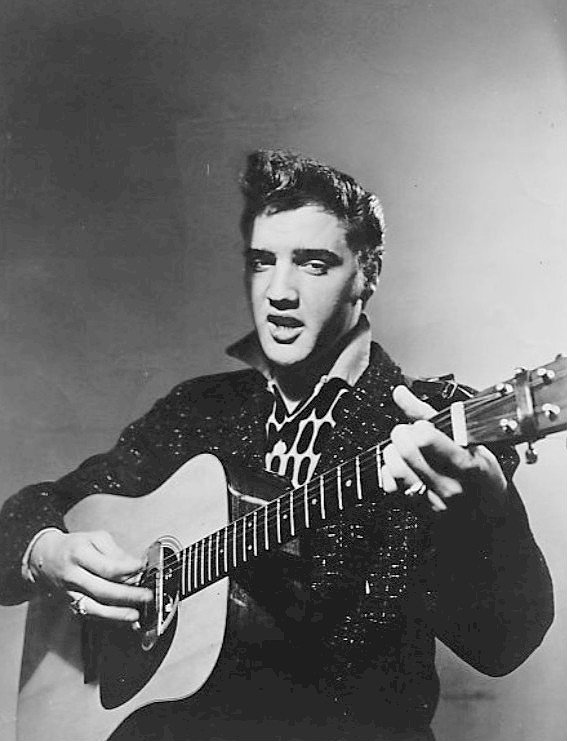
Some Elvis Presley records announce themselves. This one barely raises its voice. Can’t Help Falling in Love lasts less than three minutes, moves at a gentle sway and contains not a single moment of rock and roll swagger, yet it became one of the most durable recordings of his entire career: a wedding standard, a worldwide No. 1, and, in the strangest turn of all, the song he chose to say goodbye with at the end of almost every concert he gave for the last eight years of his life. It began, improbably, in eighteenth-century France, was written for a woman’s voice, and was nearly rejected by almost everyone around him — except Elvis himself.
A French Romance, Written for a Woman
The melody is far older than rock and roll. It comes from Plaisir d’amour, a popular French love song composed in 1784 by Jean-Paul-Égide Martini, who set a poem by Jean-Pierre Claris de Florian, taken from Florian’s novella Célestine. The title means “the pleasure of love,” and the original lyric is bittersweet: it celebrates love while warning how quickly a lover can leave. The tune survived for well over a century and a half, sung in drawing rooms long before anyone thought of a recording studio.
In 1961, the songwriting partners Hugo Peretti and Luigi Creatore and their collaborator George David Weiss were asked to reshape that melody for Elvis’s new film, Blue Hawaii. Published by Gladys Music, Presley’s own publishing company, their adaptation kept Martini’s graceful, hymn-like tune and gave it plain, direct English words: wise men, fools rushing in, a river flowing surely to the sea. Crucially, the song was first written from a woman’s point of view, under the title Can’t Help Falling in Love with Him. That origin is still hiding in plain sight in the finished lyric. The first and third lines end on “in” and “sin” — words that were meant to sit alongside “him,” not to rhyme neatly with “you.” When the song was redirected to Elvis, the perspective changed, but the rhymes stayed, and generations of listeners have never minded at all.
Weiss later recalled that the demo met a wall of resistance. Neither the film’s producers nor Elvis’s own associates liked the song, finding it, in effect, too slow and too soft for the King of Rock and Roll. Elvis disagreed, and insisted on recording it for the film. It was a characteristic piece of judgement. Throughout his career Presley’s instincts about ballads — about when to drop the volume and simply sing — were among his sharpest musical gifts, and rarely were they proved more completely right.
Twenty-Nine Takes at Radio Recorders
Elvis recorded Can’t Help Falling in Love on 23 March 1961, the final day of the Blue Hawaii soundtrack sessions, at Radio Recorders in Hollywood. The sessions had run from 21 to 23 March, and the ballad was saved for last. Around him sat one of the finest assemblies of musicians ever gathered on an Elvis record: guitarists Scotty Moore and Hank Garland, bassist Bob Moore, drummers D. J. Fontana and Hal Blaine, saxophonist Boots Randolph, pedal steel guitarist Alvino Rey, George Fields on harmonica, Freddie Tavares on ukulele and Dudley Brooks on celesta, with backing vocals from the Jordanaires.

Nothing about the performance is casual. Presley worked through twenty-nine takes before he was satisfied with his vocal — session authority Ernst Jorgensen has suggested that the ambition and concentration behind that marathon effort showed how seriously he took the beautiful, intimate ballad. You can hear the care in the result. Elvis sings at half volume, close and unforced, letting the melody do the work, while the arrangement swells almost imperceptibly behind him from a delicate opening to a full, warm backing. The film version of the song is slightly shorter than the single; the record-buying public would get the full performance, all two minutes and fifty-nine seconds of it.
In the film itself, the scene is disarmingly simple. Presley’s character, Chadwick Gates, presents his girlfriend’s grandmother with a music box for her birthday. She opens it, its little tune tinkles, and Elvis takes over the melody and sings the song to her, the accompaniment growing from that tiny mechanical music box into the full studio arrangement. Placed inside a frothy, sunlit musical comedy, the moment lands with a sincerity the rest of Blue Hawaii rarely attempts — a young man back from the Army, crooning an old French tune to an old lady in Hawaii.
The Album That Would Not Let Go of the Charts
The Blue Hawaii soundtrack album was released on 20 October 1961, carrying fourteen songs — more than any other Elvis soundtrack. It became a phenomenon in its own right, spending twenty weeks at No. 1 on Billboard’s album chart in the United States and thirty-nine weeks in the Top 10, while the film became Presley’s biggest box-office success of the era and set the template for the musical comedies that would fill much of his decade.
A month after the album, on 21 November 1961, RCA Victor pulled two of its tracks out as a single: Can’t Help Falling in Love, backed with the cheerful rocker Rock-A-Hula Baby. In America the ballad climbed to No. 2 on the Billboard Hot 100, held off the top only by Joey Dee and the Starliters’ Peppermint Twist, and spent six weeks at No. 1 on Billboard’s Adult Contemporary chart. In Britain it did even better, topping the UK Singles Chart for four weeks in early 1962. The single went on to be certified Platinum in the United States for sales of more than a million copies. The song the professionals had dismissed as too soft had outsung nearly everything else Elvis released that year.

The Song That Learned to Say Goodbye
The most remarkable chapter came years later. When Presley returned to live performing at the end of the 1960s, he rebuilt his concerts around energy and spectacle — and then, night after night, he ended them with this quiet ballad from a 1961 film soundtrack. During his late-1960s and 1970s performances, Can’t Help Falling in Love served as the show’s finale, the signal that the evening was over. He had already sung it in the live segment of his 1968 NBC television special Elvis, and from his 1969 return to the stage until 1977 it closed nearly every concert he gave.
Its biggest audience came on 14 January 1973, when Aloha from Hawaii via Satellite beamed Presley, in his white American Eagle jumpsuit, from Honolulu to viewers around the world. After the triumphs of that set, he closed, inevitably, with Can’t Help Falling in Love, spreading his cape as the final chords played. Four years later the song acquired its heaviest meaning. A faster-arranged version closed his final television special, Elvis in Concert, and on 26 June 1977, at Market Square Arena in Indianapolis, Can’t Help Falling in Love was the last song Elvis Presley ever performed live. The gentle love song had become, by repetition and by fate, his farewell to the stage.
Listening Back
The song never really went away. Other singers had taken it up within months of Elvis’s release, and in 1993 the British group UB40 carried their reggae version, retitled (I Can’t Help) Falling in Love with You, to No. 1 in both the United States and Britain — proving that Martini’s 1784 melody could top the charts in a third century. Surveys still rank Elvis’s original among the most chosen first-dance songs at weddings, and Rolling Stone placed it in its list of the greatest songs of all time.
What endures is the restraint. There is no trick to Can’t Help Falling in Love, no vocal acrobatics and no lyrical cleverness — just a 177-year-old French melody, a lyric simple enough for a music box, and a singer wise enough to take twenty-nine takes to get quiet right. Wise men say only fools rush in. Elvis, for once, was in no hurry at all, and the song has been in no hurry to leave ever since.
Leave a Reply