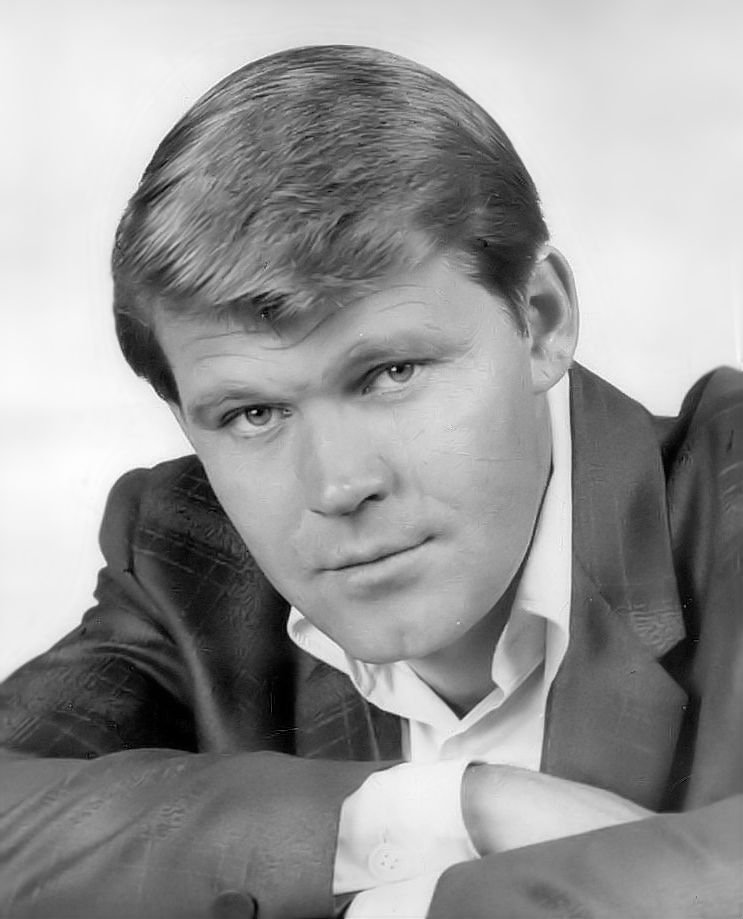
In the last week of February 1969, American radio was full of the war. The fighting in Vietnam led the news every night, and the pop charts carried the tension in coded forms — in protest records, in escapist ones, in the strange new seriousness of country music crossing over. Into that moment stepped Glen Campbell, the clean-cut host of a hit television variety show, singing a bright, striding song about a soldier cleaning his gun and dreaming of a girl in a Texas beach town. Galveston sounded like sunshine. People who listened closely to the words heard something else entirely, and the argument over what the song actually meant — protest or patriotism, lament or celebration — has followed it for more than fifty years.
A Song From the Beach at Galveston
The writer was Jimmy Webb, the Oklahoma songwriter who had already given Campbell two of the defining records of his career: By the Time I Get to Phoenix in 1967 and Wichita Lineman in 1968. Webb knew Galveston from childhood — he had visited the Gulf Coast resort town with his father, a Baptist minister — and he built the song around a young soldier waiting to go into battle, thinking of the woman he loves and the sea wind of home. The war is never named. It did not need to be: in 1968, there was only one war a young American soldier could be caught up in, and Webb later said plainly that the character was a man involved in a war, realising he would rather be somewhere else.
Webb’s song was not written as a Campbell record, and Campbell was not the first to sing it. The first release came in 1968 from the Hawaiian entertainer Don Ho, who recorded Galveston as a slow, mournful ballad and saw it issued, almost invisibly, as the B-side of a single called Has Anybody Lost a Love. Ho’s version keeps the song’s darkest verse: the soldier wonders if she could forget him, and admits he would go home if they would let him — put down his gun, and go to Galveston. As a piece of writing it is close to a desertion fantasy set to music, and in 1968 almost nobody heard it.
The Tape Ho Handed Over
The song reached Campbell through television. Don Ho appeared as a guest on The Glen Campbell Goodtime Hour, Campbell’s new CBS variety series, and introduced him to Galveston there. By the frequently retold account, Ho handed Campbell his record with a shrug: he had had no luck with it; maybe Campbell would. It was an extraordinary gift. Campbell was, at that moment, perhaps the most complete musician in American popular music — a former member of the Wrecking Crew, the Los Angeles session elite, who had played guitar on records by Frank Sinatra, the Beach Boys and Phil Spector before becoming a star in his own right — and he had built his solo breakthrough almost entirely on his ability to hear what Jimmy Webb’s songs could become.
What Galveston became, in Campbell’s hands, was faster and brighter. Where Ho had sung it as a lament, Campbell drove it forward at an up-tempo stride, and one crucial verse was rewritten. The soldier who wanted to put down his gun disappeared. In his place came the lines everyone now knows: he still hears the sea waves crashing, watches the cannons flashing, cleans his gun, and dreams of Galveston. The homesickness survived; the refusal did not. Webb himself adopted the revised verse in his own later performances and on his 1972 album Letters — the rewrite had become the song.

Two Sessions at Capitol
Campbell recorded Galveston at Capitol Studios in Hollywood across two sessions, on 27 November 1968 and 9 January 1969, with producer Al De Lory — who also arranged and conducted the record — and with members of the Wrecking Crew behind him, the same fraternity of session players Campbell had belonged to for years. The surviving union contract sheet reads like a roll of honour of Los Angeles studio craft, with bassist Joe Osborn and a young Leon Russell among the musicians in the room. The result lasts two minutes and thirty-nine seconds and wastes none of them: strings surging like weather off the Gulf, Campbell’s tenor riding on top, clear and untroubled, singing a frightened man’s daydream as if it were a homecoming parade.
The single’s flip side underlined how casual Capitol could be about a future standard: the B-side was a novelty trifle called How Come Every Time I Itch I Wind Up Scratchin’ You. Nobody remembers it, which is its own comment on how completely the A-side swallowed it. Nor was the record a one-man performance in any meaningful sense. Campbell, who had spent the first half of the decade as one of the most in-demand guitarists in Los Angeles, was now fronting his old colleagues — and De Lory’s arrangement gave the Wrecking Crew’s strings-and-rhythm machinery a melody strong enough to carry the whole apparatus at speed. The record’s brightness is a studio construction, as deliberate in its way as anything Phil Spector ever built at Gold Star.
Capitol released the single on 24 February 1969, and the record completed Webb and Campbell’s accidental trilogy of place-name hits. It reached No. 1 on the country chart, where it stayed for three weeks, No. 1 on the Easy Listening chart, and No. 4 on the Billboard Hot 100, as well as No. 14 in Britain; the RIAA certified it gold in October 1969, and the album named after it topped the country albums chart. Campbell’s original promotional film pushed the soldier story into plain sight — he performed the song dressed in a military-style outfit — and within a year, Rolling Stone later noted, recordings of Galveston had sold some six million copies across versions by twenty-seven different artists, from country star Faron Young to jazz trumpeter Dizzy Gillespie.

Protest Song or Patriotic Song?
The dispute began immediately. Listeners who attended to the lyric heard a Vietnam protest song wearing a smile: a conscript-age narrator counting the waves and the cannon fire, measuring the distance between where he is and where he belongs. Campbell’s presentation argued the opposite — the brisk tempo, the gleaming arrangement, the uniform in the promo film. Webb spent decades politely objecting to the patriotic reading of his song. Demonstrating it at a WFUV event in New York in 2010, he played his own slow, grieving version and joked about Campbell’s — “let’s all go to war” — before giving his settled verdict: if there was a statement, it was not anti-war exactly; it was about an individual getting involved in a war and realising he would rather be somewhere else.
That ambiguity is precisely why the record endured where louder protest songs dated. Galveston contains both Americas of 1969 at once: the country that sent the soldier and the soldier who dreams of the beach. Country audiences, pop audiences and easy-listening audiences could each claim it, and each did — a sweep across three charts that few records of the era matched. In 2003, CMT ranked it No. 8 in its list of the 100 Greatest Songs in Country Music, and Rolling Stone marked its fiftieth anniversary in 2019 with a history of the album it named.
Campbell sang the song for the rest of his life, through the Goodtime Hour years, the Rhinestone Cowboy comeback, and into his final tours. It remains the sunniest-sounding war song in the American catalogue — a two-minute-and-thirty-nine-second postcard from a man standing in a war zone, cleaning his weapon, listening in his head for the sea. Jimmy Webb wrote a homesick soldier. Don Ho sang him first, slowly and sadly. Glen Campbell put a marching beat under him and sent him everywhere — and the argument about whether he was protesting or saluting has never quite been settled, because in the record, wonderfully, he is doing both.
Leave a Reply