
Most artists get a final top ten hit by accident. Pat Benatar got hers from a film almost nobody went to see. In the summer of 1985, Invincible — written by Holly Knight and Simon Climie, produced by Mike Chapman, and recorded as the theme to The Legend of Billie Jean — climbed to number 10 on the Billboard Hot 100 while the movie itself was quietly failing at the box office. It was Benatar’s fourth American top ten single, and although she could not have known it, it was also her last. The film took decades to be rediscovered as a cult favourite. The song never needed rediscovering. It simply stayed on the radio, a four-minute act of defiance that outran the movie it was built to serve.
A Heroine Who Needed an Anthem
The Legend of Billie Jean, directed by Matthew Robbins, was a youth-rebellion drama with its heart in the right place: Helen Slater plays a Florida teenager who, cheated out of the money to repair her brother’s vandalised scooter and hounded by the police after a confrontation turns violent, cuts her hair, takes to the road and becomes an accidental outlaw heroine — a self-styled Joan of Arc — to every kid watching the news. The filmmakers needed a theme song that could carry the film’s whole argument — that being young, female and cornered did not mean being powerless — and they needed a singer who could make the word “invincible” sound like a fact rather than a boast. In 1985, there was exactly one obvious candidate. Benatar had already spent half a decade as rock’s reigning voice of female defiance, and her previous signature anthem, Love Is a Battlefield, had done precisely this job two years earlier.
That song’s co-writer was the link. Holly Knight, who had written Love Is a Battlefield with Mike Chapman, now teamed with British songwriter Simon Climie to write Invincible. Knight was becoming the era’s specialist in exactly this assignment: she had also co-written Better Be Good to Me, the defiant hit that powered Tina Turner’s comeback the year before, and she knew how to construct an anthem that a woman could sing as testimony rather than decoration. Climie, the junior partner, would go on to form Climie Fisher and write hits of his own. Together they understood the instrument they were writing for — verses kept low and controlled, the chorus engineered as a release, so that Benatar’s voice could do the escalating. Around her, Benatar’s career was at an interesting crossroads: her 1984 album Tropico had steered into polished pop and given her the gentler hit We Belong, and her label wanted the rock singer back without losing the pop audience. A movie anthem, done properly, could be both. She came to the assignment with a streak nobody else in rock could match: she had won the Grammy for Best Female Rock Vocal Performance four years running — for Crimes of Passion, Fire and Ice, Shadows of the Night and Love Is a Battlefield. Whatever Invincible turned out to be, it would be sung by the most decorated rock vocalist of the decade’s first half, in the middle of her prime.
Mike Chapman’s Big Room
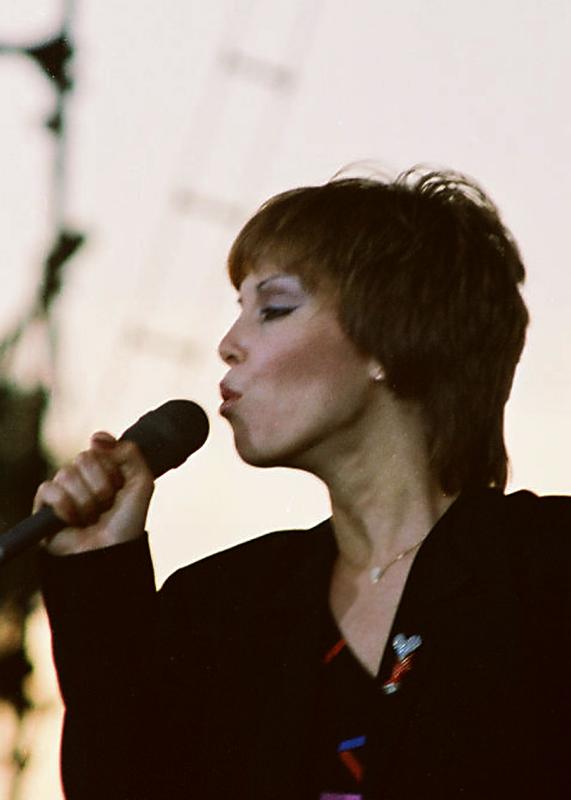
To produce it, Benatar turned to Mike Chapman himself — Knight’s old collaborator and one of the defining hitmakers of the era, the man behind records by Blondie, the Sweet and the Knack. Chapman built Invincible at arena scale: huge gated drums, banks of synthesizers under Neil Giraldo’s guitar, and a chorus mixed to sound like it was already echoing around a stadium. It also suited the singer’s peculiar equipment. Benatar was a classically trained vocalist who had abandoned a path toward opera training for rock clubs, and the song exploits the full architecture of that voice — conversational and almost restrained in the verses, then opening into the kind of clarion high register that no amount of studio armour could restrain. It clocked in at four and a half minutes on the album and was trimmed to four for the single, whose B-side, in a neat eighties touch, was an instrumental version of the song itself. When Seven the Hard Way followed in the autumn, reviews were mixed and sales were slower than the blockbusters of 1980–81 — but the album still went gold, and it was the film song, its lead single, that carried it there.
Chrysalis released Invincible on June 24, 1985, ahead of the film’s July opening and months ahead of the album it would anchor, Seven the Hard Way, Benatar’s sixth. The Marty Callner-directed video put Benatar’s performance alongside footage from the film, which is how most of America met Billie Jean — not in cinemas, but in four-minute bursts on MTV, standing next to a singer who looked entirely plausible as the heroine’s older, undefeated self. The channel owed her something, too: when MTV launched in August 1981, the second video it ever broadcast was Benatar’s You Better Run. Four years on, she remained one of the network’s defining faces, and Invincible — a performance clip with a movie folded inside it — was precisely the hybrid form the channel existed to circulate. The film’s producers were, in effect, renting the credibility she had spent six years building, one video at a time.
Number 10, and the Last of Them
The chart run tells the story of the song escaping its assignment. Invincible rose steadily through the summer and on September 14, 1985 reached number 10 on the Hot 100. It did even better on rock radio, reaching number 4 on the Mainstream Rock chart, hit number 6 in Canada, and picked up a Grammy nomination for Best Female Rock Vocal Performance — a category Benatar had already won four years running at the start of the decade. It was her fourth top ten hit in America, following Hit Me with Your Best Shot, Love Is a Battlefield and We Belong. It was also, though the eighties still had half their course to run, her final one. The follow-ups from Seven the Hard Way and its successors charted respectably, but the top ten door had closed behind the movie theme.
The film, meanwhile, disappeared — a modest box-office performer that critics dismissed. What saved its memory, and intertwined it permanently with the song, was cable television, where The Legend of Billie Jean rotated for years and gathered the audience it had missed in theatres. Generations of viewers who never bought a ticket grew up with Slater’s cropped hair and Benatar’s chorus as a single memory: the song and the heroine endorsing each other. Slater herself has said the song takes her straight back to the film; fans of the movie, who campaigned for decades for its proper home-video release, treat Invincible less as a soundtrack item than as the film’s flag, the four minutes in which its whole teenage philosophy is stated without apology.

The Song That Refused to Be a Footnote
Invincible has kept working ever since. It turned up prominently in the 2002 film Hysterical Blindness, earned a permanent place on Benatar compilations beginning with Best Shots, and has been covered by everyone from the Finnish metal band Sinergy to Canadian synthpop artist Ayria — a spread that says something about how the record was built, since the song survives translation into metal, synth and drag-show registers without losing its spine. In a catalogue full of songs about fighting back, it is the one that skips the fight and starts from the victory.
Benatar’s place in rock was eventually formalised with her induction into the Rock and Roll Hall of Fame, alongside Giraldo, in 2022. But the neat summary of her eighties is already there in the summer of 1985: a singer handed a theme song for a film the industry expected little from, who treated it like a title match anyway. Invincible was commissioned to sell somebody else’s story. It ended up stating hers.
Leave a Reply