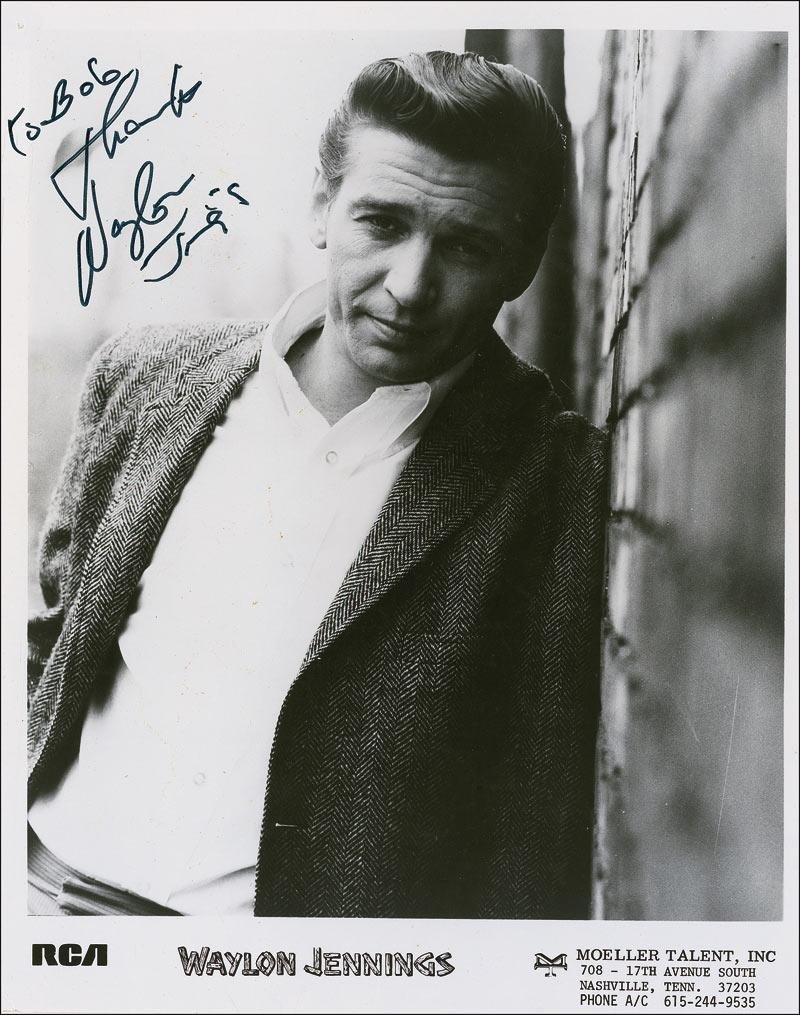
It is the most famous rhetorical question in country music, and Waylon Jennings wrote it on the back of an envelope. By the summer of 1975, Jennings had spent a decade inside the Nashville machine — ten years of producers choosing his songs, session men playing his records, and executives sanding down every rough edge he had. He had fought his way to artistic control, grown the beard, put on the leather vest, and started making records his own way in defiance of the establishment. “Are You Sure Hank Done It This Way” was the moment the rebellion got its thesis statement: a brooding, hypnotic single that name-checked the music’s patron saint, took aim at the rhinestone suits and new shiny cars of 1970s Nashville, and went to No. 1 anyway. Rolling Stone would later call it the closest thing outlaw country has to a mission statement.
The Fight for the Steering Wheel
To understand the song, you have to understand the fight that preceded it. In 1972, Jennings’ manager Neil Reshen renegotiated his RCA contract and won him something almost unheard of for a major-label country artist: complete artistic control over his own records. Jennings began producing himself, working with his own road band instead of the label’s hand-picked session players. When recording at RCA’s Nashville studios with label personnel displeased him, he moved his operation across town to Glaser Sound Studios — a breach of union custom so provocative that RCA initially refused to release the results, before backing down and setting a precedent other artists soon followed.
The records that came out of that freedom — Lonesome, On’ry and Mean, Honky Tonk Heroes, This Time — invented outlaw country as a commercial force. But Jennings was still working inside an industry that rewarded gloss. The frustration that produced “Hank Done It” was not abstract. It was the sound of a man who had won every battle except the one for the soul of the business itself.
Two Kindred Spirits at Glaser Sound
For Dreaming My Dreams, Jennings paired himself with the one Nashville producer whose philosophy matched his own. “Cowboy” Jack Clement was an ex-Marine and former bluegrass sideman who had been Sam Phillips’ right-hand man at Sun Records, working with Johnny Cash and Jerry Lee Lewis when rock and roll was being invented. Clement and Jennings became family as well as collaborators — Clement married Jennings’ sister-in-law — and when Jennings heard songwriter Allen Reynolds singing “Dreaming My Dreams with You” at a demo session in Clement’s orbit, he knew he had found his next album.
The sessions ran at Glaser Sound Studios between February and July 1974. Clement’s approach, as Rich Kienzle later observed in the reissue liner notes, was the opposite of the Nashville formula: he viewed the studio as a painter views a blank canvas, believed even the most whimsical idea was worth trying, and favored recording the singer and musicians together, live in the room, the way Phillips had at Sun. Jennings, who called Clement “a sheer-out genius, all soul,” thrived in it. Dreaming My Dreams is the only album of his career Clement produced, and it shows — a record of uncommon warmth and space, cut by two men who trusted the song more than the system.
An Expression Borrowed from Ernest Tubb’s Band
The song’s title began as backstage slang. Songwriter Billy Ray Reynolds told Jennings about an expression used by Ernest Tubb’s band, the Texas Troubadours: during breaks from the Midnight Jamboree, trudging between Tubb’s Record Shop and the air-conditioned bus, the musicians would ask each other whether “Hank done it this way” — a running joke about how the founding father would have handled the indignities of the road. Driving to the Dreaming My Dreams sessions, with the line in his head and Hank Williams’ influence on his mind, Jennings wrote the lyrics out on an envelope — and recorded the song when he arrived at the studio.
What he wrote distilled everything he felt. The song is built as a weary cross-examination. Its narrator counts up the cost of the road — the years gone, the same old tune fiddled and guitarred into the ground — and keeps returning to the founding father. Hank Williams had done it with a battered guitar and songs that told the truth. The Nashville of 1975, Jennings charged, did it with rhinestone suits and new shiny cars. The title question was never really a question. It was an accusation, aimed at everyone who had traded Williams’ honesty for showroom shine — and, quietly, at Jennings himself, who knew exactly how seductive the shine could be. AllMusic’s Stephen Thomas Erlewine heard the album’s architecture plainly: “Hank Done It” opens Dreaming My Dreams and “Bob Wills Is Still the King” closes it, framing Jennings as the heir apparent to both legacies at once.

A Mission Statement in Three Minutes
What makes the record devastating is its restraint — and its strange construction. Jennings later described it precisely: a relentless four-on-the-floor rhythm, phased guitars and eerie drums; no verse-and-chorus architecture, no fiddle break, no bridge, “nothing but an endless back-and-forth seesaw between two chords.” Clement, mixing while Jennings was away from the studio, pushed the guitars up until the two instruments fused — matching their equalization so you couldn’t tell where one guitar blended into the other, one huge instrument. Jennings came back, listened, and loved it. “It felt like a different music,” he said, “and Outlaw was as good a description as any.” Richie Albright’s drums, Duke Goff’s bass and Ralph Mooney’s steel guitar hold the whole thing at a simmer that never boils — the sound of a man too tired to shout, which is exactly why the question lands like a verdict. Released in August 1975 as the first single from Dreaming My Dreams — paired with “Bob Wills Is Still the King,” his tribute to the other founding father — it climbed to No. 1 on the country chart, Jennings’ third solo chart-topper, and stayed on the chart for sixteen weeks.
The album matched it, topping the country albums chart and going gold, and Jennings was named the Country Music Association’s Male Vocalist of the Year for 1975. Rolling Stone greeted Dreaming My Dreams with immediate acclaim, praising the choice of songs and Jennings’ vocals; the follow-up single, “Dreaming My Dreams with You,” reached the Top 10 and showed the same singer could break your heart as easily as he could indict an industry. Consider the irony he must have savored: the establishment he was attacking handed him its trophies in the same season, because the attack was also the best record in town. And notice the single’s construction — on one side, the tribute to Bob Wills, king of western swing; on the other, the question for Hank Williams. Both founding fathers on one piece of vinyl, and Jennings standing between them, asking the modern business which of the two it thought it was honoring.

The Question That Never Went Away
“Hank Done It” outlived the argument that produced it. Rolling Stone ranked it the 34th greatest country song of all time and called it outlaw country’s mission statement; the album that houses it sits at No. 2 on the magazine’s list of the 100 greatest country albums. Alabama later took their own version back up the charts, and the song became a rite of passage — the one every self-respecting country traditionalist eventually has to stand inside and sing honestly.
The performance above, from the US Festival in 1983, shows Jennings eight years on, singing it to a festival crowd as what it had by then become: not a complaint but a creed. Hank Williams died in the back of a Cadillac on New Year’s Day 1953, twenty-two years before Jennings asked the question. Every generation of country music since has had to answer it — which was, of course, exactly the point of writing it on an envelope and putting it on the radio.
Leave a Reply