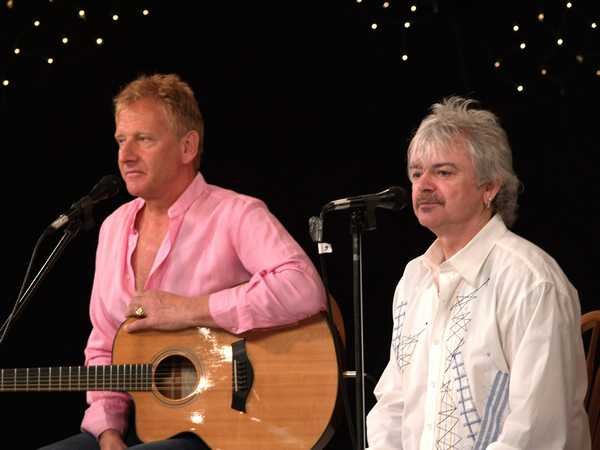
For a few shimmering years in the early eighties, no sound on American radio was more inescapable — or more romantic — than the soaring harmonies of Air Supply. “Lost in Love,” “All Out of Love,” “The One That You Love”: ballad after ballad, they piled up a chart run so remarkable it equalled a record set by the Beatles themselves. Then, almost as quickly, the hits stopped. But here is the part of the story most people miss: Air Supply never went away. Half a century after two strangers met in a Sydney rehearsal room, they are still on stage, still singing, still selling out shows on five continents. This is the untold story of the softest superstars in rock history.
Two Strangers, One Stage, May 12, 1975
Graham Russell was a tall, soft-spoken Englishman with a guitar and a notebook full of songs. Russell Hitchcock was a powerhouse vocalist from Melbourne with a range that seemed to defy physics. On May 12, 1975 — the first day of rehearsals for the Australian production of “Jesus Christ Superstar” in Sydney — their paths crossed, and the two became instant friends, bonding over a shared love of the Beatles. Both, as it happens, had seen the Fab Four perform live in 1964.
Legend has it that their partnership was sealed by a small act of kindness: Hitchcock helped Russell up after he twisted his ankle during rehearsals. Singing together in the chorus by day, they began performing Russell’s songs in Sydney coffee houses by night, and something clicked. Their voices — Russell’s warm, breathy tenor wrapping around Hitchcock’s crystalline high notes — created a blend so distinctive that audiences stopped talking to listen. Air Supply was born, though nobody, least of all the two singers, could have guessed what was coming.
Before America: The Australian Grind
The fairy tale took a while. CBS Records in Australia liked what they heard and signed the duo, and legend has it their first single was cut in a single afternoon — then shot straight to number one on the national charts. That single, “Love and Other Bruises,” announced them at home, and soon they were on the road as the opening act for Rod Stewart, touring Australia and then North America, learning the brutal arithmetic of the music business one half-empty hall at a time.
It was a long apprenticeship. They returned to Australia and made the album “Life Support,” which contained “Lost in Love” — the fifteen-minute miracle Russell had written on retreat. In Australia it was a solid top-ten hit, but America might never have heard it if a copy had not landed on Clive Davis’s desk. The grind taught them something that would serve them for fifty years: how to win over a room, any room, with nothing but two voices and a guitar. When the world finally called, they were ready.
The Demo That Travelled to Clive Davis’s Desk
Back in Australia, the duo ground it out the hard way: touring as Rod Stewart’s opening act across Australia and North America, then returning home to record. Their single “Love and Other Bruises” shot to number one on the Australian charts, recorded, by one account, in a single afternoon. An album, “Life Support,” followed, containing a song Russell had written during a songwriting retreat in rural South Australia — a time of genuine hardship, with touring work dried up and money short. He sat down alone, and “Lost in Love” poured out of him in about fifteen minutes.
The single went top ten in Australia. And then, by the kind of luck that changes lives, a copy found its way to the desk of Clive Davis, the legendary Arista Records chief who had launched Barry Manilow and would soon launch Whitney Houston. Davis heard it, flew to see the duo, and signed them on the spot. Arista remixed “Lost in Love” for the American market, and in 1980 it became, in the band’s official history, the fastest-selling single in the world, climbing to number three on the Billboard Hot 100. The soft-rock era had found its standard-bearers.
The Line Clive Davis Rewrote
“All Out of Love,” the follow-up, had already been a hit in Australia two years earlier — but not quite the version the world would come to know. Davis listened to Russell’s original lyric and winced at one line. Where American ears would eventually hear the desperate plea of a man at the end of his rope, the Australian original had Russell singing an odd, almost menacing phrase: he wanted, he explained, to “arrest” his lover’s attention. In Australia, nobody had questioned it. Davis was blunt: in America, they would not understand it. “Arrest” was not a poetic word.
At Davis’s insistence, the line became the now-immortal “I’m so lost without you” — and Davis took a co-writing credit for the surgical fix. The reworked single shot to number two in the United States, held off the top only by a Diana Ross song and Queen’s “Another One Bites the Dust.” It also set a remarkable record: Hitchcock’s sustained final note, held for 16.2 seconds, was at the time the longest-held single note by a male singer on a hit record. The song has since logged more than three million confirmed American radio performances — twelve million minutes of airtime and counting.
Seven Top Fives and a Tie With the Beatles
What happened next remains one of the great chart feats in pop history. Beginning with “Lost in Love,” Air Supply racked up seven consecutive American top-five singles in just over two years: “Lost in Love” at number three, “All Out of Love” at number two, “Every Woman in the World” at number five, “The One That You Love” — their sole American chart-topper — at number one in 1981, “Here I Am” at number five, “Sweet Dreams” at number five, and “Even the Nights Are Better” at number five. Seven straight top fives: at the time, that equalled the Beatles’ run of consecutive top-five singles.
Think about that for a moment. Two former chorus boys from a Sydney stage musical, standing shoulder to shoulder in the record books with the biggest band of all time. Their albums “Lost in Love,” “The One That You Love,” and “Now & Forever” sold tens of millions of copies, and “Lost in Love” was named Song of the Year for 1980.
The Steinman Summit
Then, in 1983, came the grandest ballad of them all. Jim Steinman — the theatrical mastermind behind Meat Loaf’s “Bat Out of Hell” — had written a seven-minute epic called “Making Love Out of Nothing at All.” He had first offered it to Meat Loaf, but fate intervened, and it landed in Air Supply’s lap instead. Steinman produced it himself, all thundering pianos and Wagnerian drama, and Hitchcock sang it like his life depended on it.
The single surged to number two on the American charts — kept from the summit by Bonnie Tyler’s “Total Eclipse of the Heart.” Which Steinman had also written and produced. For one strange, glorious season, Jim Steinman was competing with himself at the very top of the charts, with Air Supply as his second army. It was the duo’s last great American hit, and arguably their most gloriously over-the-top: proof that even at the height of the synth-pop era, there was still room for a power ballad built like a cathedral.
The Voices Behind the Velvet
Part of the magic was the division of labour, and it never changed. Graham Russell wrote nearly everything — the melodies, the words, the ache. Russell Hitchcock sang it, his voice doing things that made other singers shake their heads. Producers learned to simply roll tape and let him go; the classic Air Supply vocal was often captured in a single take, that impossible high register soaring over Russell’s gentle guitar.
They were never cool, and they knew it. While their peers chased synthesizers and music-video glamour, Air Supply wore vests and perms and sang about heartbreak with total, unironic sincerity. Critics sneered; millions of listeners wept into their steering wheels. There is a particular kind of courage in refusing to be anything but earnest, and in the early eighties, earnestness sold twenty million albums. Decades later, when irony finally went out of fashion, the sincerity was still there waiting — which may be why those harmonies feel less dated now than so many of the records that once mocked them.
130 Shows a Year, Five Decades On
By the mid-eighties, the American hits dried up as pop pivoted to synths and swagger. But Air Supply did something smarter than chasing trends: they kept touring. And touring. In Asia, Latin America, and the Philippines, their romantic legend only grew — they remain one of the most beloved live acts in those regions, capable of filling arenas decades after their last American hit. In their forty-fifth anniversary year, the duo were still playing more than 130 shows annually across England, Ireland, Israel, Korea, Japan, Canada, and the United States.
They have now charted hits across four decades, and their partnership — fifty years and counting — has lasted more than four times as long as that of their idols, the Beatles. Graham Russell still writes; Russell Hitchcock still hits those notes. Fans who fell in love to “All Out of Love” at their weddings in 1981 now bring their grandchildren to the shows.
Ask anyone who has caught a recent concert what it feels like, and they will tell you the same thing: the years fall away. Hitchcock stalks the stage, pouring that impossible voice into “The One That You Love” while Russell’s guitar chimes beneath him, and for two hours the arena becomes a time machine. No backing tracks, no nostalgia-act autopilot — just two men who have spent half a century learning exactly how to break your heart on cue, and who clearly still love doing it.
There is a lovely symmetry in it. Two young men met by chance in a rehearsal room in Sydney, helped each other up — literally — and went on to prove that the softest sound in rock could also be one of the toughest. The ballads never really went away. They were just waiting for the world to need them again. And judging by those sold-out arenas, the world still does.
The next time those first piano notes begin, do not change the station. Let it play. Some songs are not just hits; they are places we used to live. Air Supply built a whole neighbourhood — and fifty years on, the lights are still on in every window.
Leave a Reply