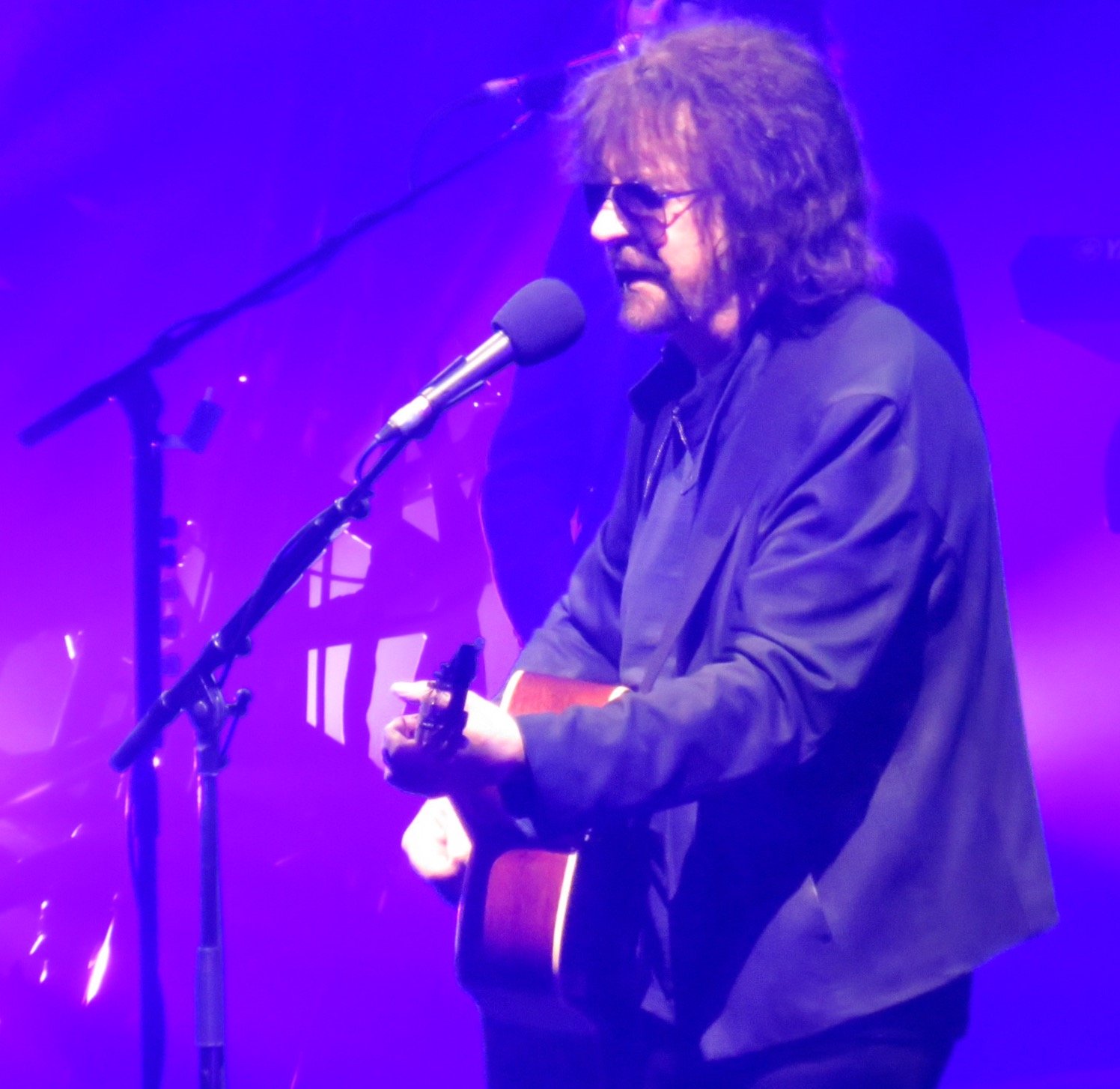
They arrived from Birmingham with cellos and a flying saucer, determined to do what no rock band had dared: pick up where the Beatles left off and bolt a full orchestra onto pop music. Electric Light Orchestra sold fifty million records, filled stadiums beneath a giant glowing spaceship, hid jokes in their grooves, and survived breakups, lawsuits, and a thirty-year silence. At the centre of it all stood one quiet man — Jeff Lynne — who wrote, arranged, produced, and often played nearly everything himself. This is the story of rock’s most ambitious daydream, and the perfectionist who refused to wake up from it.
The Band That Wanted to Finish the Beatles’ Sentence
The idea belonged, at first, to Roy Wood. The flamboyant frontman of the Move had grown restless with three-chord rock and dreamed of a new kind of group: a ten-piece ensemble with cellos, violins, and French horns playing symphonic rock. As Jeff Lynne later put it, the Electric Light Orchestra was meant to take up where “I Am the Walrus” left off — to carry the Beatles’ orchestral experiments into a full-time band. In 1970, Wood persuaded his old friend Lynne to join the Move, and together with drummer Bev Bevan they began building their strange new machine on the side, financing it with the Move’s final records.
ELO’s debut album appeared at the end of 1971, and the single “10538 Overture” hinted at the grandeur to come. But the partnership was already fracturing. Within a week of that single’s release in the summer of 1972, Wood walked out to form Wizzard, taking his wildest instincts with him. Some said he resented the attention shifting toward Lynne; Wood himself said the band had finally started to sound the way he had always wanted it to. Either way, Lynne was suddenly the sole captain of the spaceship — and he would remain so, writing, arranging, and producing virtually every note the band ever released, for the next fifty years.
The Dreamer of Eldorado
By 1974, Lynne was ready to make good on the band’s founding promise. “Eldorado” was ELO’s first true concept album — the story of a Walter Mitty-like dreamer who escapes his dull life through fantasy — and, crucially, the first ELO record to use a real orchestra instead of Lynne’s painstaking string overdubs. Hiring thirty-odd classical musicians was a gamble for a rock band, but the result was ravishing: layers of strings wrapping around Lynne’s Beatlesque melodies like velvet.
The album gave ELO their first American top-ten single, “Can’t Get It Out of My Head,” and proved the formula could conquer the world’s biggest market. From here on, there would be no more pretending — ELO were not a rock band with strings attached. They were the thing Roy Wood had dreamed of in the first place: a genuine electric light orchestra. The spaceship was finally, fully built.
The Swiss Chalet Fortnight
By 1977, ELO were huge, but Lynne was exhausted and creatively stuck. His manager booked him into a chalet in the Swiss mountains with one instruction: write. What happened next is the stuff of pop legend. After days of rain, Lynne woke one morning to find the sun blazing across the mountains — and “Mr. Blue Sky” poured out of him. Duly inspired, he wrote a new song every single day for the next two weeks. On May 22, the band entered Musicland Studios in Munich and recorded the double album “Out of the Blue,” the record that would become ELO’s commercial Everest.
The album’s centrepiece was the eighteen-minute “Concerto for a Rainy Day,” a four-song suite about weather that ends with “Mr. Blue Sky” — the sun breaking through, musically and literally. The 1978 tour that followed was pure theatre: the band performed inside a gigantic glowing spaceship, complete with laser beams and a hydraulic stage, one of the most spectacular productions rock had ever seen. Audiences did not just hear ELO; they boarded the craft. “Out of the Blue” sold millions, and “Mr. Blue Sky” became the band’s eternal calling card — later even chosen as a wake-up call for astronauts aboard the final mission of the Space Shuttle Atlantis.
“Bruce!” — Rock’s Most Famous Misheard Lyric
In 1979, with the “Discovery” album nearly finished, Lynne felt there were not enough loud songs on it. At the last minute, he knocked out “Don’t Bring Me Down” — a galloping ball of distortion built on a sped-up drum loop, with no string section at all, a first for the band. He played every instrument himself. And in the chorus, after the title line, he shouted a nonsense syllable to fill a gap in the vocals: “groose.”
Millions of listeners heard something else entirely: “Bruce!” Who was Bruce? Nobody knew, and that was the point — there was no Bruce. The engineer, German-born Reinhold Mack, told Lynne the made-up word sounded like “Gruss,” the German word for “greetings,” and Lynne decided to keep it. Mack himself later offered a competing origin story: with an Australian tour planned, the song had briefly been titled “Don’t Bring Me Down, Bruce” as a joke about how many Australian men are named Bruce, before “gruss” replaced it. Whatever the truth, the confusion became part of the song’s legend — Lynne eventually started singing “Bruce” at concerts just for fun, and fans roared it back. It remains one of the most beloved mondegreens in rock history, and the single became ELO’s biggest American hit, reaching number four.
Playing Records Backwards — On Purpose
ELO’s relationship with hidden messages began as a headache. After the 1974 album “Eldorado,” Christian fundamentalists accused the band of hiding satanic messages in the music that could be heard when the record was played backwards. Lynne’s response was pure mischief: if they wanted backwards messages, he would give them backwards messages. The next album, “Face the Music” — the title itself a wink — opened with the instrumental “Fire On High,” whose introduction contains a genuine backmasked message, intoned in a heavy masked voice by drummer Bev Bevan: “The music is reversible, but time is not. Turn back! Turn back!”
It was, as Lynne later explained, a joke at the accusers’ expense: those hunting for satanism in the grooves were wasting their time, and they should face the music. He doubled down in 1983 with an entire album titled “Secret Messages,” originally conceived as a double LP and stuffed with backwards jokes — “welcome to the big show,” “thank you for listening,” “you’re playing me backwards.” The censors and crusaders had picked a fight with the wrong perfectionist. He turned their paranoia into a concept album.
The Lawsuits and the Two ELOs
Success on that scale rarely ends tidily, and ELO’s did not. By the mid-eighties, Lynne was burned out. Bassist Kelly Groucutt, unhappy with his royalty payments, sued management and Lynne; the bitter dispute ended with Groucutt out of the band and legally barred from profiting off the ELO name. After the contractual-obligation album “Balance of Power” in 1986, Lynne simply switched the machine off.
Bev Bevan, the drummer who had been there since day one, refused to let the name die. In 1989 he launched ELO Part II, eventually recruiting several former bandmates, and toured the world playing the old hits. Lynne was furious — ELO, he felt, had always been his band — and lawyers circled. The standoff dragged on for a decade until 2000, when Bevan retired and sold his share of the ELO name back to Lynne. The remaining Part II members renamed themselves the Orchestra and carried on without the magic letters. It was a sad, very rock-and-roll coda: the man who played on every ELO record and the man who wrote every ELO song, divided by three letters of the alphabet.
The Wilbury Years
What Lynne did next surprised everyone. Instead of rebuilding ELO, he became the most in-demand producer in rock. It started with George Harrison’s 1987 comeback “Cloud Nine,” which Lynne co-produced to triumphant effect. Hanging around Harrison’s kitchen with Bob Dylan, Roy Orbison, and Tom Petty, the five friends began jamming — and the Traveling Wilburys, the most joyful supergroup in history, was born. Lynne co-wrote and produced their hits, his fingerprints all over that warm, shaggy sound.
The phone kept ringing. He produced Orbison’s “Mystery Girl,” Tom Petty’s “Full Moon Fever,” and Del Shannon’s comeback. Then came the call that stopped time: working with the surviving Beatles on “Free as a Bird” and “Real Love,” building finished songs around John Lennon’s old demos. The boy from Birmingham who had formed a band to continue the Beatles’ work had ended up, quite literally, producing the Beatles. If there is a neater circle in rock history, it is hard to name.
The Over and Out
For years, Lynne insisted ELO was finished. Then, in 2014, he relented — returning as Jeff Lynne’s ELO, the possessive now part of the name to avoid any confusion, and discovering that the world had been waiting. The tours sold out; new albums “Alone in the Universe” and “From Out of Nowhere” proved the old magic still worked; and in 2017 the band entered the Rock and Roll Hall of Fame. There was one heartbreak along the way: Richard Tandy, Lynne’s keyboard foil since 1971 and his closest musical companion, died in May 2024.
And then, the farewell. In the summer of 2025, Jeff Lynne’s ELO played its final concert — July 13 at London’s Hyde Park, closing the “Over and Out” tour before a vast, emotional crowd. Lynne, now in his late seventies, was quick to say this was not a retirement from music, only from the road; the studio, where he has always been happiest, still calls. But as the last notes of “Mr. Blue Sky” rang out over the park, it felt like the end of something enormous: fifty-five years since three young men from Birmingham decided that rock and roll needed cellos.
They were right. It did. And whenever a string section swells beneath a pop chorus today — whenever ambition crashes the three-minute single — the ghost of that spaceship is still flying overhead, lit up and bound for somewhere wonderful.
Fifty-five years on, the numbers tell their own story: more than fifty million records sold, twenty top-forty hits in America and Britain, a catalogue that never seems to age because it was never really of its time in the first place. ELO did not follow trends; they built a world — part rock band, part orchestra, part science-fiction dream — and invited everyone inside. Jeff Lynne’s great trick was making the impossible sound inevitable: of course a cello belongs in a pop song. Of course a spaceship belongs on a stadium stage. Of course a nonsense word can become the most famous lyric you never understood.
The blue sky, in the end, was never really about weather. It was about the belief that pop music could be bigger, stranger, and more beautiful than anyone had dared to imagine — and one quiet man from Birmingham who spent his whole life proving it.
Leave a Reply