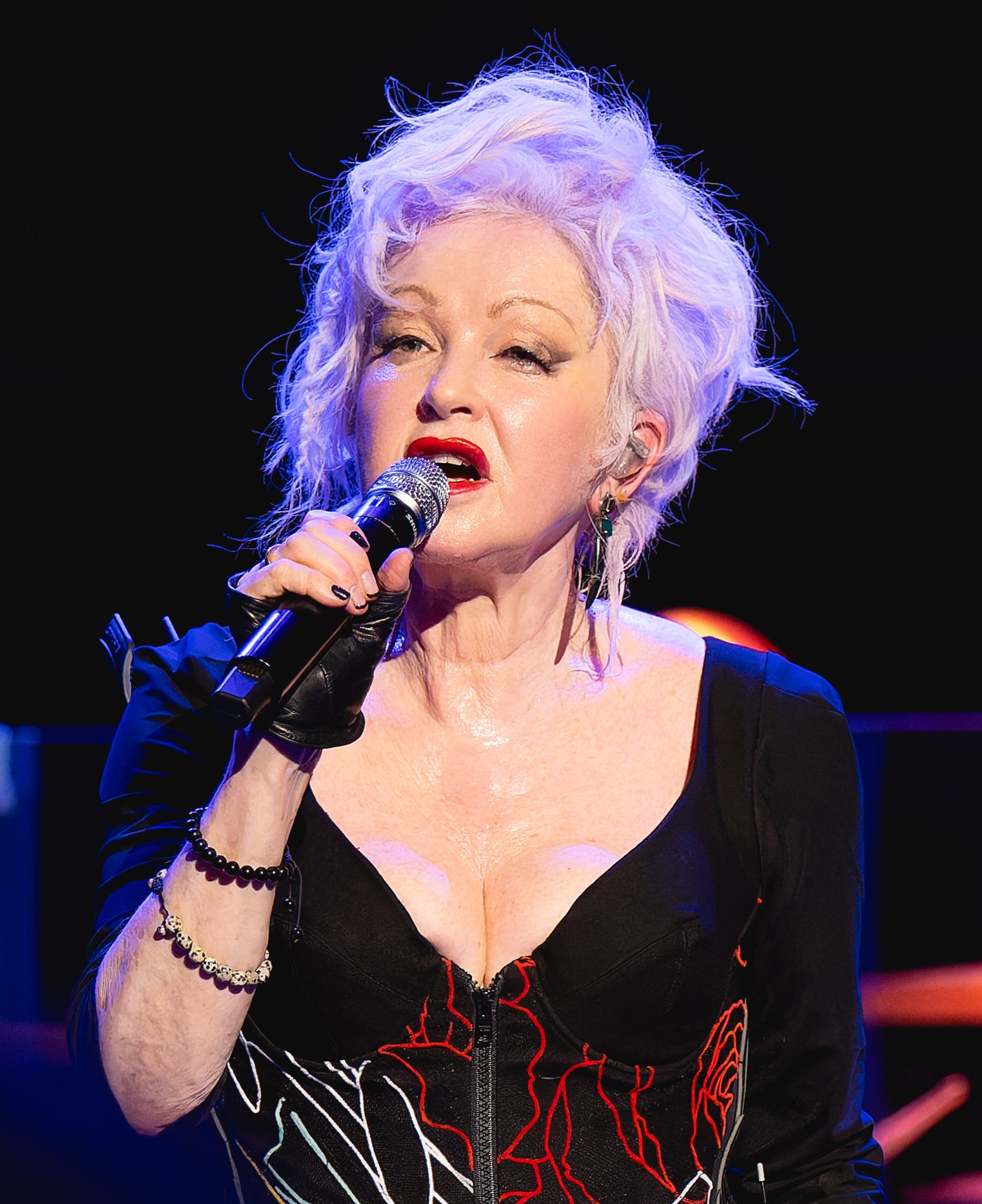
The world met Cyndi Lauper as a burst of neon — orange hair, thrift-store layers, a voice that could shatter glass and mend hearts in the same song. But the neon was never the point. It was armor, and underneath it was a girl from Queens who had learned early that the world is hard on people who don’t fit. Behind the persona stood a woman who had been knocked down more times than most stars are ever tested, who built a thirty-plus-year marriage in a business that eats marriages for breakfast, who became a mother at forty-four, and who turned her fame into a lifeline for the kids the world throws away. The hits made her famous. The heart made her matter.
The Love She Found Off Camera
By 1991, Cyndi Lauper had survived bankruptcy, two vocal collapses, and the pop machine’s first attempt to digest her. She was filming a small movie called “Off and Running” when she met David Thornton, a lanky actor from South Carolina whose father had taught English at Harvard. Thornton was nothing like the music-business men who had managed, dated, and disappointed her. He was quiet, steady, funny in a dry Southern way — and he got her.
They married on November 24, 1991, in a Friends meeting house in New York — a Quaker ceremony, simple and unshowy, about as far from a celebrity wedding as you can get. More than three decades later, they are still together, one of the longest marriages in pop music. Friends say the secret is unglamorous: two people who actually like each other, who give each other room to be themselves. Lauper has said her husband became “the strong arm of the family,” the calm center around which her whirlwind life spins. He loves art and music, though his tastes run more to electronic dance music than to her beloved rock and soul. It works because they never tried to be the same person. They just tried to show up for each other, year after year, while the spotlight swung elsewhere.
Becoming a Mother at Forty-Four
On November 19, 1997, Lauper gave birth to her only child, a son named Declyn Wallace Thornton Lauper. She was forty-four years old, an age when most pop stars are planning farewell tours, not nursery colors. Motherhood rearranged her the way nothing else had — not fame, not bankruptcy, not Broadway.
She has spoken about those early years with the candor that has always been her trademark: the exhaustion, the wonder, the fierce protectiveness, the shock of discovering that the toughest gig of her life wasn’t Broadway or the Grammys but a colicky newborn at 3 a.m. Her son, who now records music under the name Dex Lauper, grew up with a mother who was both a global icon and the woman who made sure he did his homework. In 2013, the family even let cameras in for the reality series “Cyndi Lauper: Still So Unusual,” showing a household that was, for all its fame, remarkably normal — a working musician mom, a steady dad, and a kid trying to find his own way. Lauper once said that becoming a mother taught her what her own mother had gone through raising her. It also gave her a new lens on the work that would define her second act: she was now someone’s mother, and she could not unsee the kids who had no one.
The Mother Who Danced in the Video
If you want to understand Cyndi Lauper’s heart, watch the “Girls Just Want to Have Fun” video again — not the star, but the woman dancing beside her. That was her real mother, Catrine, a woman of Italian descent who had raised three kids through a divorce and hard times in Queens. Lauper didn’t cast an actress to play her mother. She brought her mother.
The two were close in the way that matters: honestly. Catrine had watched her daughter run away at seventeen, go bankrupt at twenty-eight, and become famous at thirty — and she had shown up for all of it, even the music video. When Lauper became a mother herself, she has said, she finally understood the particular heroism of her own mom’s life. Catrine lived to see her daughter win Grammys, Tonys, and Emmys, and to see the grandson she adored. The video’s most joyful image — mother and daughter dancing together in a bedroom — wasn’t staged sentiment. It was a documentary.
The Sister Who Showed Her the Way
Lauper’s devotion to outsiders wasn’t a celebrity cause adopted for good publicity. It was family. Her younger sister Ellen is a lesbian, and Lauper grew up watching someone she loved navigate a world that didn’t always make room for her. The bond between the sisters runs through everything Lauper has done since the eighties.
It also ran through her music. “True Colors,” the ballad that became one of the great LGBTQ anthems, was inspired in part by her close friend Gregory, who died of AIDS-related illness. Lauper has described how the letters poured in after the song’s release in 1986 — letters from gay kids who heard in it permission to be themselves, letters from parents learning to love their children as they were. She kept those letters. They changed her. Where other stars might have accepted the applause and moved on, Lauper started showing up: at Pride marches, at benefits, at the 2006 Gay Games in Chicago, anywhere her presence could tell a scared kid that somebody famous was in their corner. She has called the LGBTQ community her family, and she has shown up for family ever since.
True Colors United
In 2008, Lauper did something few pop stars do: she built an institution. She co-founded True Colors United, a nonprofit devoted to ending homelessness among LGBTQ youth — young people who make up as much as forty percent of the youth homelessness population in America, often because their families rejected them for who they are. Lauper knew that story intimately. She had been the homeless teenager once, sleeping in the woods of Vermont at seventeen after running away from home.
She didn’t lend her name and walk away. She testified before a U.S. Senate subcommittee in 2015, looking senators in the eye and telling them: don’t pray for God to change your kid — pray for God to change your heart so you can love your kid. Under her advocacy, the organization helped secure $167.5 million in new annual federal funding for youth homelessness programs across forty-six communities, and trained close to two thousand shelter providers to care for LGBTQ kids with dignity and competence. For the 4.2 million young Americans who experience homelessness each year, her work has been the difference between a system that sees them and one that doesn’t. And she kept showing up long after the cameras moved on — at the annual “Home for the Holidays” benefit concerts, in meeting after meeting with lawmakers, in the unglamorous grind of nonprofit work that no award show televises.
The Causes She Carried
The throughline of Lauper’s activism has always been the same: stand up for the underdog, especially women. In 1993, she co-wrote “Sally’s Pigeons” for her album “Hat Full of Stars,” a devastating song about a childhood friend who died from a back-alley abortion — putting a human face on the abortion-rights fight years before it was fashionable for pop stars to do so. Decades later, when reproductive rights came under assault again, her old battle cry “Girls Just Want to Have Fun” was reborn on protest signs as “Girls Just Want to Have Fundamental Rights.”
In 2019, the United Nations honored her with the first-ever High Note Global Prize for her humanitarian work, presented at her annual “Home for the Holidays” benefit concert, whose proceeds support True Colors United. Former President Barack Obama had invited her to perform at his inauguration events years earlier, recognizing what the culture had long known: Cyndi Lauper doesn’t just sing about true colors. She shows them. And she has never treated compassion as a brand — it is simply who she became, the girl who ran away at seventeen deciding that no kid should have to run alone.
The Woman Behind the Neon
For all the activism, Lauper never stopped being an artist — or being disarmingly honest about the unglamorous parts of being human. She has spoken openly about living with psoriasis, the chronic skin condition she has battled for years, appearing in national awareness campaigns to tell fellow sufferers they are not alone. It was classic Lauper: the thing most celebrities hide, she turned into a conversation.
Her 2012 memoir laid bare the bankruptcy, the abuse, the vocal collapses, and the sheer stubbornness that carried her through. The 2024 documentary “Let the Canary Sing” let her tell the story in her own voice, with the archival footage to prove it — the thrift-store kid, the bankrupt bar singer, the unlikely Broadway composer. She conquered Broadway with “Kinky Boots,” becoming the first woman to win the Tony for Best Original Score solo. She recorded blues, country, and standards albums on her own terms. In 2024 and 2025, she took the “Girls Just Wanna Have Fun Farewell Tour” around the world — not as a nostalgia act, but as a victory lap, playing to arenas full of fans who had grown up, grown older, and never stopped needing her.
And in November 2025, the Rock and Roll Hall of Fame finally came calling, inducting the girl from Ozone Park who had been told she was too weird for the industry. She had outlasted the industry instead.
Cyndi Lauper’s story was never really about the hair or the hits, though the hits were glorious. It was about a woman who got knocked flat — by poverty, by illness, by a business that tried to sand down her edges — and got up every time with her edges intact. She married for love and stayed married, in a town where forever is usually a publicity cycle. She became a mother and let it crack her open, discovering in her son the same fierce tenderness her own mother had once shown her. And she took the platform fame gave her and handed the microphone to kids sleeping on the street, telling them what she had needed someone to tell her at seventeen: your true colors are beautiful, and you are not alone. The girls just wanted to have fun. The woman made sure everyone else could too. And somewhere tonight, a kid who needed to hear it is still listening.
Leave a Reply