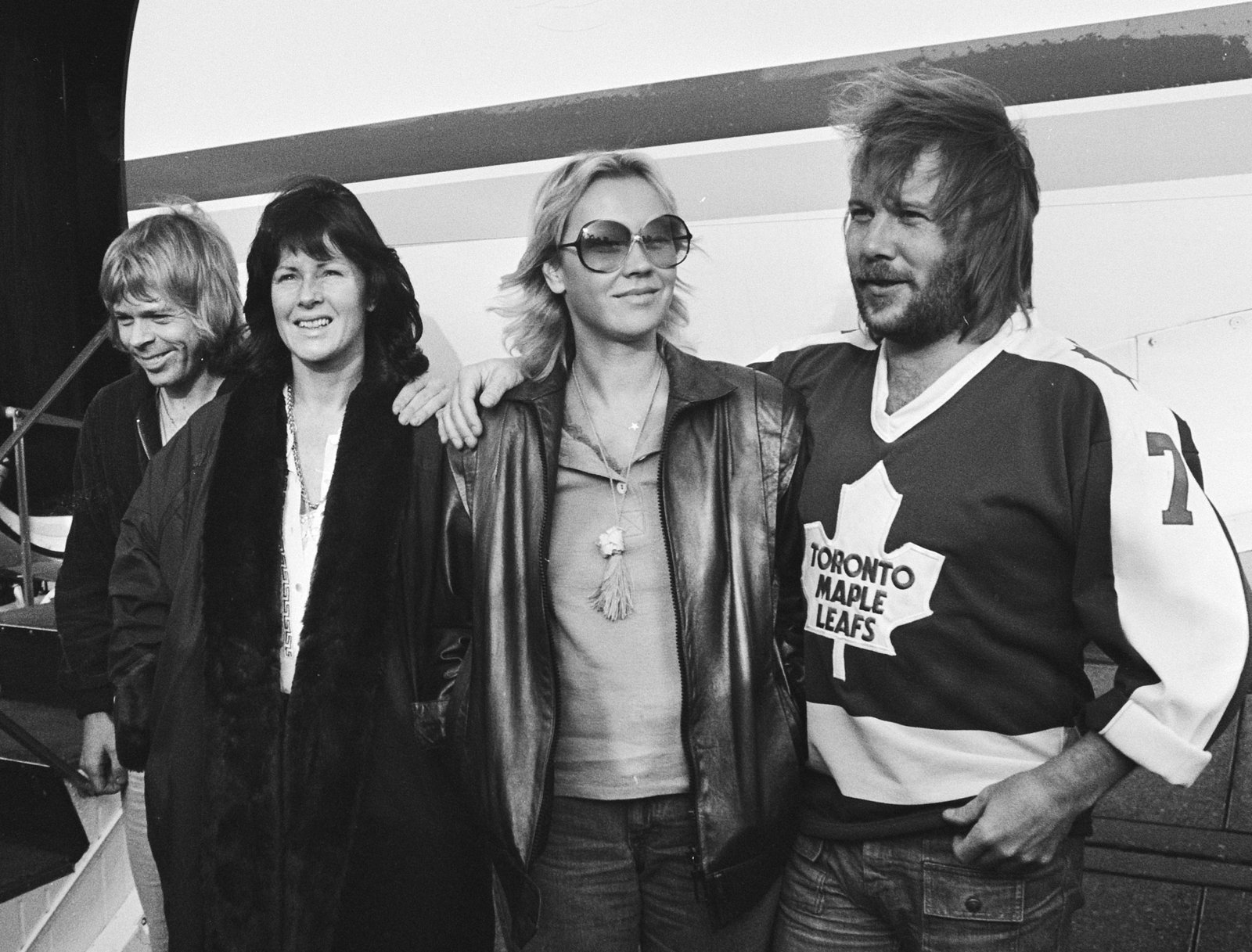
When ABBA stopped, they really stopped. No farewell tour, no press conference, no slow fade into the oldies circuit — just silence, starting in 1982, that would last the better part of forty years. The world assumed the four Swedes had simply retired into their millions. The truth is more interesting, and more human: each of them spent the decades after ABBA building a second life, and those second lives — a princess in the Swiss mountains, a recluse on a Stockholm island, a humanist crusader, a folk-music patriarch — tell you more about who they really are than the sequins ever did.
Frida: The Princess of Zermatt
Anni-Frid Lyngstad’s life reads like a novel nobody would dare to publish as fiction. The war child who became a pop queen kept reaching for happiness after ABBA ended — and kept having it snatched away. In 1992 she married Prince Heinrich Ruzzo Reuss von Plauen, a member of a German princely family, and became, formally, a princess. For a girl born in wartime Norway to a mother who died young and a father she never knew, it must have felt like the fairy tale finally resolving.
Then the tragedies came, one after another. In January 1998, her daughter Ann Lise-Lotte, just 30 years old, was killed in a car accident in the United States. The following year, in October 1999, Prince Heinrich died of lymphoma at 49. Within two years, Frida had lost her child and her husband. She withdrew from public life and later said her faith had helped her carry the unbearable.
What she built afterward is quieter and, in its way, more admirable than pop stardom. Since 1996 she has devoted herself to charity and environmental work. She was a key contributor to the creation of ABBA The Museum, which opened in Stockholm in 2013. Today she lives in the mountain resort town of Zermatt, Switzerland, with her partner Henry Smith, heir to the WHSmith fortune and Viscount Hambleden — and those who know her say she has found, at last, a durable peace. The girl who sang “Fernando” grew up to be a woman who survived everything and chose kindness.
Frida’s Solo Flight
Before the tragedies, there was a bold artistic gamble that deserves its own chapter. In early 1982, with ABBA winding down, Frida decided she wanted to make a record that sounded nothing like ABBA. She had been listening to Phil Collins’ “In the Air Tonight” on repeat for eight months, and she knew exactly who she wanted behind the board. She called Collins herself. He said yes.
The result was “Something’s Going On,” recorded in February and March 1982 at Polar Studios in Stockholm and AIR Studios in London, and released that September. It was harder-edged and rock-oriented, drenched in Collins’ signature gated-reverb drum sound, with all backing vocals sung by Frida and Collins himself. The lead single, “I Know There’s Something Going On” — written by Russ Ballard in about an hour — became a worldwide hit, reaching No. 13 on the Billboard Hot 100, and the album sold over 1.5 million copies, making it the best-selling solo record by any ABBA member. She followed it with “Shine” in 1984, produced by Steve Lillywhite, before stepping away from music to devote herself to family and environmental work.
It was a declaration of independence as much as an album: the “other one,” as she had sometimes felt herself labeled next to Agnetha, proving she could command the international stage alone, on her own terms, in a sound entirely her own.
Agnetha: The Recluse Who Came Back Singing
Agnetha Fältskog, the blonde voice of “Dancing Queen” and “The Winner Takes It All,” did what the world least expected: she disappeared. After ABBA’s quiet dissolution, she released three solo albums between 1983 and 1987, then withdrew almost entirely, living on the island of Ekerö outside Stockholm. Her fear of flying persisted; a stalking incident deepened her seclusion. For years the press called her the Greta Garbo of pop, and she seemed content to let them.
But the voice never left her. In 2004, after sixteen years away from recording, she returned with “My Colouring Book,” a collection of covers. Then, in May 2013, came the real surprise: “A,” her first album of brand-new material since 1987, produced with songwriter Jörgen Elofsson and featuring a duet with Take That’s Gary Barlow, “I Should’ve Followed You Home.” It became her highest-charting solo album ever in the UK, reaching No. 6 — proof, if any were needed, that the instrument was untouched by time.
And then, the impossible: in December 2013, Barlow coaxed her onto a live stage for the first time in twenty-five years, at the BBC’s Children in Need Rocks benefit at London’s Eventim Apollo. Twenty-five years of silence, broken for charity. It was the most Agnetha gesture imaginable — no comeback tour, no fanfare, just one night, for a good cause, and then back to the island. In 2023, “A+” reimagined the album for a new generation. She remains, on her own terms, exactly who she always was: the private soul with the public voice — the woman who walked away from the biggest band in the world, survived its glare and its aftermath, and never once looked like she regretted it.
Björn: The Humanist
Björn Ulvaeus took the strangest second act of all: he became a public intellectual. The man who wrote the lyrics to “Mamma Mia” is also one of Sweden’s most prominent atheists and humanists — a member of Humanisterna, the Swedish Humanist Association, awarded its Hedenius Prize in 2006 for his outspoken defense of reason, science, and the separation of church and state. He has debated religion on television, campaigned for a cashless society, and argued, with characteristic bluntness, that the world would be better with less religion in it.
His musical second act was just as substantial. With Benny, he wrote the musicals “Chess” and “Kristina från Duvemåla,” then co-produced the “Mamma Mia!” stage phenomenon and its two hit films. In 1981 he married journalist Lena Källersjö, and they raised two daughters. In 2008 he revealed on television that he suffered from severe long-term memory loss — the lyricist who gave the world its most memorable words, losing his own. He later said the reports were exaggerated, but the poignancy lingered. Through it all, Björn has been ABBA’s most visible ambassador: witty, candid, and utterly unwilling to pretend the past was simpler than it was.
Benny: The Patriarch
Benny Andersson, the keyboard half of pop’s greatest songwriting partnership, built his second life around the music of his homeland. After ABBA, he formed Benny Anderssons Orkester — BAO — a big folk-pop ensemble that became a beloved Swedish institution, releasing its most recent album in 2016. Where Björn became the public face, Benny became the elder statesman: the accordion-playing patriarch of Swedish popular music, equally at home with a waltz and a pop hook.
His personal road had its shadows. In November 1981, fresh from his divorce from Frida, he married television presenter Mona Nörklit; they had a son together. For years Benny struggled with alcohol addiction, a battle he has spoken about with unusual honesty — he entered rehab and has been sober since 2001. There is something fitting about Benny’s arc: the man whose piano glissando opened “Dancing Queen” found his steadiest happiness not in global fame but in folk tunes, family, and the quiet discipline of sobriety.
And through it all, the partnership that started it all never broke. Björn and Benny have been writing together for nearly sixty years — a creative marriage that survived the end of ABBA, the divorces, the solo careers, and every fashion the music industry threw at them. When they stood together at the “Voyage” premiere in London, two men in their seventies still finishing each other’s musical sentences, it was clear that the real love story of ABBA was never the marriages. It was the songwriting.
The Friendship That Survived Everything
Here is the detail that matters most. For all the divorces, the heartbreaks, the decades of silence — the four of them never stopped being, in some essential way, family. They appeared together at the “Mamma Mia!” restaurant opening in Stockholm in 2016, their first public appearance together in many years. They celebrated fifty years of the Björn-and-Benny songwriting partnership at a private party, performing together for friends. These weren’t comebacks; they were reunions — the difference matters. Nobody was selling anything. They were simply four people who had shared the strangest, brightest decade of their lives and found, underneath all the history, that they still liked each other. And then, in 2021, they did the thing nobody had dared to hope for: they recorded “Voyage” together, in secret, and released it to a world that wept.
They did it on their own terms, as they have done everything since 1982. No reunion tour. No nostalgia circuit. Just four people in their seventies, singing together because they wanted to, and a concert residency performed by their own digital avatars so nobody had to get on a plane. Agnetha didn’t have to fly. Frida didn’t have to leave Zermatt. The music came to the world instead.
There is a coda that sums up the whole strange, wonderful story. When the billion-dollar reunion offer came in 2000, Björn said performing again would disappoint fans rather than triumph, because they could never recapture what they had been. He was right — and that is precisely why “Voyage” worked. They didn’t try to recapture anything. The avatars are forever 1979; the humans are gloriously, unapologetically themselves, aged and at peace. The band that once dressed to cheat the taxman finally found a costume that fit: honesty.
That is the real story of ABBA after ABBA. The sequins were a tax dodge. The platform boots are in a museum. What lasted was stranger and better: a princess who chose charity, a recluse who chose one perfect night of singing, a humanist who chose reason, and a patriarch who chose the accordion. Four ordinary, extraordinary people who happened to make the most joyful music of the twentieth century — and who, when the lights went down, went home and became themselves: a princess, a recluse, a humanist, a patriarch. The world got the anthems. They got their lives back. Everybody, in the end, won — even the taxman, who got his deductions after all, and the fans, who got the one thing money can’t buy: the truth, sung by four people who finally had nothing left to prove.
Leave a Reply