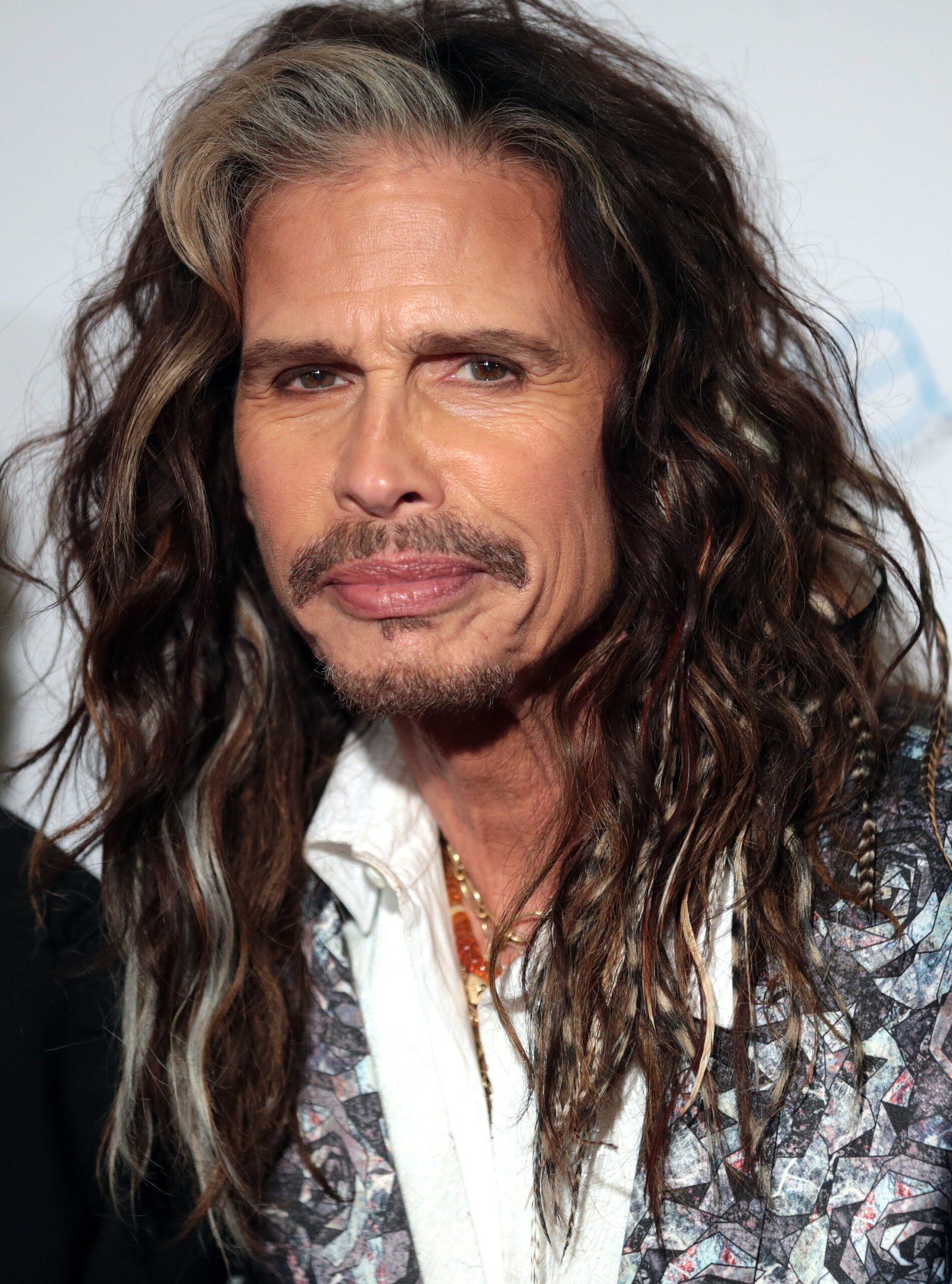
For fifty years, Aerosmith sold the world an unforgettable image: the Toxic Twins, the Bad Boys from Boston, a band that partied harder, played louder, and burned brighter than anyone else in rock. And for a long time, the image was true enough — the seventies were a blur of sold-out arenas, trashed hotel rooms, and appetites that seemed limitless. But behind the scarves and the screams, behind the decades of excess and the miraculous comebacks, there were always human hearts — a rock star discovering he had a daughter, a frontman turning a dark song into a shelter for abused girls, a quiet bassist fighting for his life, and five brothers who refused to let go of each other. This is the Aerosmith the tabloids never truly understood.
The Daughter He Didn’t Know
Liv Tyler was born on July 1, 1977, in New York City, and for the first decade of her life, she believed her father was Todd Rundgren. Her mother, model and singer Bebe Buell — a fixture of the seventies rock scene — had been in a long-term relationship with Rundgren, but during a break in 1976, she had a brief fling with a wildly drug-addled Steven Tyler, then deep in the worst of his addictions. When Buell discovered she was pregnant, Rundgren — who knew the child might not be his — made an extraordinary choice: he signed the birth certificate, gave the baby his name, and raised her as his own daughter. He and Buell made a pact to tell Liv the truth when she turned eighteen, to protect her from the chaos of Tyler’s world. It was an act of love from a man with no biological obligation, and Liv has honored it ever since.
But children know things. At around nine years old, Liv met Steven Tyler at one of Rundgren’s concerts — he bought her a Shirley Temple at the bar, and though she had no idea who he was, she felt an instant, almost magnetic connection. She put an Aerosmith poster on her bedroom wall and talked to it like a friend. Then, at an Aerosmith concert, she saw a girl at the side of the stage who looked exactly like her — Mia, Steven’s daughter with his former wife, born just a year after Liv. Staring at the poster one day, the truth clicked into place. She wrote in her diary: “I think Steven is my father.”
At eleven, she confronted her mother, who tearfully told her everything — the fling, the pact with Rundgren, the years of secrecy meant to protect her. Liv took the news with remarkable grace — “I have two dads and all this love,” she concluded, even joking about getting two Christmases — and began building a relationship with Steven that has lasted ever since. She changed her name from Rundgren to Tyler, appeared in Aerosmith’s 1993 “Crazy” video (which helped launch her acting career), and has never stopped expressing gratitude to Todd Rundgren, the man who chose to be her father. “I’m so grateful to Todd for choosing to be a father figure to me,” she has said. “It’s a big thing for a man to say, ‘I know this kid might not be mine, but I still want to be her father.’” For Steven Tyler, the wildest frontman in rock, discovering Liv was the beginning of growing up. He embraced fatherhood with the same all-in intensity he gave everything — and Liv, who grew into a beloved actress, has spoken warmly of the unconventional, loving bond they share. Two fathers, both chosen in the end: one by biology’s accident, one by love’s decision.
Janie’s Fund: Turning a Dark Song Into Light
In 1989, Aerosmith released “Janie’s Got a Gun” — a harrowing song about a girl abused by her father who takes revenge. It was one of the band’s biggest hits, winning a Grammy and reaching the Top 5, and for Steven Tyler, it planted a seed that would take decades to bloom. The song had come from a dark place of empathy — Tyler imagining the pain of girls no one protected — and as the years passed and his own daughters grew up, that empathy only deepened. Tyler had long been haunted by the subject of abused and neglected girls, and in November 2015, he did something extraordinary about it: he founded Janie’s Fund, in partnership with the nonprofit Youth Villages, to support girls who had suffered abuse and neglect. He named it for the girl in his song — so that this time, Janie would get help instead of a gun.
The fund’s work is concrete and life-changing. It established Janie’s House in Atlanta, a residential home giving girls safety, therapy, and a chance to heal — a real roof, real counselors, real second chances.
The Guardian Angel of Atlanta
Tyler has thrown himself into the cause with the same intensity he once gave to the party — visiting the girls personally, raising money tirelessly, using his fame as a shield for the vulnerable. He has spoken movingly about looking into the eyes of girls who remind him of the Janie in his song, and being determined that their stories end differently. In 2016, the United Nations honored him with a Humanitarian Award for the work. By 2020, Janie’s Fund had raised more than $7.5 million and helped over 1,200 girls find safety and healing.
For a man who spent the seventies and eighties as rock’s most notorious wild child — and who got sober in the eighties after years of addiction that nearly destroyed him and the band — Janie’s Fund represents something profound: the arc from self-destruction to service, from taking everything to giving everything. The Demon of Screamin’ grew up to be a guardian angel. Tyler has said the work gives his life a purpose that fame never could. Every girl who finds safety in Janie’s House is living proof that a dark song can become a source of light.
The Toxic Twins Grow Up
To understand the depth of these redemptions, you have to remember how far Aerosmith fell. By the early 1980s, Steven Tyler and Joe Perry — the Toxic Twins — were consuming staggering quantities of drugs and alcohol, and the damage was visible to everyone. The band that had made “Toys in the Attic” and “Rocks” was disintegrating on stage and off: missed shows, forgotten lyrics, violent arguments, Perry quitting in 1979 amid the chaos, the whole enterprise teetering on collapse. They were rock’s great cautionary tale, the band that had everything and threw it away — and then, against every odd, the band that took it all back.
What saved them was each other — and the decision, made individually and collectively in the 1980s, to get sober. It wasn’t a single moment but a grinding, years-long climb: interventions, rehab, relapses, and recommitment. Tyler has been open about how close he came to losing everything, including his life — there were years when simply showing up was a victory. But the band clawed its way back, and the comeback — powered by albums like “Permanent Vacation” and “Pump,” and sealed by the unforgettable Run-DMC collaboration — became one of the great second acts in rock history. The sobriety stuck, and it changed the men. The wild boys who had once embodied excess became, improbably, elders: mentors to younger bands, advocates for recovery, survivors with something to teach. You can’t understand Janie’s Fund without understanding what Tyler survived to build it.
The Quiet One’s Loudest Battle
While Tyler was fighting his public demons, Tom Hamilton was fighting a private one. In 2006, the bassist — the steady, soft-spoken anchor of Aerosmith’s sound, the man whose secret riff had launched “Sweet Emotion” — was diagnosed with throat and tongue cancer. The treatment was brutal: seven weeks of radiation and chemotherapy that left him unable to tour, forced to watch from the sidelines as his bandmates carried on without him. For a musician, cancer of the throat is a particularly cruel diagnosis — it threatens not just life, but livelihood, voice, identity. Hamilton, who had always expressed himself through his instrument rather than words, faced the prospect of losing both.
Hamilton fought back with characteristic quiet determination. He returned to the stage, but the cancer came back, requiring delicate laser surgery from renowned specialist Dr. Steven Zeitels to save his voice and his life. Through it all, Hamilton refused to let the illness define him. He kept playing, kept writing, kept showing up — the same steady presence he had always been, now carrying an invisible scar. Bandmates rallied around him the way families do, adjusting and supporting without fanfare. Today he is cancer-free, and in 2020 he shared in the band’s honor as MusiCares Person of the Year — recognition not just of the music, but of the resilience behind it.
His battle is a reminder of what fans often miss about Aerosmith: for all the frontman fireworks, the band’s foundation has always been its quietest member. Hamilton’s bass lines — from “Sweet Emotion” onward — are the bedrock everything else stands on, the pulse beneath the pyrotechnics. And his fight showed the same quality: no drama, no spotlight, just the determination to keep going, one day and one note at a time.
Brothers in the Storm
What holds Aerosmith together, through half a century of breakups, relapses, reconciliations, and comebacks, is something deeper than business. These five men — Tyler, Joe Perry, Hamilton, Joey Kramer, and Brad Whitford — grew up together, nearly destroyed themselves together, got sober together, and rebuilt together. They have buried friends, survived the deaths of peers, watched the music industry transform around them, and they are still standing, still playing, still brothers. When Tyler needed a family, he found Liv. When wounded girls needed a champion, he built Janie’s Fund. When Hamilton needed strength, the whole band closed ranks. That is what a real family does.
The story of Aerosmith’s hearts is really one story told many ways: a father learning to love a daughter he didn’t know he had, a wild man turning his pain into shelter for wounded girls, a quiet man refusing to surrender to disease, and five brothers who survived everything the rock life threw at them — the fame, the drugs, the breakups, the funerals, the decades. Behind the Bad Boys from Boston were always just boys — flawed, searching, and ultimately redeemed by the people they chose to become. The scarves and the screams were real. But the hearts were realer — and braver, and kinder. And after fifty years, they’re still beating — on stage, in Atlanta, in every girl who found safety because a rock star decided to care, and in every family the band’s timeless music helped hold together.
Leave a Reply