And You May Ask Yourself: How a Bahamian Jam, a Deck of Cards, and a Radio Preacher Made Talking Heads’ “Once in a Lifetime”
“And you may find yourself in another part of the world / And you may find yourself behind the wheel of a large automobile / And you may find yourself in a beautiful house, with a beautiful wife / And you may ask yourself: well, how did I get here?”
No song in the history of rock asks the question the way “Once in a Lifetime” asks it. It doesn’t sing it, exactly — David Byrne mostly speaks it, half-yelping, half-preaching, over a groove that never begins and never ends, a rhythm that folds in on itself like a sermon that forgot its subject. It is the sound of a man waking up mid-life and discovering that every choice was made by someone else — or by no one at all. “Letting the days go by, let the water hold me down / Letting the days go by, water flowing underground.” And then the punchline, delivered like scripture: “Same as it ever was.”
Here is the strange part: that question — the most famous existential riddle in pop music — was almost never asked at all. In the summer of 1980, “Once in a Lifetime” was a jam session the band nearly threw away, a riff their producer didn’t even like, built from loops cut out of a Fela Kuti-inspired groove in a Bahamian studio, steered by a deck of cryptic instruction cards, and given words that came from evangelists David Byrne had taped off the radio in the middle of the night. The lyrics about “water flowing underground” arrived by accident. The preacher’s delivery was an improvisation. The whole thing was, by the admission of everyone in the room, a happy collision of mistakes — and it became the defining record of an era, one of the most played videos in early MTV history, and a song that still sounds like it was beamed in from the future.
This is the story of how “Once in a Lifetime” was made: the Bahamas sessions, the human samplers, the cards, the sermon, and the slow-burn journey from a nearly-abandoned album track to a cultural landmark.
Nassau, July 1980: The Band That Arrived Without Songs
To understand how strange the making of “Once in a Lifetime” was, you have to understand what Talking Heads did when they arrived at Compass Point Studios in Nassau, in the Bahamas, in July 1980. They arrived, essentially, without songs.
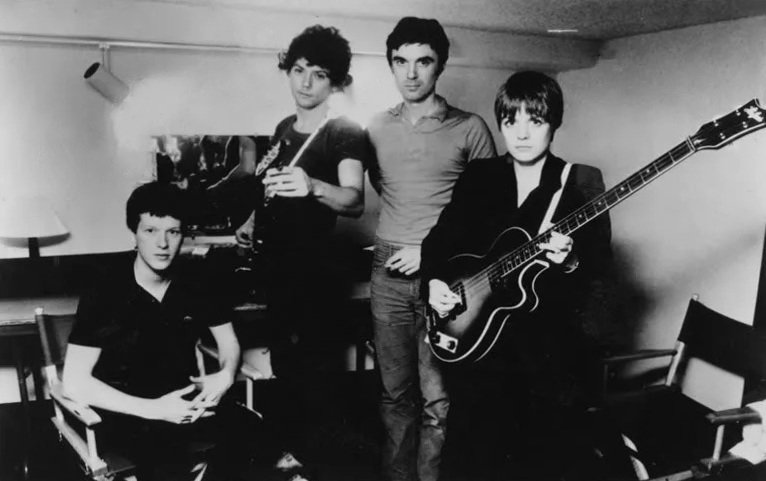
That was not how the band had ever worked. On their earlier records, singer-guitarist David Byrne, guitarist-keyboardist Jerry Harrison, bassist Tina Weymouth, and drummer Chris Frantz had come into the studio with finished compositions — verses, choruses, arrangements, the architecture already drawn. This time, working with producer Brian Eno for the third and final time, they did something closer to the opposite. They came with grooves. With rhythm beds. With a shared obsession: the records of the Nigerian bandleader Fela Kuti, whose Afrobeat — long, hypnotic, polyrhythmic jams built on interlocking percussion — had gotten under the whole band’s skin.
The sessions began at Compass Point in July 1980. It was familiar ground: the band had recorded their second album, More Songs About Buildings and Food, in the same studio, and Frantz and Weymouth had liked the place so much they’d bought an apartment above it during an earlier trip. The plan was for basic tracks to be cut in Nassau and for vocals and overdubs to be finished later at Sigma Sound Studios in New York. The album would be completed and mixed in August and released on October 8, 1980, on Sire Records — an astonishingly fast turnaround by modern standards, the record arriving just weeks after it was finished.
But the method was the real revolution. Instead of writing songs and then recording them, the band would play — long, open-ended jams, sometimes a single chord held for fifteen minutes — while the tape rolled. Then Eno and the band would listen back, find the best few seconds of groove, and build the track outward from there. It was, as one historian of the sessions put it, a jam session on steroids: play until something transcendent happens, capture it, and then learn to play that captured moment over and over again. Nobody arrived with a finished bridge or a catchy chorus. The groove was the song; everything else would be layered on top.
It was the death of the old way of writing, and the birth of something that wouldn’t have a name for another decade.
“We Were Human Samplers”
David Byrne gave the method its perfect description years later, and the description has become one of the most quoted lines in the history of record production. Talking about the Remain in Light sessions, he said: “Most of the tracks on Remain in Light were based around jams. We’d listen to the tapes, isolate the best bits, then learn how to play them over and over again. It was exactly what producers do these days with loops and samplers and sequencers. We were human samplers!”
Think about that. In 1980, there were no samplers in any practical sense — no digital looping, no Pro Tools, no Ableton. The technology to take a fragment of sound and repeat it mechanically didn’t exist in the studio. So the band became the technology. They played the loops with their hands, their bodies turned into sequencing machines, cycling a two-bar groove until it achieved the hypnotic, trance-like density of the Fela Kuti records they’d been studying.
The methodology had distinguished ancestors. Eno and the band were consciously inspired by the German experimental rockers Can, who built tracks from long improvised jams edited down into shape, and by Teo Macero, the producer who had assembled Miles Davis’s electric masterpieces like Bitches Brew by splicing together fragments of studio improvisation. What Eno and Talking Heads were doing at Compass Point was the rock-band equivalent: record everything, then compose with scissors.
“Once in a Lifetime” was the purest product of that process. It started life as a Fela Kuti-style jam — you can hear the embryonic version on the 2006 reissue of Remain in Light, where it appears as a bonus track under the title “Right Start.” Eno and the band then set about ripping that jam session apart: recreating the groove, stripping out certain instruments, and superimposing melodic and rhythmic ideas on the basic template. The song, as it was finally released, is essentially a repetitive two-bar groove — with the pattern reversed between the verse and the chorus — over which layer upon layer of independently recorded ideas float, collide, and interlock.
And here Eno pulled one of his signature moves. Because the song was essentially a cycle with no beginning and no end, he decided to approach the production by having each band member record overdubs of different rhythmic and musical ideas independently of one another — each musician kept blind to what the others had put down on tape. In the final mix, Eno faded between these independent ideas at different points in the song, so the texture constantly shifts, warps, and re-forms. It was, as the producer later described it, a song with “a funny balance, with two centres of gravity — their funk groove, and my dubby, reggae-ish understanding of it; a bit like the way Fela Kuti songs will have multiple rhythms going on at the same time, warping in and out of each other.”
The lopsidedness was partly deliberate and partly a beautiful accident. The first time Eno heard the jam, he misheard the riff — in his own words, “I always think that the ‘one’ of the bar is in a different place to where the rest of the band thought the ‘one’ was.” So he counted “one-two-three-four” differently from the band, and that rhythmic imbalance was exaggerated in the studio and is present throughout the finished song. Half the musicians were playing to one downbeat; the producer was hearing another. The result is the track’s famous off-kilter wobble — the feeling that the floor is very slightly tilted, and you’re dancing anyway.
The Deck of Cards
If the loop method was the science of the sessions, Brian Eno’s Oblique Strategies were the religion.
Oblique Strategies — subtitled “Over One Hundred Worthwhile Dilemmas” — is a deck of cards first published in 1975 by Eno and his friend, the painter Peter Schmidt. Each card carries a cryptic instruction, a lateral-thinking prompt designed to break a creative deadlock: a way of throwing the artist out of the frame, as Eno once put it to Jools Holland, “so you’re not a band in a studio focused on one song, but you’re people who are alive and in the world and aware of a lot of other things as well.”
Chris Frantz, the band’s drummer and a co-writer of the song, remembered Eno deploying the cards throughout the Remain in Light sessions. “Eno was great fun in the studio — he was still using those ‘oblique strategy’ cards,” Frantz recalled. “It was always a fun way to work. Just when you were getting daunted by something, he’d hold up a card that read: ‘Don’t care about what other people think’, which was helpful! There were other ones, too: ‘Start at the end and not the beginning’, ‘Don’t be afraid of easy things’; ‘Only a part, not the whole’.”
Consider how perfectly those prompts fit what was happening in Nassau. “Only a part, not the whole” — the entire record was built from parts, fragments, isolated grooves, nobody playing the whole song at once. “Don’t be afraid of easy things” — the courage to let a two-bar groove carry an entire track. “Start at the end and not the beginning” — a song with no beginning at all. The cards didn’t write “Once in a Lifetime,” but they gave four musicians permission to stop thinking like a band and start thinking like a system — parts interlocking, nobody in charge of the whole, the groove doing the thinking for them.
It was, in retrospect, the exact opposite of how a rock record was supposed to be made in 1980. And it was the only way this particular record could have been made at all.
“Weird Guitar Riff Song”
For all its eventual fame, “Once in a Lifetime” was, during the sessions, a problem child. At first, it wasn’t one of Eno’s favorite tracks. The working title tells you how unfinished it felt: the band called it “Weird Guitar Riff Song.” It was conceived as a single riff; then the band added a second, boosted riff over the top of the first, and Eno alternated eight bars of each riff with eight bars of its counterpart — a kind of seesaw structure that gives the track its restless, unresolved energy.
The song nearly died. Byrne later admitted it plainly: “We very nearly abandoned the song.” What saved it was stubbornness — his own. “I insisted that I could write words to it and pull it together,” he recalled. And then Eno had an idea for a melody for the chorus, and it fell into place. “It worked as a call-and-response pattern, like a preacher’s conversation with his congregation. I improvised lines as if I was giving a sermon.”
Listen to the finished track with that in mind and you can hear the architecture of the rescue. The foundation is Tina Weymouth’s bassline — which, by multiple accounts, she wrote and then fought to keep, defending her part against the churn of overdubs and competing ideas. Over that bedrock, Jerry Harrison developed the synthesizer line and added the Hammond organ climax, an idea he lifted from the Velvet Underground’s “What Goes On” — a little piece of New York art-rock DNA spliced into an Afrobeat groove. And hovering above it all, mostly speaking rather than singing — the verses of the song consist of Byrne talking, yelping, testifying — is the voice that would make it immortal.
The songwriting credits tell the story of the method: David Byrne, Brian Eno, Chris Frantz, Jerry Harrison, and Tina Weymouth — the entire band plus the producer, the first time the Heads had worked that democratically. Nobody owned “Once in a Lifetime.” Everybody did. It was a groove that had been found, not a song that had been written, and the credits reflect that: five names for a track that began as a jam and was assembled like a collage.
The Preacher on the Radio
So the groove existed. The bassline held. The riffs seesawed. But the song still needed words — and Byrne, struggling with lyrics throughout the sessions, found them in the strangest place: late-night American radio evangelists.
Byrne had been recording preachers off the radio, taping their sermons and studying the cadences — the repetitions, the rhetorical questions, the way a skilled evangelist builds a call-and-response with a congregation, the way certainty and doubt get braided together into something that sounds like truth. Some of those evangelist recordings would later surface on My Life in the Bush of Ghosts, the sample-based album Byrne and Eno released in 1981. But their first and most famous use was here, transmuted into Byrne’s own voice.
“Most of the words in ‘Once in a Lifetime’ come from evangelists I recorded off the radio while taking notes and picking up phrases I thought were interesting directions,” Byrne later said. The process was improvisational: Eno would sing nonsense verb sound blocks over the groove — rhythmic syllables with no meaning — and Byrne would convert those blocks into lyrics in the call-and-response style of the radio preachers, riffing on the theme of moving through life with little awareness or questioning.
The result is a lyric that reads like a sermon about amnesia. “You may find yourself living in a shotgun shack / And you may find yourself in another part of the world / And you may find yourself behind the wheel of a large automobile / And you may find yourself in a beautiful house, with a beautiful wife.” The “you may find yourself” construction is pure evangelist — the preacher placing you in the scene, making the abstract concrete. And then the question, asked not with an answer but with a kind of tender bewilderment: “And you may ask yourself: well, how did I get here?”
The water imagery — “Letting the days go by, let the water hold me down / Letting the days go by, water flowing underground / Into the blue again, after the money’s gone” — is the song’s subconscious, the dream-logic undertow beneath the preacher’s certainties. Byrne didn’t plan it; it arrived through the improvisation, through the sound-blocks, through the trance of the groove. That’s the paradox of the lyric: it sounds deeply considered, but it was channeled — a sermon improvised over a loop by a man pretending to be a preacher, asking a question nobody can answer.
And notice what Byrne doesn’t do in the verses: he doesn’t sing. The verses are spoken, yelped, exclaimed — a rhythmic instrument more than a melody. It’s the sound of a man possessed by the groove, testifying rather than performing. When the chorus finally arrives — “Same as it ever was, same as it ever was” — it’s less a refrain than a verdict, delivered with the exhausted certainty of someone who has asked the question too many times to expect an answer.
The Guitarist Who Wasn’t There
There is a persistent myth about “Once in a Lifetime” that needs correcting, because it tells you something important about how legends accrete around great records. The myth says that the searing, wild guitar work on the track is the playing of Adrian Belew — the virtuoso who had played with Frank Zappa and on David Bowie’s Lodger, and who was brought into the Remain in Light sessions to add guitar fireworks.
Belew’s contribution to the album was real and spectacular. When the band returned to New York to finish the record, they reached out to him, and he cut every one of his parts in a single day. “They basically said, ‘Go into the studio and wait around till you think there should be a guitar solo,’” Belew recalled. “I played and I could see everybody all excited in the control room. So I thought, what the heck? I’ll play a second one.” He played on “Crosseyed and Painless,” “The Great Curve,” “Listening Wind,” and “The Overload,” and he went on to join the band’s expanded touring lineup for the 1980–81 Remain in Light tour.
But he did not play on “Once in a Lifetime.” Belew has said so himself, explicitly and more than once: “I didn’t do anything on ‘Once in a Lifetime.’” And the famous wild guitar solo on “Born Under Punches (The Heat Goes On)” — the one that sounds most like Belew, the one fans have credited to him for decades — wasn’t Belew either. It was David Byrne, working a Lexicon Prime Time digital delay unit, mangling his own guitar into something unrecognizable.
The correction matters because it reveals how the record was really made: not by virtuoso guests parachuted in to save the day, but by the band’s own experiments with the studio as an instrument. The strangest sounds on Remain in Light — the ones that sound like they must have come from a guitar genius — came from a singer with a delay pedal and a producer with a deck of cards. The human samplers didn’t need a ringer. They were the ringers.
The Dance
The song might have remained a beloved album track — a critics’ favorite, a deep cut — if not for what happened next: the video.
The music video for “Once in a Lifetime” was co-directed by Byrne and the choreographer Toni Basil — the singer behind the hit “Mickey,” and a serious dance professional. Basil choreographed Byrne’s performance, and the two of them studied archive footage of religious rituals from around the world: African ceremonies, Japanese sects, people in trance states, and American Christian evangelists including Ernest Angley. They were looking for the physical vocabulary of possession — what the body does when the spirit takes over.
Basil also showed Byrne footage of epilepsy sufferers, and Byrne absorbed it: the sudden arm flings, the head taps, the jerky, marionette-like spasms, the unfocused eye movements, the sharp intakes of breath. In the video, Byrne appears in a large empty white room in a suit, bow tie, and glasses, dancing like a puppet with cut strings while blue-screened loops of ritual footage and multiplied copies of himself flicker behind him. In the foreground, a larger Byrne gets further and further out of synchrony with his own clones — a visual echo of the song’s theme, the self coming apart at the seams. The footage was shot with an old-fashioned zoom lens that made the jerky movements even more pronounced, turning every spasm into an event.
It was one of the strangest things ever put on television, and it arrived at exactly the right moment. When MTV launched in August 1981, “Once in a Lifetime” was one of the most heavily played videos on the new channel — an early staple that introduced Talking Heads to an audience far beyond the art-rock faithful. For many viewers, it was their first look at the band at all; the full band wouldn’t appear in one of their videos until “Burning Down the House” two years later. The image of the sweating, bespectacled preacher, jerking and testifying in an empty white room, became one of the defining images of the early MTV era — as recognizable, in its way, as anything the channel ever aired.
The Slow Burn
Here’s the part of the story that surprises people: “Once in a Lifetime” was not a hit. Not at first. Not even close.
Released as the first single from Remain in Light on February 2, 1981, through Sire Records, the song gained only modest chart success. It peaked at number 14 on the UK Singles Chart in March 1981 — the band’s first UK Top 20 single — and reached number 31 in the Netherlands. In the United States, the original single failed to reach the Billboard Hot 100 at all, stalling at number 103 on the Bubbling Under chart. For a song now regarded as one of the defining records of its era, it was a commercial shrug.
But “Once in a Lifetime” had something better than a hit single’s trajectory: it had staying power. The MTV exposure kept it alive through the early eighties. Then came Stop Making Sense, Jonathan Demme’s 1984 concert film of Talking Heads at the peak of their powers — and with it, the definitive live performance of the song. The film’s version is notable for an almost four-minute-long unbroken chiaroscuro shot of Byrne performing the song, sweating under a single light, the preacher at full possession. That version — remixed to remove the live audience — also plays over the opening titles of the 1986 film Down and Out in Beverly Hills. Released as a single from the concert film in 1985, the live “Once in a Lifetime” finally gave the song its only Billboard Hot 100 entry, peaking at number 91 in 1986 — five years after the studio version had missed the chart entirely.
And the song kept traveling. In 1996, Kermit the Frog performed “Once in a Lifetime” on Muppets Tonight, wearing a Byrne-like suit and copying the dance moves from Stop Making Sense — the surest sign in American culture that a song has become a shared reference point. In 2018, the Beninese singer Angélique Kidjo released a song-for-song cover of the entire Remain in Light album, a tribute that honored the record’s African inspirations by bringing them full circle. The single was eventually certified silver in the UK in January 2018 and gold in April 2021 — forty years after release, still accumulating.
The album around it fared better from the start: Remain in Light reached number 19 on the US Billboard 200 and number 21 on the UK Albums Chart, and the accolades compounded over the decades — Rolling Stone named it the fourth-best album of the 1980s, Pitchfork ranked it number two, and Rolling Stone‘s 2020 list placed it 39th among the greatest albums of all time. In 2017, the Library of Congress deemed the album “culturally, historically, or aesthetically significant” and selected it for preservation in the National Recording Registry. “Once in a Lifetime” itself was included among the Rock and Roll Hall of Fame’s 500 Songs That Shaped Rock and Roll, alongside “Psycho Killer” and “Life During Wartime.”
Same As It Ever Was
There is a reason “Once in a Lifetime” outlasted every song that outsold it in 1981. The hits of that year were about their moment; this song is about every moment. “And you may ask yourself: well, how did I get here?” — it is the question of the midlife crisis, the morning after, the quiet panic of the successful life. The beautiful house, the beautiful wife, the large automobile: the song lists the prizes and then asks, with genuine tenderness, whether anyone actually chose them. “Letting the days go by, water flowing underground” — time moving beneath the surface of a life, whether you watch it or not.
And the way it was made is part of why it lasts. A band that stopped writing songs and started building grooves. A producer who counted the beat wrong and kept the mistake. A deck of cards that said “don’t be afraid of easy things.” A singer who taped preachers off the radio and improvised a sermon over a loop. A bassline its player had to fight for. A guitar solo that wasn’t a guitar solo. A dance learned from footage of trances and seizures. Every element arrived sideways, by accident or by oracle, and the accidents harmonized into something that feels inevitable — which is exactly what the song is about. How did I get here? The same way the song got here: one groove, one loop, one day at a time, until you look up and the life — or the record — is finished.
“Same as it ever was,” Byrne chants at the end, and it’s both a comfort and a warning. The water keeps flowing underground. The days keep going by. The only choice, the song suggests, is whether you notice. In the summer of 1980, in a studio in the Bahamas, four musicians and a producer with a deck of cards noticed — and built a loop out of the noticing, and the loop is still playing.
Leave a Reply