The world knew Aretha Franklin’s voice — that titanic, church-shaking instrument that could turn three letters into a revolution. What the world didn’t always see was the heart that powered it: a woman who put her money, her safety, and her reputation on the line for the freedom struggle, who raised four sons away from the spotlight’s glare, and who never forgot where she came from. Long before she was the Queen of Soul, she was the preacher’s daughter who understood that a gift like hers came with obligations. This is the story of what Aretha Franklin did with hers.
The Preacher’s Daughter’s Promise
Aretha Louise Franklin was born on March 25, 1942, in Memphis, Tennessee, but she was raised in Detroit in the long shadow — and the warm light — of her father, the Reverend C. L. Franklin. He was one of the most celebrated Black preachers in America, a spellbinding orator whose sermons were pressed onto records and sold nationwide, and a fearless civil rights activist in his own right. The New Bethel Baptist Church was young Aretha’s whole world, and the movement’s leaders were her family’s dinner guests. Martin Luther King Jr. was not a distant hero to her; he was an old friend of the family, a man who had eaten at their table.
That upbringing planted something deep in her. Gospel music taught her that singing was never just entertainment — it was testimony, a way of carrying a people’s pain and hope in your throat. She would spend the next six decades proving she had learned the lesson. When the movement needed money, she gave it. When it needed a voice, she lent hers. When it needed someone to stand up and be counted, the Queen stood up.
Singing for Dr. King
On February 16, 1968, the city of Detroit declared it Aretha Franklin Day, honoring its hometown star with a ceremony fit for royalty. To everyone’s surprise, Martin Luther King Jr. himself appeared onstage to present her with a special award from the Southern Christian Leadership Conference. He was suffering from laryngitis and could barely speak, but he had come anyway — a measure of what she meant to the movement.
Less than two months later, he was gone, assassinated on a Memphis balcony. The 26-year-old Aretha was asked to sing at his memorial service in Atlanta, and she chose “Precious Lord, Take My Hand” — the Thomas A. Dorsey gospel hymn that had been King’s favorite, the song he had requested from gospel greats at benefits and gatherings for years. She sang it with a grief the whole nation could feel. Four years later, when Mahalia Jackson — the gospel giant who had sung that same hymn at King’s funeral — passed away, Aretha sang it at her funeral too. She would later record it for “Amazing Grace,” her landmark 1972 live gospel album. Some songs were hits. That one was a duty.
“Black People Will Be Free”
In 1970, at the very height of her fame, Aretha Franklin did something that could have ended her career. The political activist and philosophy professor Angela Davis had been jailed on charges connected to a deadly courtroom escape attempt in Marin County, California — charges for which she would eventually be acquitted in 1972. President Nixon had labeled Davis a dangerous terrorist. Her case was radioactive. And Aretha Franklin held a press conference to say she would pay Davis’s bail, “whether it’s $100,000 or $250,000.”
Her words, given to Jet magazine, still ring like a sermon: “My daddy says I don’t know what I’m doing. Well, I respect him, of course, but I’m going to stick by my beliefs. Angela Davis must go free. Black people will be free. I’ve been locked up (for disturbing the peace in Detroit) and I know you got to disturb the peace when you can’t get no peace. Jail is hell to be in. I’m going to see her free if there is any justice in our courts, not because I believe in communism, but because she’s a Black woman and she wants freedom for Black people. I have the money; I got it from Black people — they’ve made me financially able to have it — and I want to use it in ways that will help our people.”
In the end, Davis was not eligible for bail at the time, and when bail was eventually set, it was paid by a California dairy farmer named Roger McAfee. But Davis never forgot the offer. Speaking after Franklin’s death, she called the press conference one of the most moving moments of her imprisonment — “a high point in the campaign” — and said she had thanked Franklin publicly many times. It took extraordinary courage for the biggest Black female star in America to attach her name to the most controversial defendant in the country. Aretha did it without blinking.
Making Payroll for the Movement
The Davis offer was the most dramatic gesture, but it was far from the only one. The Reverend Jesse Jackson, her longtime friend, said it plainly after her death: “When Dr. King was alive, several times she helped us make payroll.” Let that sink in. While the world saw the gowns and the Grammys, Aretha Franklin was quietly keeping the lights on for the civil rights movement.
She headlined benefit concerts, lent her name and her presence to the cause, and stayed close to the King family for the rest of her life. This was not the fashionable activism of a star burnishing an image; in the late 1960s and early 1970s, aligning yourself this openly with the movement’s most militant causes carried real professional risk, especially for a Black woman in a white-run industry. Aretha never calculated the cost. After King’s death, she worked alongside Coretta Scott King in the long campaign to establish the King holiday, and when Aretha herself passed away in 2018, it was Dr. Bernice King — Martin and Coretta’s daughter — who spoke of how crucial Aretha had been to the family. The movement had given the preacher’s daughter her moral compass. She spent her life repaying the debt, mostly without fanfare and often without credit.
Four Sons and a Fierce Privacy
For all her public courage, Aretha Franklin guarded one part of her life with legendary determination: her children. She was the mother of four sons — Clarence, born in 1955 when she was just 12; Edward, born in 1957; Ted White Jr., born in 1964 during her first marriage and known professionally as the guitarist Teddy Richards; and Kecalf Cunningham, born in 1970, whose name forms an acronym of his parents’ names, Ken E. Cunningham and Aretha Louise Franklin.
She almost never discussed them with interviewers, and she raised them largely out of the spotlight’s glare — the older boys were brought up in Detroit by her grandmother Rachel and her sister while Aretha’s career exploded. Those who knew her said she was a devoted, old-fashioned mother behind closed doors: strict, protective, and fiercely proud, the kind of parent who showed up even when the world was pulling her in every direction. The boys grew up understanding that their mother’s fame was her job, not their identity. But the family bond ran deep and musical: Teddy Richards became a fixture on guitar in his mother’s touring band; Edward became a gospel singer who performed duets with her; Kecalf became a Christian rapper who shared her stage, including a memorable night at Radio City Music Hall. All four sons inherited the music, even if only some chose the stage. In an industry that devoured its stars’ families, Aretha built a wall around hers — and held it for sixty years.
Faith, Detroit, and Home
Through every triumph and heartbreak, two anchors held Aretha Franklin fast: her faith and her hometown. In 1982, she moved back to Detroit for good, and she never really left again. She recorded “Amazing Grace” — still the best-selling gospel album of all time — as a homecoming to the church music of her childhood, and she carried that gospel fire into every pop song she ever sang. Friends said the stage was the one place where every hurt in her life made sense, transformed into something the audience could feel in their bones.
She was, to the end, a Detroit institution: the voice at the city’s great occasions, the benefactor of its churches and causes, the hometown queen who could have lived anywhere and chose to live there. When she died on August 16, 2018, Detroit mourned like it had lost family — because it had.
The Obamas and the Full Circle
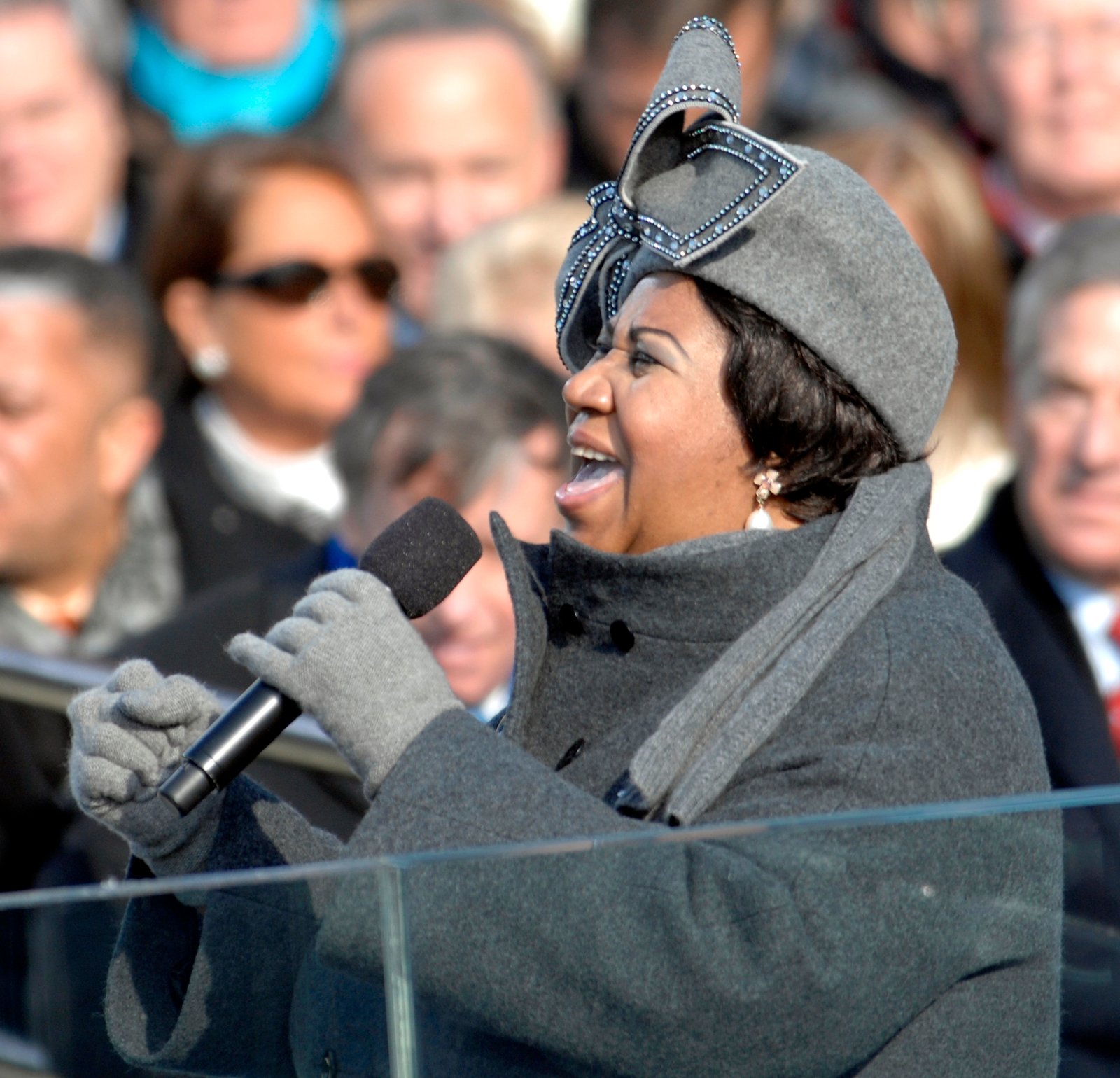
There was a beautiful symmetry to Aretha Franklin’s later years. The preacher’s daughter who had sung for Dr. King lived to sing at the inauguration of Barack Obama, the first Black president, on January 20, 2009 — bundled against the Washington cold in a gray hat with an enormous jeweled bow that instantly became a legend of its own, designed by milliner Luke Song and later bound for the Smithsonian. She and the Obamas became genuine friends; she sang for them at the White House and the Kennedy Center, and they cherished her.
Then came the night that said it all. In December 2015, at the Kennedy Center Honors, a 73-year-old Aretha Franklin took the stage to honor Carole King — the co-writer of “(You Make Me Feel Like) A Natural Woman” — and delivered a performance for the ages. She began at the piano, rose mid-song, tossed off her fur coat, and brought the house down, leaving President Obama wiping away tears in the balcony. It was the movement’s song, the women’s song, her song — sung by a woman who had lived every word of the history behind it. Months earlier, she had sung “Nessun dorma” for Pope Francis in Philadelphia. The preacher’s daughter had carried her gift to presidents and popes alike, and never let it change her.
https://www.youtube.com/watch?v=XHsnZT7Z2yQ
Aretha Franklin’s voice could fill an arena, but her heart was bigger than any room she ever played. She paid the movement’s payroll and offered a quarter of a million dollars for a stranger’s freedom. She sang a murdered leader into rest and raised four sons out of the spotlight’s reach. She stayed in Detroit, stayed in the church, and stayed true to the promise she had absorbed as a little girl in New Bethel: that a gift like hers was never really hers at all. It belonged to her people — the ones who had made her, sustained her, and needed her. And she spent it — gloriously, generously, all of it — on them.
Leave a Reply