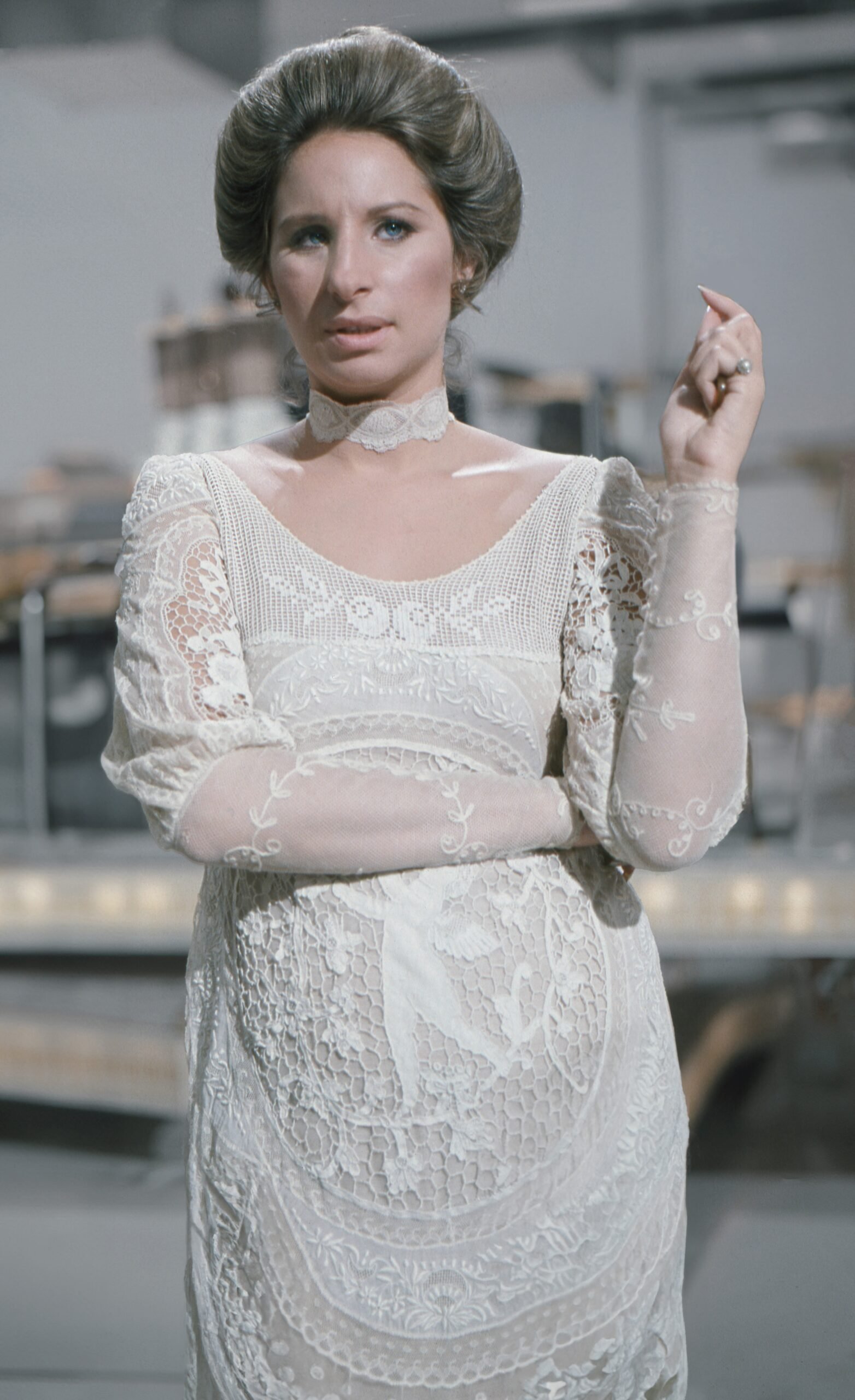
Barbra Streisand has always been the most guarded of superstars — the perfectionist who controlled every take, every camera angle, every note. But behind the control was a heart that kept breaking the rules: a marriage to a struggling young actor when she was Broadway’s brightest new star, a blind date she almost cancelled that became the love of her life, and a $10 million gift to save women’s hearts — including, in a way, her own. This is the story of the heart behind the legend.
The First Marriage
Before she was an icon, she was a 21-year-old Broadway baby with everything to prove. In 1963, the same year she became a star in “I Can Get It for You Wholesale,” Barbra Streisand married Elliott Gould — a young actor she’d met during the show, talented and ambitious but nowhere near her level of fame. It was a love match between two hungry kids from Brooklyn, both clawing their way up.
The marriage lasted eight years, through Streisand’s transformation from stage star to movie star to global phenomenon. That transformation was, in the end, the problem. It’s hard to be married to a supernova; the gravity distorts everything around it. Gould’s own career was rising — he’d become a major film star in his own right — but the marriage couldn’t survive the combined pressures of two enormous careers and one enormous ego (hers, by her own later admission).
They divorced in 1971. But the marriage gave Streisand the thing she would later call the most important in her life: her son. And it taught her something she would carry into every relationship after: that love, for a woman like her — a woman with that much talent, that much drive, that much need for control — was never going to be simple. The world wanted her to be the girl in the love song. She was always, instead, the woman writing it.
Jason: Her Only Child
Jason Gould, born in 1966, is Barbra Streisand’s only child — and by all accounts, the center of her universe. While the world saw the diva, Jason got the mother: the woman who showed up, who worried, who loved with the same intensity she brought to everything else.
Their bond has been one of the constants of her life, through every marriage and every reinvention. When Streisand finally found lasting love with James Brolin, Jason gained a stepfather — and Brolin, who had his own children, embraced the role with the easy warmth of a man who’d been a father for decades. The blended family became a quiet refuge from the spotlight: holidays together, ordinary days, the kind of normalcy that had always eluded the most famous woman in the room. For Streisand, building a stable, loving family was both an achievement and a healing — the one production she couldn’t direct, only nurture.
Streisand has always been fiercely protective of Jason’s privacy, and rightly so. But those close to her say that motherhood changed her — softened the perfectionist, deepened the artist. Every love song she ever sang had a new addressee.
The Blind Date She Almost Cancelled
By the mid-1990s, Streisand had been through the wringer romantically — the Gould marriage, a string of high-profile relationships, years of being the most eligible (and most intimidating) woman in Hollywood. She wasn’t looking. Which is, of course, exactly when it happened.
On July 1, 1996, a mutual friend set her up on a blind date: dinner at a friend’s house with actor James Brolin. Streisand nearly cancelled. Brolin nearly cancelled. Neither of them wanted to be there — two busy, guarded, famous people being maneuvered into a social situation. And then they met, and the evening ignited. Her opening line to him, upon seeing his hair, was pure Streisand: “Who screwed up your hair?” He laughed instead of taking offense. That was that. The guardedness cracked, the evening stretched, and two people who’d almost stayed home found the thing they’d stopped looking for.
Two years later — to the day — on July 1, 1998, they married at her Malibu home, surrounded by the people who mattered most. It was the kind of precise, meaningful symmetry that Streisand loves: the date that almost didn’t happen became the anniversary. Nearly three decades later, they’re still together — Hollywood’s most enduring unlikely couple, the diva and the cowboy, still going strong.
There’s a lesson in the story she tells on herself: the woman who controlled everything couldn’t control this. Love arrived uninvited, on a night she almost stayed home. All she had to do was show up — and, for once, let go.
The $10 Million Heart
In 2008, Streisand did something extraordinary even by her standards. She raised $22 million for women’s heart health — including $10 million of her own money. It was one of the largest single gifts ever directed at the cause, and it transformed the landscape of cardiac care for women.
The money went to Cedars-Sinai Medical Center in Los Angeles, whose women’s heart center was renamed in her honor: the Barbra Streisand Women’s Heart Center. But she didn’t just write a check. She co-founded the Women’s Heart Alliance, dedicated to raising awareness and funding research. She threw her fame, her fortune, and her formidable will behind a cause that had been ignored for decades.
In June 2012, she hosted a fundraiser at her Malibu home — $100,000 per couple — where she serenaded former President Bill Clinton and a roomful of deep-pocketed donors. It was classic Streisand: the performer as philanthropist, using the voice as a fundraising instrument. Picture it: the most famous voice of the century, singing in a living room, and every note converting directly into research dollars. And it worked. Millions more flowed to the cause, from people who’d come for the legend and stayed for the mission.
Why Women’s Hearts
Why this cause? Because Streisand had done her homework, and what she learned infuriated her. Heart disease is the number one killer of women — yet for decades, cardiac research was conducted overwhelmingly on men. Women’s symptoms were misunderstood, misdiagnosed, dismissed. The medical establishment had a blind spot the size of half the population.
This was, for Streisand, personal and political at once. She has said she “can’t stand inequality, whether it’s about civil rights, gay rights or gender discrimination” — and the gender gap in heart research was inequality with a body count. It was also, in a deeper sense, about being seen: women’s pain, minimized and misread for generations, finally taken seriously because one famous woman refused to look away. Her gift wasn’t charity in the abstract. It was an attack on a specific injustice, funded with the precision of a woman who does nothing halfway.
The center that bears her name has since become a leader in women’s cardiac research and care. Thousands of women have been treated there. Researchers there have advanced the understanding of how heart disease manifests differently in women. That $10 million didn’t just buy a name on a building. It bought knowledge — and lives.
One Night Only
On September 26, 2009, Streisand did something she hadn’t done in 48 years: she played a nightclub. The venue was the Village Vanguard in New York — the legendary basement jazz club, capacity 123, a room where the walls sweat history. The occasion was the release of “Love Is the Answer,” her album of jazz standards produced by Diana Krall.
The audience was about a hundred people, chosen by lottery from her fan club — the luckiest hundred fans alive that night. And they weren’t the only ones watching. In the tiny, packed room sat Bill and Hillary Clinton, Sarah Jessica Parker, Nicole Kidman — A-listers crammed into a basement like everyone else, because nobody misses Barbra Streisand’s first club set in nearly half a century.
She was, by all accounts, transcendent. The Vanguard strips away everything — no orchestra pit, no staging, no distance. Just a singer, a microphone, and a room small enough that every breath is audible. For an artist famous for her control, it was an act of vulnerability: the biggest voice in the world, in the smallest room in New York. She sang the standards from “Love Is the Answer” the way they were meant to be sung — close, conversational, confessional — and the hundred lucky fans in the room heard something no arena could ever deliver: Barbra Streisand, unguarded. The performance was later released on DVD and CD as “One Night Only” on May 4, 2010, and it topped the music-DVD chart — proof that intimacy, from Streisand, was a commercial force too.
The Teenager Who Auditioned
Here’s the detail that makes the Vanguard night a perfect circle. Decades earlier, as a teenager, Barbra Streisand had auditioned at the Village Vanguard — hoping to land a gig opening for Miles Davis. A waiter at the club, Rick Edelstein, had arranged the audition for the unknown Brooklyn girl with the impossible voice. She didn’t get the job.
Think about that. The teenager who couldn’t get hired to open at the Vanguard grew up to be the legend who sold it out — or rather, filled it by lottery — 48 years later, with a former president in the audience. The room hadn’t changed. She had. Everything had.
It’s the kind of symmetry Streisand herself would appreciate: the perfectionist who loves a meaningful date, a full-circle moment. The Vanguard wasn’t just a gig. It was a homecoming — to the room where she’d once been nobody, returning as the somebody she’d always known she’d become. Every legend has an origin story. Hers has a basement in Greenwich Village, a waiter who believed in her, and a gig she didn’t get — the rejection that started everything.
The Heart, At Last
Barbra Streisand spent a lifetime being the most controlled person in every room — the takes, the angles, the notes, all perfect. But the moments that define her have all been about letting go: marrying the struggling actor, showing up for the blind date, writing the $10 million check, walking into the tiny club with nothing but a microphone.
The heart she guarded so carefully turned out to be the biggest thing about her. Bigger than the voice, even. It loved a husband, raised a son, welcomed a stepson, saved women’s lives by the thousand, and finally — at the Vanguard, at 67 — stood alone in a basement and sang, with nowhere to hide and nothing to prove. The control was always just the shell, the armor she’d built to survive being Barbra Streisand. The heart was the point all along. It just took her a lifetime to let us see it.
Leave a Reply