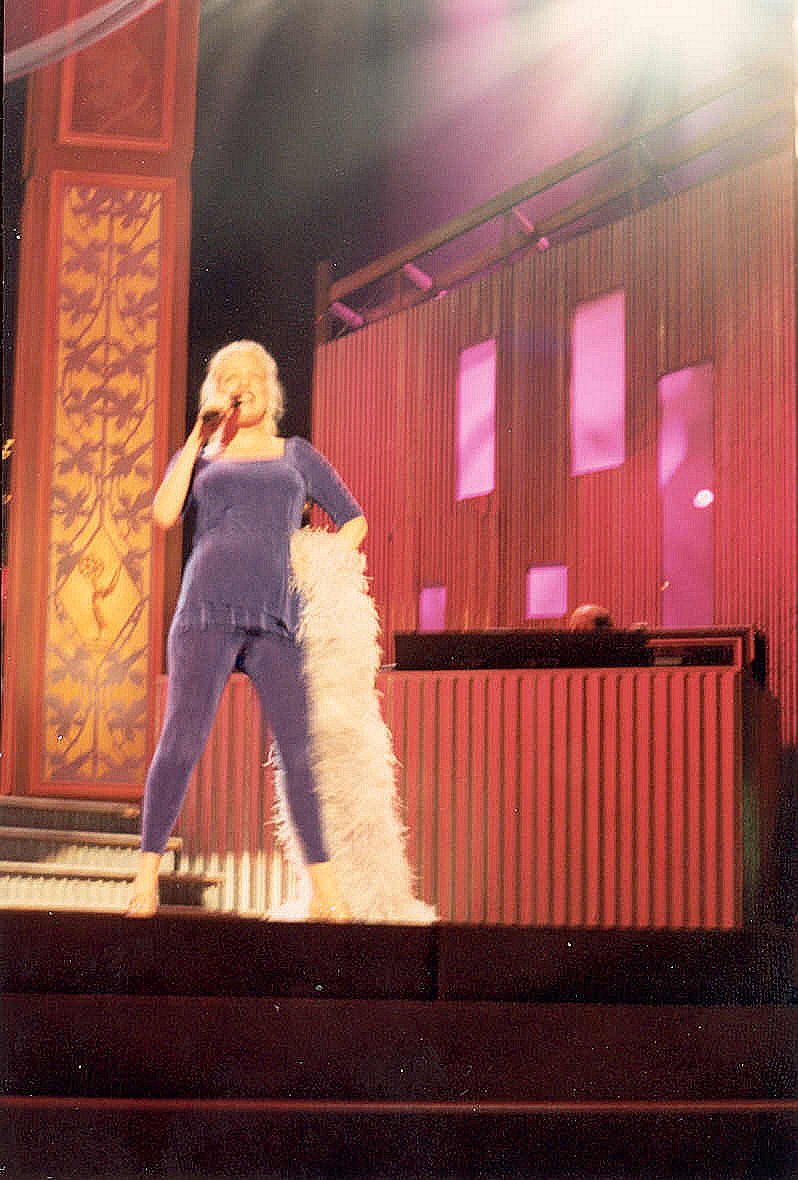
The Divine Miss M is a character — brassy, bawdy, unstoppable. But behind the character there has always been a woman of surprising tenderness: a wife of forty years, a devoted mother, and the unlikely savior of New York City’s parks. While the world was laughing at her jokes, Bette Midler was quietly building a second legacy — one measured not in Grammys but in trees planted, gardens saved, and a marriage that defied every rule of Hollywood.
This is the story of the heart behind the hits.
The Six-Week Whirlwind
Every great love story needs a great beginning, and Bette Midler’s is one of the best in show business. In November 1984, she met Martin von Haselberg — a performance artist and sculptor best known as “Harry Kipper,” one half of the boundary-pushing art duo The Kipper Kids. Six weeks later, on December 16, 1984, they eloped to Las Vegas.
The wedding was pure Midler: unpretentious, spontaneous, and slightly absurd. The ceremony took place at the Starlight Chapel, officiated by an Elvis impersonator, and cost all of $45. Midler later revealed on Jimmy Kimmel Live that she was the one who proposed — and that the whole thing was a spur-of-the-moment decision. There was no designer gown, no massive guest list, no press circus. Just two people, an Elvis, and a feeling.
Hollywood marriages that begin this fast usually end just as fast. This one didn’t. In December 2024, Midler and von Haselberg celebrated their fortieth wedding anniversary — a milestone almost unheard of in the entertainment industry, and one they marked the way they’ve marked everything: together, privately, and on their own terms.
The Secret of Forty Years
So what’s the secret? In July 2024, just months before the big anniversary, Midler gave an interview to Entertainment Tonight that sent the internet into a delighted frenzy. Asked for the key to her long-lasting marriage, the 78-year-old star didn’t hesitate: “Separate bedrooms.”
She explained that she and von Haselberg have slept in separate bedrooms since the very beginning of their relationship — and she believes it’s contributed enormously to the marriage’s longevity. A good night’s sleep, it turns out, may be the most underrated ingredient in a lasting romance.
But there’s more to it than that. Friends of the couple say the real secret is mutual respect for each other’s independence. Von Haselberg gave up his own avant-garde art career to support his wife’s — a sacrifice Midler has never taken lightly. The Kipper Kids had been genuinely notorious in the performance-art world; walking away from that to become Mr. Bette Midler took a particular kind of confidence. He became her anchor: the calm, steady presence behind the hurricane. While she was out being the Divine Miss M, he was home being Martin — and that balance held for four decades.
Sophie: The Daughter Who Chose Her Own Stage
Two years after the Las Vegas wedding, the couple welcomed their only child: Sophie Frederica Alohilani von Haselberg, born on November 14, 1986. Midler, who had spent her twenties and thirties conquering the world, threw herself into motherhood with the same ferocity she brought to everything else.
Sophie grew up to be an actress in her own right — appearing on stage and screen — but she did it on her own terms, largely out of the glare of her mother’s spotlight. Midler has always been fiercely protective of her daughter’s privacy, rarely bringing her to premieres or parading her for the cameras. Those who know the family say Sophie inherited her mother’s wit and her father’s calm — a combination that served her well growing up as the only child of the Divine Miss M.
There’s a lovely symmetry here. Midler’s own mother was a seamstress in Hawaii; Midler became the most outrageous woman in show business. Midler became the most outrageous woman in show business; her daughter became a working actress who values a quiet life. Each generation, it seems, rebels just enough.
The Bag of Trash That Started a Movement
But the most extraordinary chapter of Bette Midler’s personal life has nothing to do with marriage or motherhood. It has to do with garbage.
In the mid-1990s, Midler returned to New York after years of living in Los Angeles, and she was appalled by what she found. The parks of upper Manhattan — the green spaces of her adopted hometown — were drowning in litter and neglect. So she did what Bette Midler does: she grabbed a bag and started picking up trash herself, along the desolate stretches of the West Side Highway and in Fort Tryon Park and Fort Washington Park. She has said she simply couldn’t stand to see the city she loved wasted and overgrown — so she picked up a bag of trash, and kept picking it up.
People stared. A superstar, hauling garbage in a public park? But Midler didn’t care who was watching. She recruited friends and family to help. And then, on July 7, 1995, she did something far bigger: she founded the New York Restoration Project (NYRP), a nonprofit dedicated to revitalizing neglected parks in the city’s most economically disadvantaged neighborhoods. The city’s own Parks Department partnered with NYRP that same year to help clean and maintain Fort Tryon Park — the establishment, for once, following a volunteer’s lead.
It was the beginning of one of the great second acts in American philanthropy.
Saving the Gardens
NYRP’s early work focused on upper Manhattan and the Bronx: Sherman Creek Park, Highbridge Park, Fort Washington Park, Fort Tryon Park, and Roberto Clemente State Park. The organization planted trees, renovated gardens, restored playgrounds, and hauled away literal tons of garbage — more than 2,000 tons in the early years alone.
Then came the crisis that made NYRP a household name. In 1999, then-Mayor Rudolph Giuliani announced plans to auction off 114 community gardens to commercial developers to plug a budget shortfall. These were the scrappy, beloved green oases that neighborhood residents had built with their own hands in vacant lots across the five boroughs — and they were about to be paved over.
Midler and NYRP sprang into action, rallying a coalition of nonprofits and raising the money to save the gardens. Working with the Trust for Public Land and other like-minded organizations, they ensured the plots would remain public gardens in perpetuity — eventually establishing the New York Garden Trust to protect them forever. It was a stunning victory — a singer from Hawaii staring down City Hall and winning, for the sake of tomato plants and sunflowers in the South Bronx. The organization went on to take ownership of dozens of the most vulnerable gardens, and today NYRP owns and manages more than fifty parks and community gardens across all five boroughs.
A Million Trees
If saving the gardens was NYRP’s defining battle, the MillionTreesNYC campaign was its defining dream. In 2007, Midler was standing with Mayor Michael Bloomberg along the Harlem River, celebrating the planting of 600 cherry and crabapple trees, when she exclaimed: “Why should we stop here? We should plant one million!”
And so they did. NYRP partnered with the city’s Parks Department on an audacious campaign to plant one million trees across the five boroughs — a goal that was ultimately reached, permanently changing the landscape of New York. When the millionth tree went into the ground in the Bronx, Midler was there with Mayors Bloomberg and de Blasio to celebrate. For her work, Midler received the Jane Jacobs Medal in 2013, one of the highest honors in American urban planning. In 2012, Mayor Bloomberg presented her with the Doris C. Freedman Award for her contributions to the people of New York.
Every October, Midler throws Hulaween — a lavish Halloween party at Cipriani 42nd Street that serves as NYRP’s annual fundraiser. It is, by all accounts, the most fun charity gala in New York: part costume ball, part concert, part love letter to the city. She has done it for thirty years.
Hulaween: The Wildest Fundraiser in New York
Every October, Midler throws the party that has become a New York institution: Hulaween, a lavish Halloween costume ball at Cipriani 42nd Street that serves as NYRP’s annual fundraiser. It is part concert, part costume contest, part love letter to the city — and by all accounts the most fun charity gala in town. Midler performs, the guests outdo each other in outrageous costumes, and the money flows to the parks. She has thrown it for thirty years, and it provides a significant portion of NYRP’s budget.
It is the perfect Midler production: show business in the service of something real. The Divine Miss M on stage, the trees in the ground.
The Woman Behind the Character
Here’s what makes Bette Midler’s story so moving. The Divine Miss M was always a performance — a brilliant, hilarious suit of armor. But the woman inside the armor spent her offstage hours doing the least glamorous work imaginable: picking up other people’s trash in neglected parks, fighting City Hall for community gardens, planting trees she would never live to see fully grown.
She did it because, as she once said, she couldn’t stand to see the city she loved wasted and overgrown. So she picked up a bag of trash. That one small act grew into an organization that has transformed hundreds of acres across all five boroughs — the only citywide conservancy bringing private resources to the parks that need them most.
And she did it while maintaining one of the longest marriages in Hollywood, raising a daughter who adored her, and performing at the highest level of her art well into her seventies. The separate bedrooms, the Elvis wedding, the forty years — it’s all of a piece with the parks and the trees. Bette Midler has always done things her own way, on her own schedule, for her own reasons.
The Divine Miss M will always be the character we fell in love with — the mermaid in the wheelchair, the brassy broad with the heart of gold. But the heart was never just part of the act. It was picking up trash in Fort Tryon Park. It was proposing to a performance artist after six weeks. It was sleeping in a separate bedroom for forty years and waking up every morning still in love.
That, in the end, may be the greatest performance of Bette Midler’s life — and she never needed a stage for it at all. The Divine Miss M gave the world the laughs. Bette Midler gave her city the trees. Both will outlive her, and she knows it. Not a bad legacy for a girl from Honolulu who came to New York with a suitcase, a dream, and — eventually — a bag for picking up trash.
[END EXTERNAL CONTENT: source=file file=~/workspace/blog-drafts/artists260/81c-bette-midler.md tool_name=read]
Leave a Reply