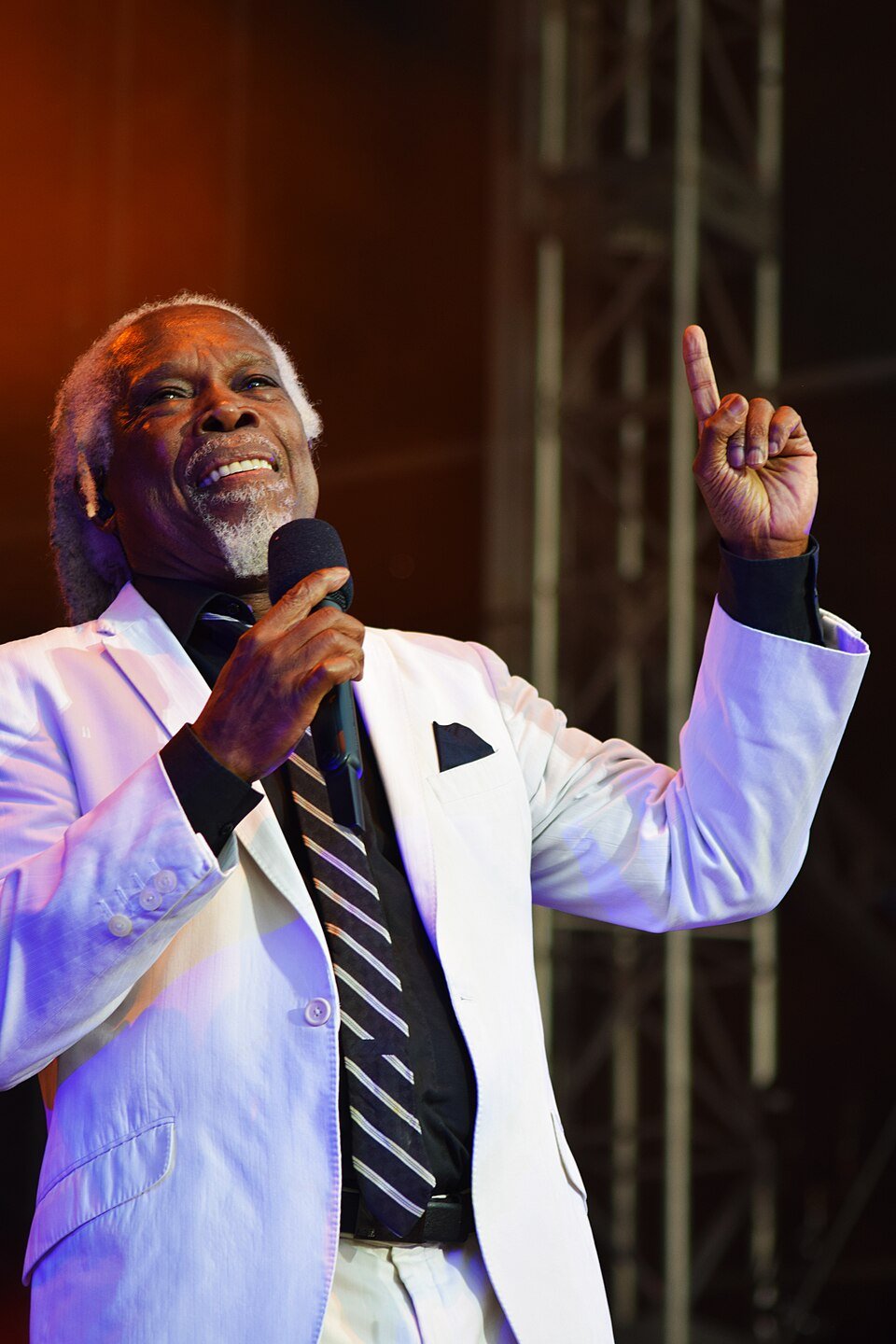
Billy Ocean has sold more than thirty million records, topped charts on three continents, and collected a Grammy. But ask him what he’s proudest of, and he won’t point to the platinum discs. He’ll point to the house in Sunningdale he bought with his first real money and never left, the school sweetheart he married in 1978, and the three children he raised far from the madness. In a business famous for burning through marriages, fortunes, and families — where the average rock marriage lasts about as long as a tour bus warranty — Billy Ocean did something almost unheard of: he kept it all. This is the story of the heart behind the hits.
The Girl from School
Long before the stage name, the Grammys, and the ocean-blue vinyl, there was Judy Bayne. Billy — then plain Leslie Charles — met her when they were schoolchildren; he was around thirteen, she was thirteen, and the future R&B superstar was just a shy boy with a big voice. They grew up together in the East End of London, and somewhere along the way, the schoolyard friendship became the love of his life.
They married in 1978, just as his career was beginning its long, frustrating climb. Judy was there for the lean years — the flop albums, the label changes, the nights when the dream looked like a delusion. She was there when “Suddenly” exploded in 1984 and turned their quiet life upside down. Friends of the couple say Judy was always the steady one, the person who kept the household sane when the phone wouldn’t stop ringing and the tour buses lined up outside. And she is still there, more than forty-five years later. In an industry where marriages are measured in months, the Oceans’ union is one of the great untold love stories of pop music — not because it was dramatic, but because it never had to be.
The House That Never Changed
When “Love Really Hurts Without You” gave Billy his first real money in 1976, he did what his mother would have wanted: he bought a house. Not a mansion in Los Angeles or a penthouse in London, but a comfortable home in Sunningdale, Berkshire — and he never left. Through the “Caribbean Queen” millions, the movie-soundtrack fortune, the Grammy and the fame, the family stayed put.
That house became the anchor of everything. While other stars of the 1980s were building empires and losing them, Billy Ocean was driving his kids to school and coming home for dinner. He has said many times that staying out of the spotlight’s orbit was a choice, not an accident. The Sunningdale house was his declaration that the music was the job and the family was the life — and he never confused the two. It is still the family home, nearly fifty years on.
Three Children, Three Paths
Billy and Judy raised three children, and — true to form — they kept them almost entirely out of the public eye. Cherie, the eldest, inherited the music gene and pursued singing, at one point signing with Jive Records herself. Antony went into music production and surprised everyone by taking up rugby sevens, representing Barbados at the 2014 Commonwealth Games in Glasgow. Rachel, the youngest, chose the most private path of all, staying resolutely out of the spotlight.
What united them was the way they were raised: in a house where their father was famous but never let fame into the living room. Ocean has spoken about the importance of keeping his children grounded, of giving them the stable childhood that his own peripatetic upbringing — Trinidad to Romford, tailoring apprenticeship to nightclub stage — never quite provided. There were no nannies raising them in his absence, no tabloid childhoods, no stage-school pressure to follow in his footsteps. Cherie found music on her own terms; Antony found it alongside sport; Rachel found a life entirely her own. He was the pop star who came home. And somewhere along the way, he became a grandfather, too — the “Suddenly” singer rocking a new generation to sleep.
Walking Away
Then came the moment that stunned the music business. In the late 1980s, at the absolute peak of his fame — fresh off “Get Outta My Dreams, Get Into My Car,” fresh off a Grammy — Billy Ocean walked away. He turned down the tours, the albums, the money, and disappeared from public life for the better part of fifteen years.
The reason was as simple as it was devastating: his mother had died, and he was shattered. In a 1993 interview on “Live with Regis and Kathie Lee,” he explained that losing her had taken something out of him. “It’s not fair,” he said of the business that kept demanding while he was grieving — “something was missing.” He needed to be home, with Judy and the kids, to grieve and to heal. So he did what almost no star at his level ever does: he stopped.
It was an act of extraordinary integrity — and extraordinary risk. The industry forgets quickly, and fifteen years is an eternity in pop. Managers warned him. The money stopped. The phone stopped ringing. But Billy Ocean had already learned, during the wilderness years before “Suddenly,” that he could survive being forgotten — he had done it once, and he could do it again. When he finally returned with 2009’s “Because I Love You,” he was betting that the songs would still be there, and that the audience would be too. They were. But the hiatus revealed the man underneath the hits: for Billy Ocean, family was never the price of fame. Fame was the thing you could walk away from. Family was the thing you couldn’t.
The Mother Who Made Him
To understand why her death stopped him cold, you have to understand what Billy Ocean’s mother meant to him. It was she who brought the family from Trinidad to Romford in London when he was young, chasing a better life. It was she who watched her son trade the Savile Row apprenticeship for the nightclub stage, and who stood by him through the lean years when the records weren’t selling. When he bought the Sunningdale house with his first hit money, it was her values he was honoring: family first, roots always.
Her loss in the late 1980s — just as he stood at the summit of his fame — hollowed him out in a way no chart position could fix. The man who had sung about love so convincingly for a decade found he couldn’t sing at all. “Something was missing,” he said, and he was right: the person who had believed in Leslie Charles before there was a Billy Ocean was gone. He didn’t walk away from success. He walked toward grief, the way a dutiful son should. Every interview he has given since carries the same undertone: everything he built, he built for her. And everything he protected — the marriage, the children, the home — he protected because she taught him what mattered.
The Quiet Faith
Those who know Billy Ocean well speak of a deeply spiritual man — a member of the Rastafari movement, whose faith has guided him through the industry’s temptations for five decades. It helps explain the choices: the loyalty to one wife, the refusal to live the rock-star life, the calm with which he walked away from millions and the grace with which he returned.
His faith is not a brand or a slogan; it’s the quiet center of a life built on conviction. In interviews, he returns again and again to themes of gratitude, patience, and trust — the belief that what is meant for you will find you, in its own time. “Suddenly” took a decade. The comeback took fifteen years. Billy Ocean was never in a hurry. He was in it for the long haul, and his faith told him the long haul was the only one worth taking. It’s the same patience that carried a boy from Trinidad through a Savile Row apprenticeship, through a decade of failure, to the top of the American charts — and then carried him home again, whole.
The Comeback and the Crown
When he did return, the industry welcomed him like a returning hero. In 2010, the MOBO Awards honored him with a Lifetime Achievement Award — a recognition from the Black British music community that meant the world to him. In 2020, he was appointed a Member of the Order of the British Empire (MBE) for services to music, the tailor’s son from Trinidad receiving one of Britain’s highest honors. He has also received an honorary doctorate from the University of Westminster, and he continues to tour the world to packed houses of fans who never forgot.
The comeback wasn’t just about nostalgia. In 2020, he released “One World,” a new album recorded with his old collaborator Barry Eastmond — a record about unity and hope that showed the voice had lost none of its silk. He has kept recording, kept touring, kept showing up. Night after night, he stands onstage and sings the songs that made him, and the audience sings them back — three generations of them now, from the fans who bought “Love Really Hurts Without You” on vinyl to the grandchildren discovering “Caribbean Queen” for the first time. The man who walked away came back on his own terms, and the crown fit better than ever.
Still the Same Billy
Ask Billy Ocean today about the secret — the marriage, the family, the sanity — and he’ll tell you there is no secret. He married his school sweetheart. He bought a house and stayed in it. He put his family first and his career second, and when the two conflicted, he chose the family every single time. It sounds simple because it is simple. It’s just that almost nobody in his business manages to do it — which is precisely what makes him remarkable.
He still lives in Sunningdale. He still talks about Judy the way he did when they were teenagers — with the easy affection of a man who never had to look twice. He still sings “Suddenly” like he means every word — because he does. The hits made him famous. The heart made him last.
Thirty million records. A Grammy. An MBE. And the thing Billy Ocean values most is a house in Berkshire, a wife of forty-five years, and three kids who grew up knowing their father. In a business that devours everything it touches, he kept the things that truly mattered — not by accident, but by choosing them, again and again, every single time it counted. The voice was the gift. The heart was the achievement.
Leave a Reply