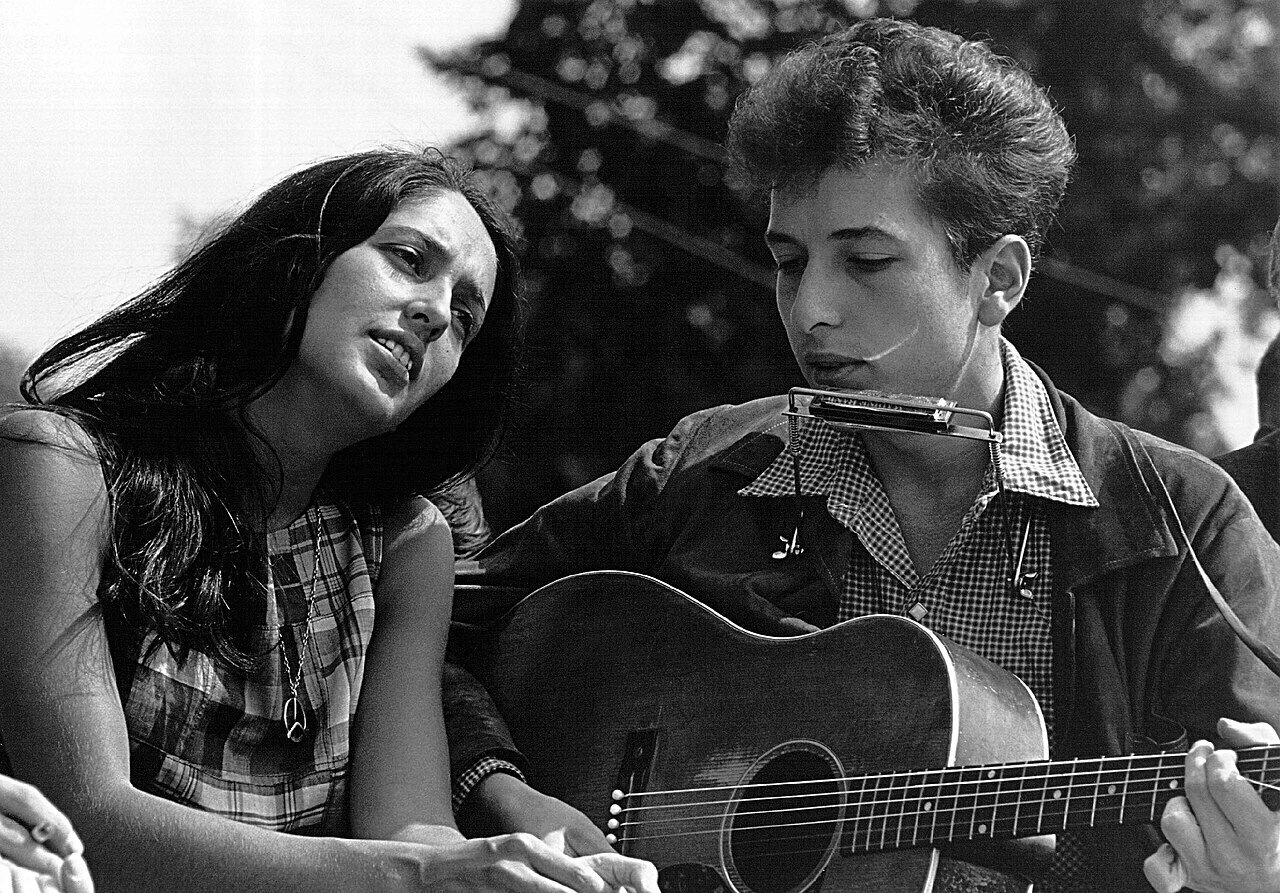

A folk hero walks into a folk festival
By the summer of 1965, Bob Dylan was not a newcomer hoping for a hearing. He was one of the central figures of the American folk revival, a young songwriter whose work had already travelled far beyond the coffee houses and clubs where he had started. His songs had been taken up by other singers, discussed in newspapers and magazines, and sung at rallies and gatherings. At the Newport Folk Festival in Rhode Island, he was a familiar and celebrated presence, someone the audience felt it knew. That familiarity is part of why what happened on the evening of Sunday, 25 July 1965, still matters. It was not a stranger shocking a crowd that had never heard of him. It was a favourite artist doing something his audience had not expected, in the place where that audience felt most at home.
Newport mattered because it was more than a concert. The folk festival presented itself as a gathering for a tradition: older blues and country musicians alongside younger revival singers, workshops in the daytime and main-stage concerts in the evening, and an audience that took the music seriously as a form of culture and, for many, as a form of conscience. For a performer, Newport offered approval from the folk community itself. For an audience, it offered a sense that the music on stage belonged to a shared project, one that valued acoustic instruments, old songs, and new songs written in the spirit of the old ones. Dylan had thrived in that world. His early reputation rested on acoustic guitar, harmonica, and a voice that sounded older and rougher than his years. People listened closely to his words, and they expected those words to arrive without drums, electric guitars, or amplification that turned a song into something else.
That expectation was already under strain before Newport. Dylan was twenty-four years old in the summer of 1965, and he was changing fast. He had spent the spring touring in Britain, and he had been recording in New York with a band. He was writing longer, stranger, more personal songs, and he was hearing possibilities in rock and roll and electric blues that did not fit neatly into the folk-revival frame. The question was not whether he would change. The question was where, and how publicly, the change would be declared. Newport provided the answer, in about fifteen minutes of loud music, followed by two quiet songs that somehow made the evening even more memorable.
The road to Newport ran through a studio in New York
The clearest sign of the change had arrived in March 1965, with the album Bringing It All Back Home. It was Dylan’s fifth studio album, released on 22 March 1965, and it was deliberately divided. One side was electric, with a full band behind him. The other side was largely acoustic, but the writing was more surreal and inward-looking than the topical songs with which many listeners still associated him. Anyone who had listened carefully to that record knew that Dylan was no longer working only in the acoustic folk idiom. The electric side was not a joke, a novelty, or a brief experiment tucked away at the end of a record. It opened the album, and it set a tone of speed, wit, and restlessness.
The next step came in June, in a New York studio, when Dylan recorded Like a Rolling Stone. The song was recorded on 16 June 1965, after sessions that had begun the day before, and it was released as a single on 20 July 1965, only five days before Newport. At more than six minutes long, it broke the usual rules for a hit single, yet it became one of Dylan’s biggest successes to that point, eventually reaching number two in the United States. Its sound was unmistakable: drums, electric guitar, and organ carrying a long, confrontational song that refused to behave like a short pop record. The musicians on the session included Mike Bloomfield on electric guitar and Al Kooper on organ, two men who would also be on stage at Newport. That connection matters, because Newport was not an isolated stunt dreamed up for one festival evening. It grew directly out of the studio work Dylan was already doing.
At the same time, Dylan was still finishing the album that Like a Rolling Stone would open. Highway 61 Revisited was recorded in sessions running from June into early August 1965, and it was released on 30 August 1965, about five weeks after Newport. When it appeared, it confirmed the direction that Newport had announced. It was a largely electric record, full of blues, rock and roll, and surreal imagery, and it has since been treated as one of the defining albums of the decade. Newport, then, sits in the middle of a run of work rather than at the end of it: after Bringing It All Back Home, during the Highway 61 Revisited sessions, and just after the release of the single that would become the new album’s opening track. The festival performance was a public preview of a change that was already under way in the studio.
Saturday: the acoustic Dylan, one last time that weekend
Dylan performed twice during the 1965 festival. On Saturday, 24 July, he took part in an afternoon workshop devoted to contemporary songs, playing acoustically. The songs in that workshop set included All I Really Want to Do, Tombstone Blues, Mr. Tambourine Man, If You Gotta Go, Go Now, and Love Minus Zero/No Limit. For anyone in the audience that afternoon, there was nothing to suggest that the following evening would be different in kind. Dylan was still, in that setting, the acoustic singer-songwriter they recognised, presenting new material in the familiar folk-festival format of a daytime workshop.
That Saturday performance is worth remembering because it sharpens the contrast with Sunday. It shows that Dylan had not simply abandoned his acoustic work, or arrived at Newport determined to insult the festival. He could still do the workshop, still play the quieter songs, and still be heard clearly in that context. The difference on Sunday was not that Dylan had forgotten how to play acoustically. It was that he chose, for the main evening stage, a different sound altogether, and he chose it at the moment when the largest audience was listening. The workshop and the evening set belong together in the story: one shows continuity, the other shows a break, and both were Dylan in the same weekend.
The festival itself was also presenting electric blues that weekend through the Paul Butterfield Blues Band, whose members were at Newport. That fact is important, because it complicates any simple story in which electric instruments were entirely foreign to Newport. They were not. What was new was Dylan, the folk revival’s most famous young songwriter, stepping onto the main stage with an electric band of his own. The surprise was personal as much as musical. It was about who was plugging in, not only about the fact that somebody, somewhere at the festival, was using an amplifier.
Sunday night: three electric songs
On Sunday evening, 25 July 1965, Dylan walked onto the main stage carrying a Fender Stratocaster electric guitar, backed by a band assembled for the occasion. The band included Mike Bloomfield on electric guitar, Al Kooper and Barry Goldberg on keyboards, Jerome Arnold on bass, and Sam Lay on drums. Bloomfield, Arnold, and Lay were members of the Paul Butterfield Blues Band, while Kooper and Goldberg were brought in alongside them. The group had very little rehearsal time, which is part of why the performance sounds urgent rather than polished. This was not a touring band that had spent months learning an act. It was a band put together quickly, around songs Dylan had recently recorded or was in the process of recording, and it played as if it knew the moment would not come again in quite the same form.
The electric set itself was short: three songs. Dylan opened with Maggie’s Farm, a track from Bringing It All Back Home, played at a fast, driving tempo. He followed it with Like a Rolling Stone, the single released only five days earlier, which was also its first live performance. The third electric song was an early version of It Takes a Lot to Laugh, It Takes a Train to Cry, then known under the working title Phantom Engineer. After those three songs, Dylan left the stage, and then returned alone with an acoustic guitar for two further songs: It’s All Over Now, Baby Blue and Mr. Tambourine Man. The whole evening set, electric and acoustic together, therefore consisted of five songs, but it is the three electric songs that gave the night its name in popular history.
It is worth pausing on the choice of songs, because they were not random. Maggie’s Farm came from the electric side of Bringing It All Back Home, so it linked the Newport stage directly to the album Dylan had released in March. Like a Rolling Stone was the brand-new single, and playing it at Newport meant presenting his most ambitious recent recording to an audience that still largely knew him acoustically. The third song pointed forward to Highway 61 Revisited, which was still being finished. In other words, the short set was a compact summary of where Dylan had been, where he was, and where he was going, all in the space of three songs. A longer set might have diluted that effect. A shorter, sharper set made the point impossible to miss, even if it also left part of the audience wanting more, or wanting something else entirely.
What the crowd actually did: a disputed noise
The most famous part of the Newport story is also the least settled. Accounts agree that the reaction was mixed, with cheers and boos heard together, but they disagree about how loud each response was, who was booing, and why. That disagreement is not a minor footnote. It shapes how we understand the night, and any honest retelling has to present the dispute rather than smoothing it into a single, dramatic scene.
One explanation is the simplest and the most often repeated: some members of the audience booed because Dylan had gone electric, and they regarded electric instruments as a betrayal of folk music. In this version, the booing was a judgement on the sound itself, and on what the sound seemed to represent: commercial rock and roll replacing an acoustic tradition that the folk revival held dear. There is real evidence for this view, in the sense that some folk-revival listeners did object to electric instruments, and some did feel that Dylan was leaving them behind. But it is not the whole story, and later witnesses have complicated it considerably.
A second explanation points to the sound quality. Several people who were present, including festival figures and musicians, later said that the amplification was poor, the mix was muddy, and Dylan’s words were hard to hear. On that account, some of the hostile reaction was frustration with distortion and volume, not a verdict on electric music in principle. The folk festival’s sound system had been set up primarily for acoustic performance, and a loud electric band was a different technical challenge. If the audience could not hear the singing clearly, the performance would have felt unsatisfying even to listeners who were open to the new direction.
A third explanation points to the length of the set. Festival sets that weekend were generally much longer than fifteen minutes, and Dylan was the headline attraction of the evening. Al Kooper later argued that part of the upset came from brevity: the audience had expected a substantial set from the festival’s biggest name and instead received three electric songs before Dylan left the stage. On this reading, some of the noise was disappointment at a short performance, rather than, or in addition to, disapproval of the instruments. These three explanations are not mutually exclusive. Different people in a large crowd can boo, cheer, or shout for different reasons at the same time, and a single evening can contain all three reactions at once.
The story of Pete Seeger illustrates how quickly a vivid detail can harden into myth. Seeger, a central figure in the folk revival and a founder of the festival’s spirit, is often said to have tried to cut the power cables with an axe because he hated the electric sound. Seeger himself later denied that version. In a letter written in 1990, and in interviews late in his life, he said that his anger was about the distorted sound, and that he could not understand the words of Maggie’s Farm. He also pointed out that he admired electric playing by other musicians, including Howlin’ Wolf, who had used electric instruments at Newport earlier in the festival. The axe story, as usually told, should therefore be treated as disputed and probably exaggerated, not as an established fact. What can be said with more confidence is that Seeger was upset on the night, that his upset concerned the sound, and that later retellings turned a backstage argument about amplification into a much more dramatic tale.
The acoustic return also complicates the story. When Dylan came back alone with an acoustic guitar, the applause was warm, and the two closing songs gave the evening a reflective ending. Some writers have read those songs as a farewell to Newport, and in a sense they were: Dylan did not return to the Newport Folk Festival until 2002, thirty-seven years later. But the acoustic encore should not be read as an apology, or as proof that Dylan regretted the electric set. He returned, played two of his best-known acoustic songs, and then continued in the electric direction he had already chosen. The encore settled the evening for the audience, but it did not reverse the decision.
After Newport: the electric years begin in earnest
Newport did not end Dylan’s career, and it did not end the argument, but it did mark a point after which there was no plausible way back to the old frame. Within weeks, Highway 61 Revisited was released, and Dylan went on tour that autumn with an electric band. The following year brought Blonde on Blonde, completing a trio of mid-1960s albums that reshaped his reputation: Bringing It All Back Home, Highway 61 Revisited, and Blonde on Blonde. Together, they showed that the Newport performance was not a one-night experiment. It was the public announcement of a sustained new phase, in which Dylan’s writing, electric blues, and rock and roll were fused into something that neither folk purism nor straightforward pop could easily contain.
The touring years that followed were often confrontational. Audiences in Britain and America sometimes reacted with the same mixture of cheers and hostility that had been heard at Newport, only spread across whole concerts rather than a single short set. The most famous later episode came on 17 May 1966 at the Free Trade Hall in Manchester, England, when a member of the audience shouted a hostile word at Dylan during the electric part of the show, and Dylan answered back before telling his band to play loudly. That moment, like Newport, has been retold many times, and like Newport, it is often simplified. What it confirms, however, is that the argument that began at Newport did not stay at Newport. It followed Dylan on tour, because the change he had announced was not a costume he could take off at the end of a festival evening. It was the basis of his new work.
It is also important not to overstate what Newport changed overnight. Folk music did not disappear, acoustic songwriting did not end, and Dylan himself would return to quieter, more acoustic approaches at various points in his later career. What changed was the idea that a folk-revival star had to remain within acoustic limits to be taken seriously, and the idea that rock and roll could not carry serious, complex writing. After Newport, and after the albums that followed it, those boundaries looked less like rules and more like preferences, open to argument. Other musicians were already exploring similar territory, and the wider movement that came to be called folk-rock drew on many sources, not on one night alone. Newport’s importance lies in how sharply it made the argument visible, not in any claim that Dylan invented a whole genre single-handed on one stage.
For Dylan personally, the night also clarified a relationship with his audience that would define much of his later career. He had been treated, especially in the early 1960s, as a voice for a movement, someone whose songs could be claimed by a cause or a generation. Newport showed, in public, that he would not accept that role on other people’s terms. He would follow his own writing, even when it disappointed people who had invested heavily in an earlier version of him. That independence could look stubborn, ungrateful, or brave, depending on where a listener stood. What it was not, in the long run, was temporary. Dylan’s career after 1965 is full of further turns, some welcomed and some resisted, and the pattern of a large audience arguing with an artist it admired begins, for many listeners, at Newport.
Why the night still draws us back
Sixty years on, it is easy to wonder why a fifteen-minute electric set should still be discussed at all. Part of the answer is the music itself. The three electric songs at Newport are strong songs, and Like a Rolling Stone in particular has endured as one of the most widely discussed recordings of the twentieth century. Hearing it played live for the first time, only days after its release as a single, with a hastily assembled band, gives the song a different charge from hearing the studio version alone. The Newport performance is rough, loud, and imperfect, and those imperfections are part of its appeal. They remind us that a turning point in music is not always a polished masterpiece. Sometimes it is a short, risky performance that sounds as if it might fall apart, and then does not.
Another part of the answer is the argument itself. Newport crystallised a debate that still recurs whenever a popular artist changes direction: who does the music belong to, the artist or the audience that first loved it? Folk revivalists at Newport felt a sense of ownership, because they had helped to create the world in which Dylan became famous. Dylan felt a sense of authorship, because the songs were his to develop. Neither feeling was unreasonable, and neither could fully win. The night endures because that tension has never gone away. Every generation of listeners meets it again, in different styles and with different instruments, whenever a favourite artist moves somewhere unexpected.
The surviving film and recordings add a further reason to keep returning. Murray Lerner filmed Dylan at Newport across 1963, 1964, and 1965, and his later film The Other Side of the Mirror, released in 2007, allows viewers to watch the change unfold across three festival years. Martin Scorsese’s documentary No Direction Home also uses Newport material in telling the story of Dylan’s early career. Watching those films, it is possible to see the acoustic Dylan and the electric Dylan as the same person, only a short time apart, and to notice how much of the change was already present in his manner, his humour, and his restlessness before the amplifiers were switched on. The footage does not settle the argument about booing, but it does make the human scale of the night clearer. This was a young man, a small band, and a large field of listeners, all trying to work out, in real time, what kind of music they were hearing.
For a listener coming to the story today, the best way in is probably through the records that surround the night, rather than through the mythology alone. Start with Bringing It All Back Home, and notice how the electric first side and the acoustic second side sit together on one album. Then listen to Like a Rolling Stone as a single, and notice its length, its organ, and its drums. Then listen to Highway 61 Revisited, released at the end of August 1965, and notice how fully the electric sound has become Dylan’s working language. After that, the Newport performance makes more sense, not as a betrayal or a triumph in isolation, but as the live moment when a studio direction became a public statement. The three electric songs, heard in that context, sound less like a provocation for its own sake and more like a musician testing, in front of the hardest possible audience, whether his new songs could stand up on stage.
There is also a quieter lesson in the two acoustic songs that closed the evening. It’s All Over Now, Baby Blue and Mr. Tambourine Man are both songs from the acoustic side of Dylan’s work, and hearing them after the electric set is a reminder that Newport did not erase the earlier Dylan. It added to him. The acoustic songs were still there, still beautiful, and still his. What had changed was that they were no longer the whole story. A listener who wants to understand Dylan’s career needs both halves: the quiet songs that made him a folk hero, and the loud songs that made him argue with the very audience that had crowned him. Newport is the night when both halves were heard in the same evening, a few minutes apart, and the contrast between them is still startling.
In the end, the most durable fact about Newport 1965 may be the simplest one. A twenty-four-year-old songwriter, who had already changed popular music once with his acoustic songs, decided that he would not stop there. He took a band he had barely rehearsed onto the main stage of the folk festival that had helped to make him famous, played three electric songs, and then returned alone to sing two acoustic ones. People cheered, people booed, and people have argued ever since about why they did either. The albums that followed proved that the change was real, and the long career that followed proved that it was only the first of many changes. That is why the night is still told, still filmed, still written about, and still worth hearing with fresh ears: not because it settled anything, but because it showed, in public, what it sounds like when an artist refuses to stay in the place where his audience first found him.
Image credit: Close-up of an electric guitar, via Pexels, free licence (thematic image only, not a photograph of Bob Dylan; photographer not identified in the returned result)
Sources / further reading
- Bob Dylan 1965 Newport Festival Programme, bobdylan-comewritersandcritics.com: https://www.bobdylan-comewritersandcritics.com/pages/programmes/dylan-newport-folk-festival-1965.htm
- Consequence, “Revisit Bob Dylan’s electric performance at Newport Folk Festival 50 years later”: https://consequence.net/2015/07/watch-bob-dylan-go-electric-at-the-newport-folk-festival-50-years-later/
- Ultimate Classic Rock, “Did Fans Really Boo Because Bob Dylan Went Electric at Newport?”: https://ultimateclassicrock.com/bob-dylan-goes-electric-newport/
- Far Out Magazine, “Read Pete Seeger’s apology letter to Bob Dylan”: https://faroutmagazine.co.uk/pete-seeger-letter-bob-dylan/
- Wikipedia, “Like a Rolling Stone”: https://en.wikipedia.org/wiki/Like_a_Rolling_Stone
- Wikipedia, “Highway 61 Revisited”: https://en.wikipedia.org/wiki/Highway_61_Revisited
- YouTube, “Maggie’s Farm (Live at Newport Folk Festival, Newport, RI – July 1965)”, provided to YouTube by Columbia: https://www.youtube.com/watch?v=32Rz7RLKUWA
Leave a Reply