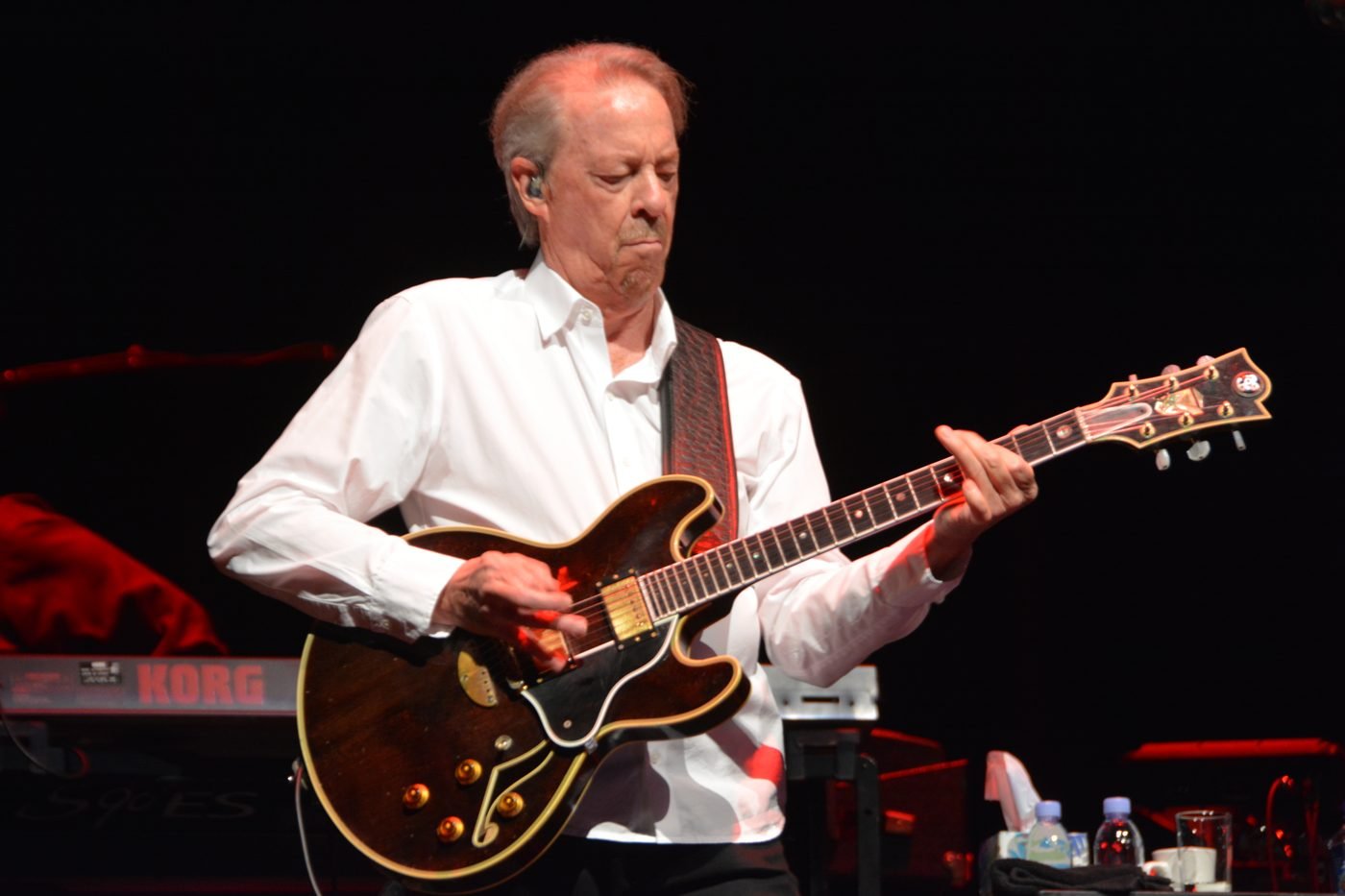
Boz Scaggs sings like a man who has lived — because he has. Behind the silky voice and the immaculate suits is a life marked by the things that mark all of us: marriages that didn’t last and one that did, children who found their way and one who didn’t, a vineyard built with love and lost to fire, and a nightclub that became a San Francisco institution. He has rarely talked about these things in detail. He is, by all accounts, a private man — and a deeply thoughtful and generous one. But the private life explains the voice — the warmth, the weariness, the romantic who always sounds like he knows how the story ends. This is the heart behind the hits.
Two Marriages
Scaggs married his first wife, Donna Carmella Storniola, in 1973, just as his solo career was finding its footing. They had two sons together, Austin and Oscar. The marriage didn’t survive the seventies — they divorced in 1980, with joint custody arrangements settling into place around 1983. It was the classic rock-star story: the road, the pressure, the fame that arrived with Silk Degrees and changed everything. Scaggs has never spoken bitterly about it. Some chapters just end.
The second marriage has been the lasting one. In 1992, Scaggs married Dominique Gioia, and the two built a life together in Northern California that has now endured for more than three decades. Friends describe Dominique as his anchor — the partner who shared his love of wine, food, and the good life, and who stood with him through the losses that were coming. In a business where marriages are measured in months, theirs is measured in decades. They made their home in the Napa Valley, among the vines and the hills, far from the Los Angeles machinery that had made him famous. It was a deliberate choice: a quieter life, built on purpose.
The Quiet Californian
To understand Boz Scaggs the man, you have to understand that he never wanted to be a celebrity — he wanted to be a musician. While his peers were cultivating images, Scaggs was cultivating interests: wine, food, sailing, the pleasures of a life well-lived offstage. He gives interviews sparingly and deflects personal questions with the ease of a man who has been doing it for fifty years. He is unfailingly polite, often funny, and almost impossible to truly know.
This reticence is not arrogance; it is self-preservation. Scaggs watched the seventies chew up and spit out more talented people than he can count, and he decided early that the way to survive was to keep something for himself. The stage persona — the sharp suits, the easy charm, the voice like expensive bourbon — is real, but it is also a suit of armor. Underneath is a Texan who still thinks of himself as a working musician, a craftsman who shows up, does the job beautifully, and goes home to his vines.
Losing Oscar
On December 31, 1998 — New Year’s Eve, a night the rest of the world spends celebrating — Boz Scaggs lost his younger son, Oscar, to a heroin overdose. There is no way to write about this gracefully, because there is nothing graceful about it. It is the worst thing that can happen to a parent, and it happened to a man whose public image was all smoothness and control.
Scaggs has spoken about Oscar rarely and carefully, and that restraint deserves respect. What is known is that the loss shadowed everything that came after. When you hear Scaggs sing a ballad like “We’re All Alone” in the years since — that voice catching on the edges of the words — you are hearing a man who knows what it means to be truly alone with grief. He kept working. He kept touring. That is what professionals do. But those who watched him closely say the light changed, that a new gravity entered the music. Grief, for a singer, is not just an emotion; it is an instrument, and Scaggs learned to play it whether he wanted to or not.
If there is any meaning to be taken from such a loss, it is this: it humanized a singer who could sometimes seem too polished to be real. The smoothness remained, but it was no longer the whole story.
Like Father, Like Son
The elder son, Austin Scaggs, found his own way into the family business — sideways. He became a music journalist, writing for Rolling Stone, where his interviews and features carried the family ear for what matters in a song. There is something poignant and perfect about it: the son of a rock star who chose to write about rock stars, who grew up backstage and decided the best seat in the house was the one with the notebook.
Austin’s career has been substantial in its own right — a respected byline at one of the most famous music magazines in the world, a deep knowledge of the music, none of the tortured rock-kid clichés. For a father who lost one son, the other son’s thriving must be both a comfort and a complicated joy. The Scaggs family story, like so many, holds grief and gratitude in the same hand, and Austin has carried the family name in journalism with the same quiet professionalism his father brought to the stage.
The Vineyard
In 1996, at an age when most rock stars are buying sports cars, Boz Scaggs planted 2.2 acres of vines in Napa Valley. Grenache, Mourvedre, Syrah, Counoise — Rhône varietals, the connoisseur’s choice. He bottled his first wine in 2000, earned organic certification in 2006, and built a small, respected label. This wasn’t a celebrity vanity project; Scaggs was genuinely obsessed, a student of soil and climate who happened to have a famous voice.
The vineyard was an expression of who he had become: a man who valued patience, craft, and the slow reward. Wine, like music, can’t be rushed. You plant, you wait, you tend, and years later you taste what you made. For a singer who had spent his youth chasing hits, there was something deeply appealing about an art form measured in vintages rather than chart weeks. He walked the rows himself, learned the language of soil and sun, and earned the respect of neighbors who cared nothing for his gold records. In 2016, he sold the vineyard plot to Newfound Wines — a changing of the guard, but the vines he planted are still producing, still turning California sunshine into something worth savoring.
The Fire
Then came October 2017. While Scaggs was on tour, wildfires tore through Napa and Sonoma counties in one of the most destructive fire seasons California had ever seen. His house burned to the ground. He lost the vineyard property, his cars, and — the detail that hurts musicians most — a collection of lyric napkins and notes, the raw material of songs, the archaeology of a career.
He learned about it the way you learn about disasters when you’re on the road: a phone call, far from home, with nothing to do but keep playing the show. The response from the music community was immediate and warm — benefit concerts, messages of support, the tribal solidarity of people who understand that a musician’s home is also their archive. Scaggs rebuilt. What else was he going to do? But the fire took things that can’t be replaced, and he has carried that knowledge quietly ever since.
https://www.youtube.com/watch?v=n0_-Zz8EVOA
Slim’s
Long before the vineyard, there was the nightclub. In 1988, Scaggs opened Slim’s in San Francisco — a mid-sized venue that quickly became one of the city’s essential rooms. Everybody played Slim’s: legends, newcomers, secret shows, career-defining nights. Scaggs wasn’t just a name on the door; he was a genuine club owner who cared about sound, sightlines, and treating artists right.
Slim’s survived earthquakes, recessions, and the transformation of the music business. It closed in 2020, a casualty of the pandemic era that shuttered venues across the country. Thirty-two years is an eternity for a nightclub — most don’t make it to five. For a generation of Bay Area music fans, Slim’s wasn’t just a venue — it was where they saw their favorite band in a room small enough to feel like a secret, where they discovered their next obsession on a Tuesday night. That was Boz Scaggs’ gift to his adopted hometown, and it outlasted almost everything else he built. When the doors finally closed, the tributes poured in from musicians who had played there and fans who had grown up there. A club, it turns out, can be a legacy too.
Still on the Road
Through all of it — the divorce, the death of his son, the fire, the closing of his club — Scaggs never stopped making music. His album Dig was released on September 11, 2001, a date that swallowed every other story that day; the record’s quiet virtues were unfairly overlooked in the national trauma. He kept recording, kept touring, kept refining, releasing a string of well-crafted albums that his loyal audience treasured even when radio had moved on. In October 2025, he released Detour on Concord Records, still singing in that unmistakable voice, still finding new corners of soul and R&B to explore, still backed by players who revere him.
There is something quietly heroic about a career like this. No scandals, no desperate comebacks, no reality shows — just decade after decade of showing up and singing beautifully. The road has been his constant: the bus, the band, the nightly communion with audiences who have grown old alongside him.
There is a lesson in Boz Scaggs’ life, though he would be the last person to preach it. The hits are wonderful — “Lowdown,” “Lido Shuffle,” “We’re All Alone” will outlive us all. But the man behind them is more interesting than the chart positions. He is a father who buried a son and kept singing. A husband who found lasting love the second time around. A winemaker who lost his vines to fire and didn’t become bitter. A club owner who gave his city thirty-two years of music.
The voice was always the giveaway. Nobody sings that warmly without having loved deeply, and nobody sings that wistfully without having lost. The smoothness was never emptiness — it was control, the discipline of a man who had decided that whatever chaos life threw at him, the music would remain beautiful, the show would go on, the note would land. Boz Scaggs: the heart behind the hits, still beating, still on the road, still showing up night after night to prove that grace under pressure is its own kind of artistry.
Leave a Reply