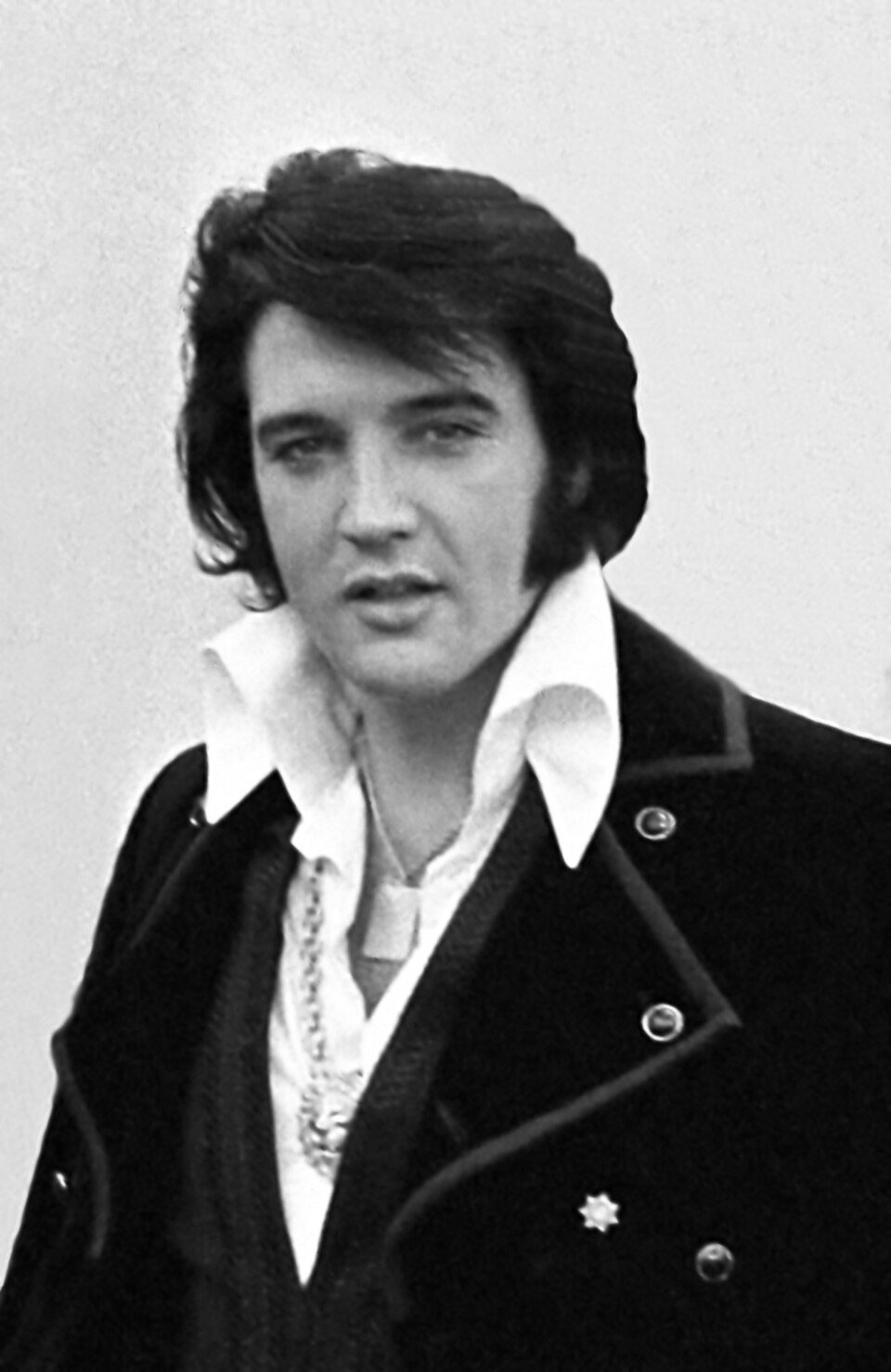
Caught in a Trap: How Elvis Presley Turned “Suspicious Minds” Into His Last Great Comeback
At four o’clock on a freezing January morning in 1969, Elvis Presley walked into a recording studio in one of the roughest neighborhoods in Memphis, Tennessee, and began singing for his career. He had not recorded in his hometown in fourteen years. He had not had a number one record in seven. The movies that had once made him the biggest star on earth had become a joke he was in on but could not escape. And yet, in a converted movie theater at 827 Thomas Street, in front of a group of young session musicians he barely knew, the thirty-four-year-old King of Rock and Roll was about to cut the record that would put him back on the throne — a song he had learned only days earlier, written by a struggling staff songwriter, recorded between karate exercises in the middle of the night, and finished with one of the strangest endings in pop history.
This is the story of “Suspicious Minds” — the song Elvis Presley almost never recorded, the producer who fought for it, the manager who tried to kill it, and the fifteen seconds of studio trickery that turned a fade-out into a legend.
The King in Exile
To understand what happened in Memphis in January 1969, you have to understand how far Elvis Presley had fallen. It seems impossible now, but by the mid-1960s the most electrifying performer in American music had become a punchline. The British Invasion had rewritten the rules of rock and roll while Elvis was stuck in Hollywood, churning out formula pictures with titles like “Clambake,” “Harum Scarum,” and “Double Trouble.” The films made money, but the music inside them was forgettable, and Elvis knew it. He had gone from the man who scared Ed Sullivan’s censors to a movie star singing to a bulldog.
The charts told the story plainly. His last number one single, “Good Luck Charm,” had topped the Billboard Hot 100 in the spring of 1962. Since then: nothing. Year after year, the singles charted lower and lower, while the Beatles, the Rolling Stones, Motown, and the entire counterculture moved the center of popular music somewhere Elvis was not invited. By 1968, the King of Rock and Roll was, commercially speaking, a nostalgia act — and he was only thirty-three years old.
Then came December 1968 and the television special that changed everything. Officially titled “Elvis” but remembered forever as the ’68 Comeback Special, the NBC broadcast put Presley in black leather, in front of a live audience, playing his old songs with a ferocity nobody had seen from him in a decade. The famous “sit-down” jam session portion of the show — Elvis loose, laughing, and trading licks with his old bandmates — reminded America what it had been missing. The special was a triumph of ratings and, more importantly, a triumph of credibility. Elvis was cool again. He was dangerous again. He was, impossibly, himself again.
But a television special, however brilliant, is one night. The question hanging over Memphis that winter was whether Elvis Presley could make a record that mattered — a record for 1969, not 1956. He needed new songs, a new sound, and, though almost no one around him would admit it, a new way of working. That is what brought him to American Sound Studio.
The Studio on Thomas Street
American Sound Studio was not Graceland. It was not even close. The building at 827 Thomas Street sat in a tough part of North Memphis, a converted theater that producer Chips Moman had turned into one of the most productive hit factories in American music. By 1969, Moman and his house band — a crack group of young Memphis session players known as the Memphis Boys — had already cut hits for B.J. Thomas (“Hooked on a Feeling”), the Box Tops (“The Letter,” “Cry Like a Baby”), and Dusty Springfield, whose landmark “Dusty in Memphis” album had been recorded there the previous year. The studio’s sound was a deep, warm blend of country, soul, rhythm and blues, and gospel — exactly the musical gumbo Elvis had grown up on, and exactly what his Hollywood records had been missing.
Getting Elvis to American Sound was the work of his Memphis friends, particularly Marty Lacker, who convinced him that Moman’s studio — not an RCA facility in Nashville or Hollywood, with all the old habits and old yes-men — was where the comeback had to happen. It was a bold suggestion. Elvis had not recorded in Memphis since his Sun Records days in 1955, back when Sam Phillips was still discovering what the kid from Tupelo could do. Fourteen years later, he was coming home.
The sessions were booked for January 1969: roughly ten days of recording, with Moman producing and Elvis’s longtime RCA producer Felton Jarvis also present. Moman was not a man easily impressed by fame, and he ran his studio like a craftsman, not a fan club. He had opinions about material, about arrangements, about everything — and he expected the artist, even an artist named Elvis Presley, to listen. That friction would produce some of the greatest music of Elvis’s life. It would also produce one of the great backstage battles in rock history.
The Songwriter Who Wrote His Own Heartbreak
“Suspicious Minds” did not begin with Elvis Presley. It began with a Texas songwriter named Francis Rodney Zambon, who wrote under the name Mark James. Moman had brought James to Memphis from Houston to be a staff writer for American Sound, and James had already tasted success writing hits like “Hooked on a Feeling” and “Eyes of a New York Woman” for B.J. Thomas. But “Suspicious Minds” was personal in a way those songs were not. James later said it grew out of his own tangled love life — a song about two people trapped in a relationship neither can leave and neither can fix, caught, as the lyric puts it, in a trap from which “we can’t walk out.”
James recorded the song himself in 1968 with Moman producing, releasing it on Scepter Records. It went nowhere. Commercially, “Suspicious Minds” was a dead song — one more failed single in a business full of them. But Moman believed in it, and when he learned that Elvis Presley was coming to American Sound, he told James to start writing songs for the King. James had one he didn’t need to write. He just needed Elvis to hear it.
Moman played James’s Scepter record for Presley early in the sessions. According to Moman’s later account to The Wall Street Journal, Elvis was immediately hooked: “I played him Mark’s Scepter record, and he was crazy about it. He wanted to hear the song over and over again, and learned it on the spot.” Moman made a cassette tape for him, and Elvis took it home to study, playing it until the song lived in his bones. The King of Rock and Roll, who could have had any song in the world, had fallen for a flop — and he was about to stake his entire comeback on it.
James himself was almost too nervous to be in the room. He later recalled visiting the studio once during the sessions, sensing that his presence made Elvis uncomfortable, and mostly staying away. On one visit he ran into Presley leaning against a studio baffle during a break. “Hey Elvis, I heard you might cut ‘Suspicious Minds,’” James said. “Hey Mark, been thinking about it,” Elvis replied — cool, noncommittal, unmistakably Elvis. The songwriter went home and waited.
Four in the Morning
The recording session for “Suspicious Minds” began at 4:00 AM on January 23, 1969, and ran until about 7:00. Elvis worked best at night — always had — and Moman was happy to keep the studio running on Presley time. The band was the Memphis Boys at their peak: Reggie Young on guitar, whose stinging, lyrical playing would become one of the record’s signatures; Tommy Cogbill on bass; Bobby Wood on piano; Bobby Emmons on Hammond organ; Gene Chrisman on drums; Mike Leech handling string arrangements; and a horn section that gave the track its urgent, brassy punch.
The atmosphere, by all accounts, was focused but loose. Elvis was relaxed enough to practice his karate moves between takes — he had become serious about the discipline and liked to work through forms in downtime. Moman kept the takes coming. At the end of the seventh take, Moman asked through the talkback, “You have one more in ya?” Elvis answered simply: “Yeah.” One more take was all it took. Eight takes total, cut between four and seven in the morning, and the master was in the can — with Elvis overdubbing additional vocals that same night.
What they had captured was extraordinary. “Suspicious Minds” is a pressure cooker of a record: it starts low and coiled, Elvis singing almost conversationally over a pulsing rhythm, and builds verse by verse into something desperate and huge. The lyric — about suspicion poisoning a love affair, about two people who “can’t walk out” because “we’ve got too much to lose” — gave Elvis something he rarely got from his Hollywood material: an adult emotion, sung by an adult. You can hear him believing every word. The Memphis Boys played it like a soul record, because that’s what it was — a soul record sung by the man who had invented rock and roll.
But before the song could change Elvis’s life, it nearly died in a conference room.
The Colonel’s Cut
Colonel Tom Parker, Elvis’s manager, had built his entire operation on a simple principle: Elvis Presley did not record a song unless the Presley organization got a piece of the publishing. It was standard practice in Parker’s world — songwriters who wanted the incomparable career boost of an Elvis cut routinely surrendered half their publishing royalties as the price of admission. For most writers, it was a bargain worth making. For Chips Moman, it was theft.
When Parker learned that Elvis had cut “Suspicious Minds” — a song whose publishing Parker did not control — he moved to stop the recording from being released. According to contemporary accounts, Parker demanded his usual cut of the song and threatened to shelve the track if he didn’t get it. Moman, who had the publishing through his own company, refused. The standoff escalated until Moman threatened to shut down the entire session and throw Elvis Presley out of his own studio.
It was an astonishing moment: a Memphis producer telling the most famous entertainer in the world to get lost. And in a move that surprised almost everyone who knew the dynamics of the Presley organization, Elvis sided with the producer. He told his people to back off. He knew — maybe for the first time in years, he truly knew — that this song was his lifeline, and he was not going to let the business kill it. “Suspicious Minds” would be released as Moman had made it. The Colonel had lost.
The rest of the American Sound sessions were just as productive. Out of those January and February days came “In the Ghetto,” “Don’t Cry Daddy,” “Kentucky Rain,” “Long Black Limousine,” and the bulk of what would become “From Elvis in Memphis” — the album many critics still call the finest of his career, a rich, mature, deeply soulful record that finally gave the comeback a musical foundation to stand on. Even the B-side of the “Suspicious Minds” single, the gentle “You’ll Think of Me,” showed the new range Elvis had found in Memphis: tender, unhurried, and utterly convincing. The King was not just making hits again. He was making records that sounded like the man he had always wanted to be.
The Fifteen-Second Scar
If you have ever heard “Suspicious Minds” on the radio, you know the strangest thing about it. About three and a half minutes in, just as the song reaches its emotional peak, it starts to fade away. The band gets quieter. Elvis gets quieter. You think it’s over. And then — fifteen seconds later — the horns blast back in, Elvis roars back for one more desperate chorus, and the song surges to its real ending. It is one of the most famous false endings in popular music. And it was never supposed to happen.
The fade-out was added after the Memphis sessions by Felton Jarvis, Elvis’s longtime RCA producer, who had been present at American Sound but had let Moman run the show. According to Moman’s 2012 interview with The Wall Street Journal’s Marc Myers, Jarvis was never comfortable with Elvis recording outside the RCA system. “It was a control thing,” Moman said. “So when Jarvis took the tape of ‘Suspicious Minds,’ he added this crazy 15-second fade toward the end, like the song was ending, and brought it back by overdubbing to extend it. I have no idea why he did that, but he messed it up. It was like a scar.”
Moman hated it. He thought it ruined the flow of the track they had worked so hard to capture. But here is the thing about scars: sometimes they become the most distinctive thing about a face. Another account holds that Jarvis was trying to replicate what Elvis had started doing with the song on stage — during his triumphant return to live performance that summer at the International Hotel in Las Vegas, his first concerts since 1961, Elvis had made “Suspicious Minds” the centerpiece of the show, stretching it to seven minutes by letting it “end,” collapsing dramatically, and then rising again for a final chorus as the audience went wild. Jarvis, hearing that reaction night after night, decided to bake the drama into the studio master.
Whatever the motive, the fake ending worked. It turned the record’s structure into a mirror of its lyric: a song about a relationship that keeps trying to end but can’t let go, given an ending that keeps trying to end but can’t let go. Radio listeners in 1969 would turn up the volume during the fade, thinking the song was over, only to be hit by the returning horns. It was a trick, a gimmick, a scar — and it became the song’s signature. Elvis performed the extended ending on stage for the rest of his life.
Back on Top
“Suspicious Minds” was released as a single on August 26, 1969, backed with “You’ll Think of Me.” The timing was perfect. Elvis was in the middle of his historic Las Vegas engagement — four weeks at the International Hotel that announced his return to live performance after an eight-year absence — and the single rode that wave of excitement straight up the charts. On November 1, 1969, “Suspicious Minds” reached number one on the Billboard Hot 100.
It had been seven years since “Good Luck Charm.” Seven years of bad movies, declining sales, and irrelevance. Now Elvis Presley, at thirty-four, was back on top of the pop charts with the most contemporary-sounding, most emotionally committed record he had ever made. The single would sell nearly two million copies. And though nobody knew it at the time, it would be the last number one single of his lifetime — the final chart-topper of a career that had begun with “Heartbreak Hotel” thirteen years earlier.
“From Elvis in Memphis,” released that summer, confirmed that the single was no fluke. The album was a revelation: deep, gospel-soaked, country-soul music, sung by a man who sounded like he had something to prove and everything to lose. Critics who had written Elvis off were forced to reconsider. The comeback was not a television stunt. It was real, and it was built on the Memphis sessions.
The Memphis Boys
The musicians behind “Suspicious Minds” deserve to be named, because they were not anonymous studio hands — they were one of the great American rhythm sections, and Elvis knew it. The Memphis Boys were the house band at American Sound: guitarist Reggie Young, bassist Tommy Cogbill, pianist Bobby Wood, organist Bobby Emmons, and drummer Gene Chrisman, with arranger Mike Leech writing the string and horn charts. They were young, mostly in their twenties, and they had a telepathic tightness that came from cutting hits together day after day.
Reggie Young, in particular, was a phenomenon. His guitar work on “Suspicious Minds” — the stinging fills that answer Elvis’s vocal, the coiled tension of the verses — is as much a part of the record’s identity as the singing. Young would go on to become one of the most recorded guitarists in Nashville history, playing on hundreds of hits, but musicians still talk about the American Sound years as his peak. Gene Chrisman’s drumming gave the track its relentless forward push; Bobby Emmons’s Hammond organ added the gospel grit; Bobby Wood’s piano and Tommy Cogbill’s bass locked the groove into place.
What made the Memphis Boys right for Elvis was that they did not treat him like a monument. Moman’s studio ran on a simple principle: the song comes first, egos come second. Elvis, who had spent years recording with musicians too intimidated or too professional to challenge him, found himself in a room where the band played with the confidence of men who had made hits without him. It brought out something in him. Listen to the “Suspicious Minds” master and you hear a singer responding to a band, not a band following a singer. That had not happened on an Elvis record in a very long time.
Years later, the Memphis Boys would scatter to Nashville and Los Angeles session work, carrying the American Sound method with them. But for ten days in January 1969, they were the best band in the world, and they had the best singer in the world standing in front of them at four in the morning.
The Vegas Centerpiece
“Suspicious Minds” had not even been released when Elvis Presley walked onto the stage of the International Hotel in Las Vegas on July 31, 1969. It was his first live concert appearance since 1961 — eight years away from the stage — and nobody, least of all Elvis, knew if the magic would still work in person. The ’68 Comeback Special had been television. This was real: a showroom, a live band, an audience that had paid to see a legend and might leave having seen a ghost.
They did not leave disappointed. The International Hotel engagement — four weeks, two shows a night — became one of the most celebrated residencies in entertainment history, and “Suspicious Minds” was its centerpiece. Elvis performed the song as a full theatrical production: the band would play it to what seemed like the end, the lights would dim, Elvis would sink to the stage as if spent — and then, as the audience erupted, he would rise and drive the song to an even bigger finish. Stretched to six or seven minutes, it was less a song than a resurrection ritual, performed nightly.
This was the stage version Felton Jarvis had tried to capture with his studio fade-out. Whether or not Moman approved of the edit, Jarvis had understood something real: “Suspicious Minds” was not a song that ended. It was a song that refused to end. Night after night in Vegas, Elvis proved it — collapsing and rising, fading and returning, caught in the trap of his own greatest performance. The audiences that summer were watching a man who had been written off come back to life in front of them, and the song’s fake ending gave them the perfect metaphor: you thought it was over? Watch this.
The Vegas engagement also confirmed the commercial logic of the comeback. The single, released on August 26 in the middle of the residency, had the entire machinery of Elvis’s renewed fame behind it: the television special, the live triumph, the new album. When it hit number one on November 1, it was not a fluke or a nostalgia vote. It was the sound of the biggest star in the world operating at full power again.
The Afterlife of a Scar
Great songs outlive their chart runs, and “Suspicious Minds” has had one of the richest afterlives in pop history. In 1986, the British band Fine Young Cannibals took the song back into the top ten with a sleek, modern arrangement — proof that Mark James’s melody and lyric were strong enough to survive being stripped of their Memphis soul setting entirely. Country artists, rock bands, and pop singers have been cutting it ever since, each finding something new in the song’s architecture of tension and release.
The song’s reputation among critics has only grown. It appears on virtually every major list of the greatest songs ever recorded, and “From Elvis in Memphis” — the album it anchored — is routinely cited as the creative peak of Presley’s career, the record that proved the comeback was about music, not marketing. The American Sound sessions as a whole produced a run of hits — “In the Ghetto,” “Don’t Cry Daddy,” “Kentucky Rain” — that gave Elvis a contemporary catalog to stand beside his fifties landmarks.
And then there is the fade-out. The fifteen seconds that Chips Moman called a scar became one of the most imitated and discussed production choices of the era. Producers and engineers still argue about whether Jarvis was right. Moman went to his grave in 2016 believing the edit damaged the record. But ask any listener what they remember about “Suspicious Minds,” and the false ending is always in the answer — the moment the song dies and comes back, the trick that turned a great single into an unforgettable one. Sometimes the scar is the signature.
Mark James, the struggling staff writer who stayed away from the studio because he made Elvis uncomfortable, got the last laugh on history. “Suspicious Minds” made him one of the most successful songwriters of his generation — he would go on to co-write “Always on My Mind,” the song Willie Nelson took to the top of the charts in 1982 — and his brief, awkward exchange with Presley by the studio baffle became part of rock and roll lore. He wrote a song about being trapped. It set him free.
Why It Endures
More than half a century later, “Suspicious Minds” remains the definitive Elvis Presley comeback record — and one of the definitive records of his entire career. It regularly appears on lists of the greatest songs of all time, and its influence runs through decades of pop, rock, and soul. The song has been covered by everyone from Waylon Jennings to the Fine Young Cannibals, whose 1986 version took it back into the top ten, proving that the song’s bones were strong enough to survive any arrangement.
But the record’s real legacy is what it represents: the moment Elvis Presley stopped being a product and became an artist again. Think about what had to go right. Mark James had to write a song out of his own heartbreak. Chips Moman had to believe in a failed single enough to play it for the King. Elvis had to be brave enough to record in Memphis, in a strange studio, with strange musicians, at four in the morning. He had to stand up to Colonel Parker — the man who had controlled his career for fourteen years — and say, in effect, this song matters more than the deal. And Felton Jarvis had to add fifteen seconds of studio trickery that everyone involved argued about and that nobody has ever forgotten.
Every comeback needs a song. For Elvis Presley, the greatest comeback in rock and roll history needed “Suspicious Minds” — a song about not being able to walk away, recorded by a man who finally refused to walk away from himself. He was caught in a trap, the lyric says, and he couldn’t walk out. In January 1969, in a studio on Thomas Street in Memphis, Elvis Presley stopped trying to walk out. He stayed, he sang, and he won. The scar and all, it remains perfect — the sound of a king reclaiming his crown at four in the morning, one take at a time, and history has never let it fade.
Leave a Reply