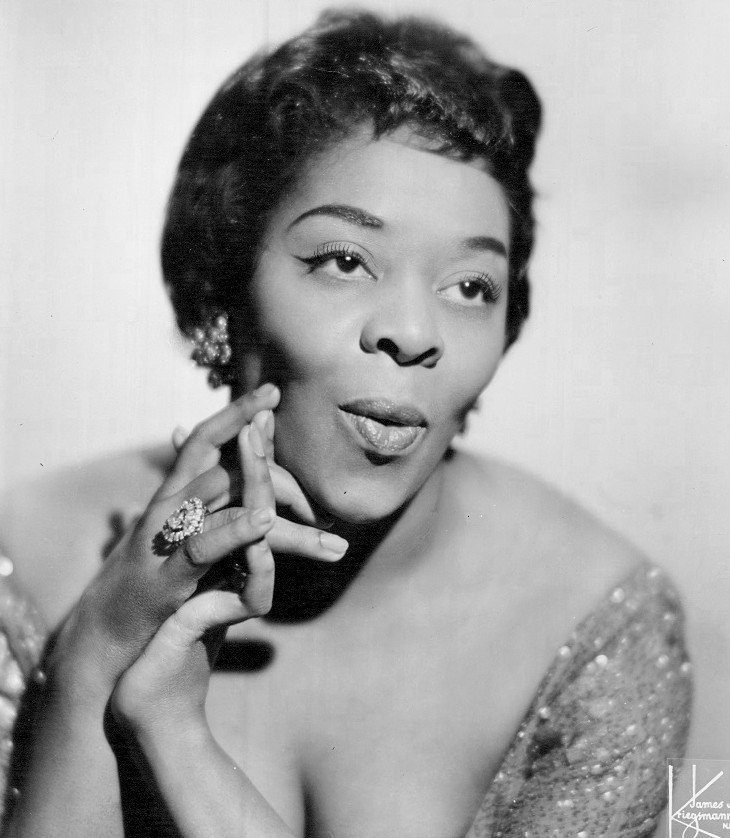

Dinah Washington was born Ruth Lee Jones on 29 August 1924 in Tuscaloosa, Alabama, and raised in Chicago, where gospel singing in church gave her first training and her first audience. She sang with a clarity and a bite that made every word land, and she could move, in a single evening, from a blues shout to a tender ballad without ever sounding as if she were trying on a style that did not fit her. By the time she reached her thirties she had already lived several musical lives: gospel singer, big-band vocalist, rhythm-and-blues star, and jazz interpreter. The record that finally carried her to the widest audience of her career, however, was not a blues at all in the narrow sense. It was a song written in Spanish in 1934, given English words, dressed in strings, and released in 1959 under the title “What a Diff’rence a Day Makes” — a record that won her a Grammy Award, reached the pop top ten, and fixed her in the public mind as something more than a blues singer, even though the blues never left her voice.
To understand why that record mattered, it helps to start with the singer rather than the song. Washington grew up in a household where music was part of daily life, and in Chicago she sang in the choir at St. Luke’s Baptist Church, where her mother played piano and organ. Gospel taught her timing, breath control, and the art of making a line sound like a personal statement rather than a performance. It also taught her something less obvious: that a singer could be both disciplined and free, holding a melody steady while bending a note just enough to make it hurt or to make it swing. Those lessons stayed with her through every change of repertoire. When she sang the blues, she did not imitate the roughness of the form; she brought to it the precision of a gospel singer and the phrasing of a jazz musician. When she sang a popular ballad, she did not soften her attack; she brought to it the directness of a blues singer who had learned, in clubs and on bandstands, that an audience will forgive almost anything except vagueness.
From Ruth Lee Jones to Dinah Washington
Washington’s professional break came in the early 1940s, when she joined Lionel Hampton’s band. Hampton, a bandleader with an ear for strong singers, gave the young vocalist a stage name — Dinah Washington — and a place in a working band that toured, recorded, and played for dancing audiences night after night. The experience was a hard education. A band singer in that era had to be heard over brass, had to learn a large repertoire quickly, and had to hold a crowd that had come to dance as much as to listen. Washington learned all of it, and she learned something else besides: how to make a song her own in the short space of a single chorus, so that even a familiar tune sounded like a story she was telling for the first time.
After Hampton, she recorded for Keynote and then, decisively, for Mercury Records, where in the late 1940s and through the 1950s she built a catalogue that crossed the boundaries of the record business as it was then organised. Her Mercury records included blues, rhythm-and-blues, jazz standards, and popular songs, and they sold to audiences that the industry usually treated as separate markets. She was, in the language of the time, a “race records” star and a jazz singer and, increasingly, a popular singer, all at once. The nickname “Queen of the Blues” stuck to her, and it was deserved, but it was also incomplete. It described one part of her gift and, by doing so, sometimes hid the rest. Washington herself seemed untroubled by labels. She sang what she liked, in the way she liked, and trusted the voice to make the connection.
The 1950s brought her a run of rhythm-and-blues hits that made her one of the most reliable sellers on the Mercury roster. Songs such as “Teach Me Tonight” and “This Bitter Earth” showed different sides of her: the first a warm, swinging popular song, the second a slow, aching ballad that let her hold notes until they seemed to fill the room. She also recorded duets, including the celebrated pairing with Brook Benton on “Baby (You’ve Got What It Takes)”, which reached the pop top ten in 1960 and showed how naturally her voice blended with a male singer without losing its edge. Through all of this, she remained a club and concert singer of formidable reputation. People who heard her live remembered not only the voice but the presence: a small woman with a large sound, a singer who could be funny, flirtatious, angry, or heartbroken within a single set, and who never seemed to be going through the motions.
A Song from 1934 Finds a New Singer
“What a Diff’rence a Day Makes” began life as “Cuando vuelva a tu lado”, a Spanish-language song written in 1934 by the Mexican composer María Grever. English words were later written by Stanley Adams, and the song had already been recorded by several artists before Washington ever touched it, including early versions in the 1930s that treated it as a straightforward romantic ballad. What Washington and her arranger did in 1959 was to slow it down, give it a gentle swing, and frame the voice with strings and a wordless chorus that seemed to hover behind her rather than compete with her. The result sounded both old and new: a song with a long history, sung as if it had been written for that moment, in that studio, for that voice.
The recording session itself was not a grand occasion in the way later legends sometimes suggest. Washington was a working singer making a record with an orchestra, doing what she had done hundreds of times before. What made the difference was the fit between the song and the singer. The melody moves in a way that lets a singer linger on certain notes and hurry through others, and Washington used that freedom with complete assurance. She sings the opening lines almost conversationally, as if telling a friend something surprising, and then lets the chorus open out, the strings rising under her, the wordless voices answering her. It is a performance of great restraint. She never pushes, never shouts, never decorates a line for its own sake. The emotion comes from the steadiness of the singing, from the sense that this is a woman who has seen enough of life to know that a single day really can change everything, and who is not going to oversell the point.
The record was released in 1959 and became Washington’s most successful solo single, reaching the pop top ten and winning the Grammy Award for Best Rhythm and Blues Performance in 1959. The Grammy matters not only as a prize but as evidence of how the record was heard at the time: it was recognised, by an industry that loved categories, as a rhythm-and-blues performance, even though its arrangement and its audience were plainly pop. That double identity was Washington’s whole career in miniature. She had made a pop record without abandoning the blues feeling that had made her famous, and she had made a blues singer’s record that pop radio could play without apology.
Why the Record Still Works
Part of the record’s durability lies in its simplicity. The lyric says, in essence, that yesterday a person was lost and today that person is found, and that the difference was made by love. It is not a complicated idea, and Washington does not complicate it. She sings it plainly, and the plainness is what makes it moving. A more elaborate performance would have dated quickly; a simpler one might have sounded thin. Washington finds the middle ground, where the singing feels both personal and universal, as if she is singing about her own life and, at the same time, about anyone who has ever woken up to find the world changed overnight.
The arrangement helps, and it is worth listening to it closely. The strings are present but never heavy; they cushion the voice rather than carrying it. The rhythm section keeps a light, steady pulse, the kind of pulse that lets a singer breathe naturally. The wordless chorus, which could easily have sounded like a gimmick, instead sounds like a memory: voices in the background, half-heard, as if the past were still present in the room. Washington sings over all of this with a diction so clear that every word can be understood on a first hearing, even on a small radio speaker of the kind most listeners owned in 1959. That clarity was one of her great gifts, and it is why her records still sound fresh when so many of her contemporaries sound muffled or mannered.
There is also the matter of timing. By 1959, popular music was changing fast. Rock and roll had arrived, the charts were filling with younger singers, and many established singers of Washington’s generation were struggling to find a place. Washington did not chase the new sound, and she did not retreat into nostalgia either. She made a record that belonged to no single fashion, and for that reason it outlasted most of the fashions around it. It is still played, still covered, still used in films and television, not because it was a novelty but because it was, in the best sense, timeless: a good song, well arranged, sung by a singer who understood it completely.
The Last Years and the Legacy
Washington’s life after 1959 was short. She continued to record and perform, made further records that showed her range, and remained a formidable live singer. She died on 14 December 1963, at the age of thirty-nine, from an accidental overdose of prescription medication, a death that shocked the music world and cut short a career that still seemed to be growing. The brevity of her life has sometimes led writers to treat her as a tragic figure, but that is only half the story. The other half is the work itself: a catalogue of hundreds of recordings, a reputation among musicians as one of the great singers of her generation, and an influence that can be heard in singers as different as Nancy Wilson and Aretha Franklin, both of whom cited Washington as a model.
Aretha Franklin’s connection is especially telling. Franklin, who would go on to become the Queen of Soul, recorded a tribute album to Washington in 1964, shortly after Washington’s death, and the gesture was more than formal. Franklin had grown up hearing Washington, and she understood what Washington had done: she had shown that a Black woman singer could move between gospel, blues, jazz, and pop without asking permission from any of those worlds, and that she could do so while remaining unmistakably herself. That lesson mattered enormously to the generation that followed, and it still matters. Washington’s career is a reminder that categories in popular music are often conveniences for record companies, not descriptions of how singers actually work.
Today, “What a Diff’rence a Day Makes” is Washington’s signature song for most listeners, and it deserves that place. But it should not be allowed to stand alone. A listener who starts with that record and then moves on to her blues, her jazz standards, and her duets will discover a singer of extraordinary range, a singer who could be tough and tender in the same phrase, who could swing hard and then, a moment later, sing a ballad so quietly that a room would fall silent. That range is the real story of Dinah Washington. The 1959 record was not a departure from it; it was a summary of it, a single performance that contained, in miniature, everything she knew about singing. A day, the song says, can make all the difference. In Washington’s case, a single record, made in a single session, made the difference between a great singer known mainly to jazz and blues audiences and a great singer known to everyone.
Sources / further reading
- Grammy Awards: Dinah Washington, Best Rhythm and Blues Performance, 1959, for “What a Diff’rence a Day Makes”.
- Great American Songbook Foundation: Dinah Washington collections highlight, including “What a Diff’rence a Day Makes” and its 1959 Grammy.
- WRTI: “Queen of the Blues and then some: in awe of Dinah Washington at 100” (2024).
- Encyclopaedia and reference entries on Dinah Washington (born Ruth Lee Jones, 1924–1963), Lionel Hampton, Mercury Records, and the Grever–Adams song history.
Image credit: Image: Franco Monsalvo via Pexels, free licence (thematic stage image, not a photograph of Dinah Washington).
Leave a Reply