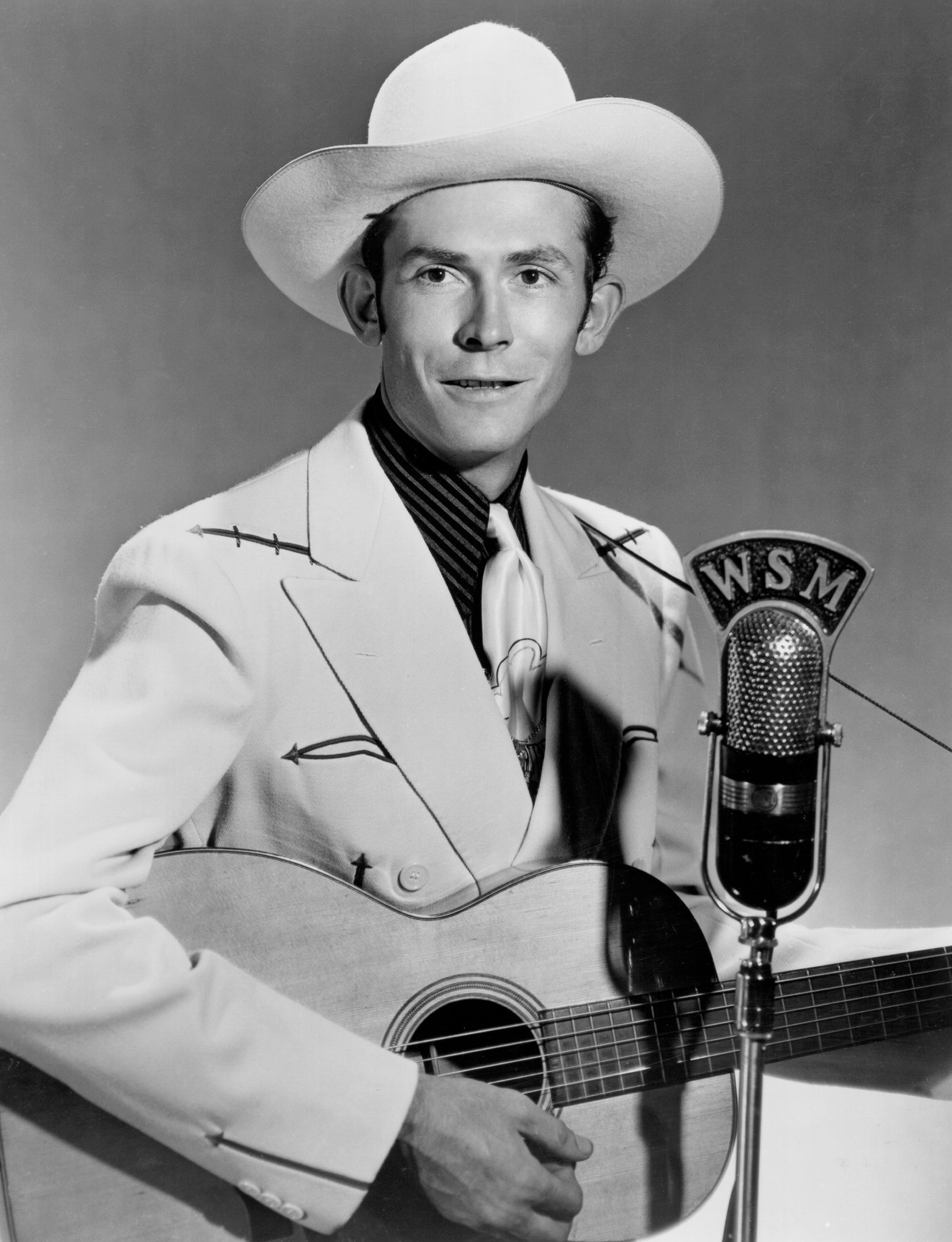

Hank Williams was born Hiram Williams on 17 September 1923, in Mount Olive, Alabama, and raised in the poor, rural South during the Depression. His father was often absent, his mother ran a boarding house, and the boy learned guitar from a Black street musician named Rufus Payne, known as Tee Tot, who taught him blues chords and showmanship in exchange for meals and small change. Williams sang on a local radio station as a teenager, formed a band called the Drifting Cowboys, and, after wartime work in a shipyard, began the climb that would make him, in a career of barely six years, the most influential singer-songwriter in the history of country music. His songs — “Lovesick Blues,” “I’m So Lonesome I Could Cry,” “Cold, Cold Heart,” “Jambalaya,” “Your Cheatin’ Heart” — became the language of country music itself, covered by singers in every genre, quoted by songwriters as scripture, and still played on country radio decades after his death.
Williams’s gift was for plain speech. He wrote lyrics that sounded like things people actually said, or wished they could say, and he sang them in a voice that was high, keening, and unmistakably Southern, with a yodel that came from his hero Jimmie Rodgers and a phrasing that came from the blues. He did not write about abstract ideas. He wrote about loneliness, drinking, faith, cheating, and the fear of hell, because those were the subjects of his life. By 1949, with “Lovesick Blues,” he was a star on the Grand Ole Opry, the most important stage in country music. By 1951 he was one of the biggest names in American popular music, with hits crossing over to the pop chart and a touring schedule that would have exhausted a healthier man. He was also, by then, in serious trouble. He drank heavily, he suffered from back pain caused by spina bifida, he took painkillers and other drugs, and his marriage to Audrey Sheppard Williams, herself a singer and a forceful manager of his career, was collapsing. In August 1952 the Opry fired him, officially for missing shows and for unreliability, and the firing was a public humiliation for a man who had been its brightest star.
A song written in a car
“Your Cheatin’ Heart” is, according to the story most often told, a product of that collapsing marriage. Williams and Audrey divorced in 1952, and Williams soon began a relationship with Billie Jean Jones, whom he would marry in October of that year. As the story goes, Williams was driving with Billie Jean from Shreveport, Louisiana, to Nashville, talking bitterly about Audrey, when he used the phrase “cheatin’ heart” to describe her. Billie Jean is said to have suggested that the phrase would make a good song title, and Williams, so the story continues, dictated the lyric to her as they drove, finishing much of it before they arrived. Like many stories about Williams, this one cannot be verified in every detail, and it has been told in slightly different versions by different people. What is not in doubt is that the song was written in 1952, in the middle of the divorce, and that it draws directly on the language of betrayal and blame that filled Williams’s life at that time. The lyric addresses a faithless lover directly, in the second person, and predicts, with grim satisfaction, that the lover will weep, will walk the floor at night, and will learn that a cheating heart will, in the end, tell on its owner. It is not a forgiving song. It is a song written by a man who felt wronged and who wanted the wrongdoer to feel it too.
The recording session that produced “Your Cheatin’ Heart” took place on 23 September 1952, at Castle Studio in Nashville’s Tulane Hotel, with the producer and publisher Fred Rose supervising. It was Williams’s last recording session. The band included some of Nashville’s finest players — Chet Atkins on electric guitar, Don Helms on steel guitar, Tommy Jackson on fiddle — and Williams sang with the weary authority of a man who knew the lyric was true in his own life, even if the details were his to keep. The session also produced “Kaw-Liga,” “I Could Never Be Ashamed of You,” and “Take These Chains from My Heart,” all of which became posthumous hits. That a single afternoon’s work could yield four enduring records is a measure of Williams’s genius at the end of his life, and a measure of how much was lost when he died three months later. He was twenty-nine years old.
Death on New Year’s Day
Williams died in the early hours of 1 January 1953, in the back seat of a car on the road to a New Year’s Day concert in Canton, Ohio, near Oak Hill, West Virginia. He had been travelling with a young driver, Charles Carr, and had been given injections, including morphine and vitamin B12, by a doctor in the days before, in an attempt to treat his back pain and his drinking. The official cause of death was heart failure, brought on by a combination of alcohol and drugs, though the exact sequence of events has been debated ever since. He was buried in Montgomery, Alabama, where his funeral drew thousands of mourners and where his grave remains a place of pilgrimage. The news of his death travelled fast, and the records he had just made took on a new meaning overnight. A song about a cheating heart, recorded by a man who had just died at twenty-nine, no longer sounded like a clever country lyric. It sounded like a last testament.
“Your Cheatin’ Heart” was released in January 1953 as the B-side to “Kaw-Liga,” and it went to number one on the country chart, where it stayed for six weeks. The fact that it was a B-side that became a number one in its own right tells us something about Williams’s standing: disc jockeys and listeners simply turned the record over, because anything with his name on it was worth hearing. The song was later inducted into the Grammy Hall of Fame, and it has been covered by an extraordinary range of singers, from Ray Charles, whose version brought the song to a rhythm-and-blues and pop audience, to Patsy Cline, Elvis Presley, and countless country singers who treated it as a test piece. Joni James and Frankie Laine both had pop hits with it in 1953, which shows how quickly the song travelled beyond country music. A 1964 Hollywood biopic of Williams took the song’s title, with George Hamilton playing Williams and Hank Williams Jr. singing the soundtrack, a film that introduced a new generation to the story, even if it smoothed the roughest edges of the life.
Why the song still cuts
Part of the song’s endurance is musical. The melody is simple, almost a chant, built on a few notes that a singer can bend and stretch, and the lyric’s central image — a heart that cheats, that will not stay faithful, that will betray its owner in the end — is vivid without being complicated. A listener does not need to know anything about Williams’s divorce to understand the song, because the feeling it describes, of being betrayed and of wanting the betrayer to feel the same pain, is universal. But part of the endurance is also biographical, and it is the part that makes the song uncomfortable as well as powerful. Williams wrote a song accusing his wife of infidelity at a time when his own infidelities, drinking, and unreliability were well known to everyone around him. The song’s moral certainty — the cheater will suffer, the faithful will be vindicated — sits uneasily beside a life in which Williams himself was often the one who caused pain. Listeners have always sensed that tension, and it is one reason the song rewards repeated listening. It is not a simple morality tale. It is a man, in pain, pointing a finger, and the finger points, in the end, at everyone, including himself.
That tension is also what makes Williams himself so enduring as a figure. He is often described as country music’s first tragic genius, and the description, though overused, fits. He lived fast, wrote brilliantly, self-destructed publicly, and died young, leaving a body of work that other songwriters have spent seventy years trying to match. His son, Hank Williams Jr., and his grandson, Hank Williams III, both built careers in his shadow, and the family story — talent, trouble, and early death — has become a kind of legend in itself. But the legend should not obscure the work. Williams wrote more than a hundred songs, many of them in a few short years, and the best of them have a directness that has not dated. “I’m So Lonesome I Could Cry” is still, by common consent, one of the finest lyrics ever written in American popular music, and “Your Cheatin’ Heart” is still, for many listeners, the most immediate of his songs, the one that hits first and hardest.
The afterlife of a last session
There is a final, quiet detail about the last session that deserves to be remembered. Williams recorded “Your Cheatin’ Heart” with a band of professionals who knew they were working with a difficult, gifted, and visibly unwell singer, and who played with a restraint that lets the vocal carry the record. Chet Atkins, who would go on to become one of Nashville’s most important producers, later spoke of Williams’s ability to make a song sound inevitable, as if it had always existed and he had merely found it. That is the quality that separates Williams from the many songwriters who imitated him. His songs do not sound written. They sound overheard, as if the listener has walked into a room where someone is telling the truth about a marriage, a drink, or a lonely night, and has forgotten that anyone is listening. “Your Cheatin’ Heart,” written in a car, recorded in an afternoon, released after its author’s death, and still sung today, is the purest example of that quality. It is a song about betrayal that betrays, in its turn, how much its author understood about the human heart — including, perhaps especially, his own cheating heart, and the hearts of everyone who has ever sung along with it and meant every word.
Luke the Drifter, the gospel songs, and the other Hank Williams
Williams’s career contained a second, quieter body of work that is often overlooked beside the hits, and it is essential to understanding him. Under the pseudonym Luke the Drifter, Williams recorded a series of spoken-word and semi-spoken moral tales — recitations about death, judgement, faith, and the consequences of a wasted life — that his record company feared would confuse his honky-tonk audience if released under his own name. Records such as “Too Many Parties and Too Many Pals” and “Be Careful of Stones That You Throw” are stern, sermon-like performances, closer to a preacher than to a bar singer, and they reveal a side of Williams that the drinking songs hide: a man raised in a religious household, haunted by the idea of hell, and convinced that his own life was a cautionary tale. The Luke the Drifter records did not sell as well as the hits, but they were important to Williams, who insisted on making them, and they show that his moral imagination was larger than the honky-tonk. He was not only singing about cheating and drinking. He was singing about the judgement that, in his faith, followed them.
The gospel songs tell a similar story. Williams recorded “I Saw the Light” (1948), a song about conversion and redemption that became a standard in churches as well as on country radio, and he sang gospel songs in his live shows, often closing with a hymn. The tension between the gospel singer and the honky-tonk singer — between the man who sang “I Saw the Light” and the man who sang “Your Cheatin’ Heart” — is the central tension of Williams’s life and art. He lived, as many Southerners of his generation did, between Saturday night and Sunday morning, and his songs give voice to both nights. That is why his music has lasted in churches as well as in bars, and why songwriters as different as Bob Dylan, who has often cited Williams as an influence, and the rock musicians who covered his songs, have found something in him to admire. Dylan, in particular, has spoken of Williams as a songwriter who wrote with a directness that rock and roll later tried to imitate, and whose songs, for all their simplicity, contain a whole worldview: that life is short, that love fails, that faith offers a way out, and that the way out is hard to find.
Williams’s influence, measured in covers alone, is immense. “Cold, Cold Heart” became a pop hit for Tony Bennett in 1951, a fact that surprised Williams and pleased him, because it proved his songs could travel beyond country music. “Jambalaya (On the Bayou)” became a hit for Fats Domino and for the Carpenters, among many others. “I’m So Lonesome I Could Cry” has been recorded by singers in every genre, and is often cited, in polls of songwriters, as one of the greatest lyrics in American popular music. That a man who died at twenty-nine, who recorded for barely six years, and who left behind a catalogue written largely in hotel rooms, cars, and studios between shows, could have such an influence, is a measure of his genius. “Your Cheatin’ Heart,” the last song of that short life, is not an outlier in that catalogue. It is its summary: a plain lyric, a keening vocal, a story about love and betrayal, and a melody that will not leave the listener alone.
Sources
- Colin Escott, Hank Williams: The Biography (1994, revised editions)
- Country Music Hall of Fame biography and exhibits on Hank Williams
- Billboard chart history for “Your Cheatin’ Heart” and “Kaw-Liga” (1953)
- Grammy Hall of Fame listing for “Your Cheatin’ Heart”
- Session records for the 23 September 1952 Castle Studio session, Nashville
- Contemporary reporting on Hank Williams’s death, January 1953
Image credit: Piano keyboard, CC0, Raysonho, via Wikimedia Commons (thematic image, not a photograph of Hank Williams).
Leave a Reply