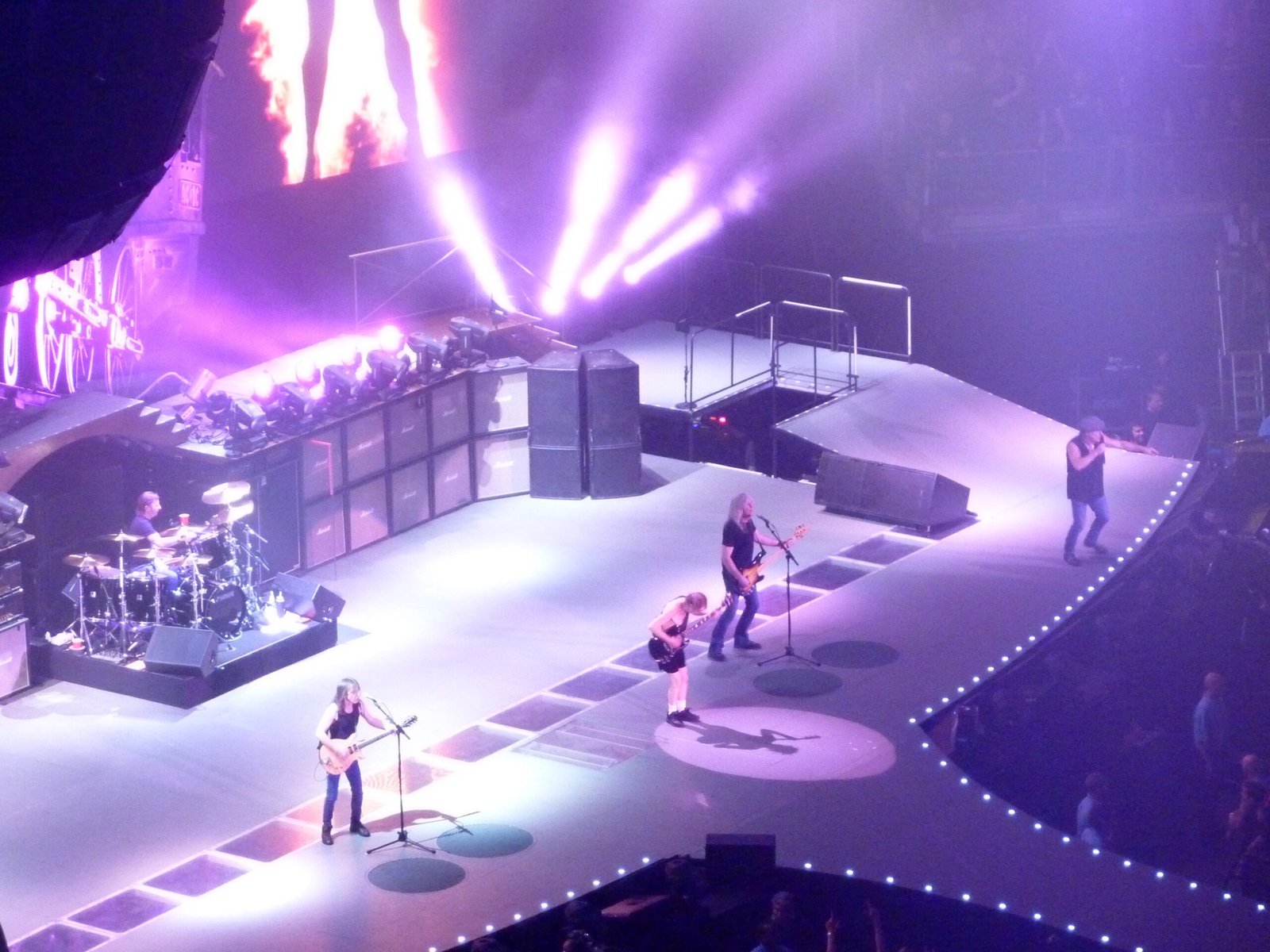
In 1990, AC/DC badly needed a comeback. The Australian band that had opened the decade with Back in Black had spent the late eighties sliding down the bill, and their recent albums had sold on loyalty rather than excitement. So they flew to Little Mountain Sound Studios in Vancouver, hired Bruce Fairbairn — the producer who had revived Aerosmith and launched Bon Jovi — and made an album, The Razors Edge, built around an opening track that began with Angus Young doing something he had once done purely to warm up his fingers. Fairbairn had given the band a simple brief, as he later recalled: “I want you to sound like AC/DC when you were seventeen.” On Thunderstruck, they did.
A Little Trick on Guitar
The most famous guitar intro of the decade began as an accident of practice. Angus Young explained in the liner notes to the 2003 reissue of The Razors Edge: “It started off from a little trick I had on guitar. I played it to Mal and he said, ‘Oh, I’ve got a good rhythm idea that will sit well in the back.’ We built the song up from that. We fiddled about with it for a few months before everything fell into place.” Talking to Guitar World in 1993, he added: “I was just fiddling with my left hand when I came up with that riff; I played it more by accident than anything. I thought, ‘not bad,’ and put it on a tape.”
The riff itself is a feat of economy: a relentless stream of sixteenth notes alternating between fretted notes and the open B string, all articulation and momentum. It is also a small masterclass in how tension works. Most rock records spend their energy; this one saves it. Angus’s figure runs alone and exposed, hypnotic and slightly ominous, while the elements arrive one by one like guests who each make the room louder — the chant, the drums, the bass, Malcolm’s rhythm guitar grinding underneath — so that by the time Brian Johnson finally screams the first line, well into the record, the song feels less performed than detonated. The verses, when they come, are almost an afterthought: short, feral bursts between returns of the riff and the chant. It is an arrangement so confident that it trusts a thirty-year-old warm-up exercise to carry the first act of a comeback single unaided. Around it, the brothers built the record like a machine assembling itself in public — the riff alone, then the crowd chant of “Thunder!”, then Chris Slade’s drums, then Cliff Williams’s bass, then Malcolm Young’s rhythm guitar locking in behind, and only then Brian Johnson’s voice, howling in at the top of his range. Even the title came out of the Young brothers’ childhood: Angus has said the “thunder thing” was based on ThunderStreak, their favourite toy as boys. “AC/DC = Power,” he shrugged. “That’s the basic idea.”

Vancouver, a New Drummer, and No Third Writer
The Razors Edge was the only AC/DC studio album of the era written entirely by Angus and Malcolm Young. Johnson, the band’s singer and usual third writer, was largely absent from the songwriting sessions while he finalised a divorce, so the brothers wrote everything themselves — and the leanness shows. Behind the glass, Fairbairn and engineer Mike Fraser pursued a dry, enormous sound: no studio gloss, just the band at full volume, captured at Little Mountain, the same Vancouver room where Fairbairn had made Aerosmith’s Pump the year before.
The sessions also introduced a new face behind the kit. Chris Slade, recruited from Manfred Mann’s Earth Band by way of The Firm, played drums on what remains his only studio album with the band. His part on Thunderstruck is brutal simplicity itself: a pounding, unadorned beat that leaves all the filigree to Angus’s fingers and all the swing to Malcolm’s right hand, the most underrated rhythm guitar in rock.
The Video at Brixton
The single was released on 10 September 1990, a fortnight ahead of the album, with another Razors Edge rocker, Fire Your Guns, on the B-side — and its video made the song’s staging literal. Director David Mallet filmed the band performing at London’s Brixton Academy on 17 August 1990, before an audience handed free T-shirts reading “AC/DC – I Was Thunderstruck” on the front and the date on the back — a crowd of extras all wearing the slogan, shot like a stadium gig in a theatre. Mallet knew the band well and would film their monumental Donington concert the following year, but this tight, sweaty club shoot became the song’s definitive visual: no storyline, no effects, just the riff, the chant and Angus in perpetual motion. MTV put the clip into heavy rotation, and the image of Angus duck-walking through that chanting crowd fixed the song in the minds of a new generation who had never bought an AC/DC record in the eighties.

The Slow-Burning Giant
By the standards of a lead single, Thunderstruck’s first chart run was respectable rather than spectacular: No. 5 on Billboard’s Album Rock Tracks chart in America, No. 1 in Finland, No. 4 in Australia and No. 13 in Britain. But the album around it restored AC/DC to the front rank: The Razors Edge climbed to No. 2 on the Billboard 200, stayed on the chart for 77 weeks and went multi-platinum in the United States. The album’s second single, Moneytalks, even became the band’s highest-charting American single, reaching No. 23 on the Hot 100 — a measure of how completely The Razors Edge reconnected AC/DC with the mainstream audience they had drifted away from in the eighties. And the song itself simply refused to stop growing. In the download and streaming era it became a phenomenon: more than fifteen million copies sold worldwide, a Diamond certification in the United States for ten million units, and a permanent place at the top of fan polls, topping Triple M Melbourne’s Ultimate 500 Rock Countdown in 2010. The Guardian ranked it eighth among the forty greatest AC/DC songs; Kerrang! put it sixth. It opens the band’s 1992 concert album AC/DC Live, captured at Donington, and Hollywood has reached for it whenever a film needs instant adrenaline — most famously in the 1999 high-school football drama Varsity Blues.
Some of its afterlife is stranger than fiction. In 2012, a computer virus that attacked workstations in the Iranian nuclear programme reportedly blasted Thunderstruck at full volume in the middle of the night. In 2025, it emerged that the US Department of Agriculture in Oregon was using drones playing the song to frighten wolves away from livestock. Stadium crowds on every continent chant its intro; the band still opens concerts with it more than three decades on. A warm-up exercise, a childhood toy, a producer asking a band to sound seventeen again — from those three small things came the loudest four minutes and fifty-two seconds of 1990, and a riff that every guitar shop on Earth has been unable to escape ever since.
Part of the secret is that the song never pretends to be more than it is. There is no metaphor to decode, no message beyond the thunder itself; the record is a machine for generating anticipation and then paying it off, over and over, for nearly five minutes. Where Back in Black announced a resurrection, Thunderstruck announced something just as valuable to a band then written off as heritage rock: that AC/DC could still sound like the future arriving. Every arena that has ever dimmed its lights to that opening riff understands the transaction instinctively — the crowd is not listening to the storm; for five minutes, the crowd is the storm. It remains the first thing a new listener hears when they press play on the band — and, all these years later, it still sounds like a storm warning.
Leave a Reply