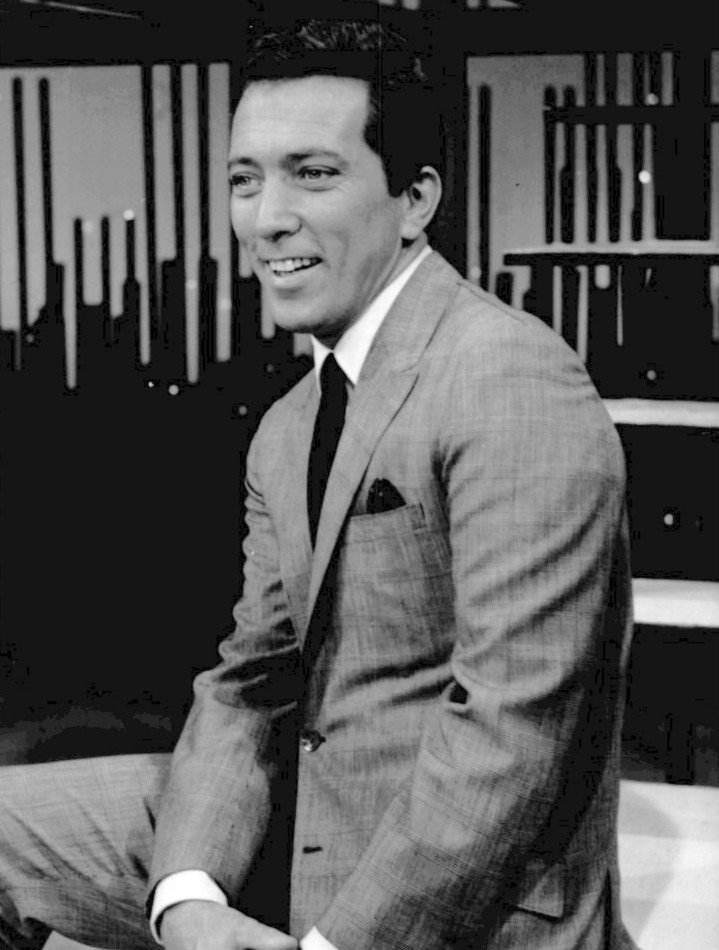
In the spring of 1963, the smoothest voice in America sang a song about a man who could not get over a woman, and America could not get over the song. Can’t Get Used to Losing You lasts barely two minutes and twenty seconds, yet it held the No. 2 spot on the Billboard Hot 100 for four weeks, topped the Easy Listening chart, reached No. 1 on the Cash Box chart and climbed to No. 2 in Britain as well. It became one of Andy Williams’s signature records. The irony at the center of its story is that Williams himself had to be talked into recording it — he preferred the song on the other side of the single.
Two Songwriters in a Cubicle
The song came from one of the great partnerships of the Brill Building era. Jerome Doc Pomus was a Brooklyn-born former blues singer who had given up performing to write songs full time. Mort Shuman was a classically trained pianist, more than a decade younger, whom Pomus met through family connections and recruited because Shuman understood the new rock and roll in a way Pomus, by his own admission, did not. Songwriter Otis Blackwell introduced the pair to Hill and Range Music, which installed them in New York’s Brill Building, the song factory at 1619 Broadway where professional writers worked in small cubicles, each with a piano, turning out material to order.
The division of labor was simple and durable: Pomus generally wrote the words, Shuman the melodies, though each crossed into the other’s territory. Together they produced a catalogue that defined the turn of the decade — A Teenager in Love, This Magic Moment, Save the Last Dance for Me, Sweets for My Sweet, and a string of hits for Elvis Presley including Surrender, Little Sister and (Marie’s the Name) His Latest Flame. Can’t Get Used to Losing You belonged to that same production line, but its lyric carried the ache Pomus specialized in: not the drama of a breakup, but the flat, daily refusal of life to return to normal afterward.

The Singer Who Preferred the Other Song
Williams had signed with Columbia Records at the end of 1961 and was in the middle of the most successful run of his career. His album Moon River and Other Great Movie Themes had peaked at No. 3 and stayed on the charts for years, and in the fall of 1962 he had become the host of his own NBC variety series, The Andy Williams Show. His producer at Columbia was Robert Mersey, who also arranged and conducted his records, and it was Mersey who championed the Pomus and Shuman song.
Williams, by his own later account, initially did not like it. His heart was with the single’s companion piece, Days of Wine and Roses, the Henry Mancini and Johnny Mercer ballad from the film of the same name — exactly the kind of lush, cinematic material on which he had built his Columbia reputation. Mersey encouraged him to record the pop song anyway, and in December 1962 Williams cut it. Columbia released the single in March 1963, with Days of Wine and Roses on the flip side. The song Williams had doubts about became the hit; the song he loved peaked at No. 26.
Two Minutes and Twenty Seconds of Heartache
What Mersey built around Williams’s voice explains much of the record’s hold. Instead of the expected wash of strings, the arrangement opens with a clipped, staccato violin figure — strings used as rhythm, jabbing in unison with the guitars over a supple bass line — and that figure returns in each verse like a thought the singer cannot shake. It is a hook as assertive as any guitar riff, and it gives the record its restless, circling motion.
Williams’s vocal is doubled in a way that deepens the effect. On the verses his voice is double-tracked in unison, thickening the line without disturbing its calm, and on the choruses it is overdubbed so that he appears to be singing harmony with himself. The technique suits the lyric perfectly: this is a man arguing with his own memory, answering himself because there is nobody else left to answer. Through it all Williams never raises his voice or pleads. He sings the saddest words on the chart that spring as if he were still smiling for the television cameras, and the restraint is what makes the record ache.

Four Weeks at Number Two
The single climbed through March 1963 and settled at No. 2 on the Billboard Hot 100 in April, where it stayed for four consecutive weeks. The top spot was occupied first by the Chiffons’ He’s So Fine and then by Little Peggy March’s I Will Follow Him, and Williams never quite got past them. On Billboard’s Easy Listening chart, aimed at the adult audience that was his natural constituency, there was no such frustration: the record spent four weeks at No. 1. It also reached No. 1 on the rival Cash Box chart, completing a near sweep of American pop measurement that spring.
Britain told the same story. The Official Charts record the single peaking at No. 2 there too, during an eighteen-week run that began at the end of March 1963 and included six weeks in the Top 10. A crooner in his mid-thirties, working in a style the teen market was supposed to have left behind, had come within one place of the top in both of the world’s major singles markets at the same moment — with a song he had recorded reluctantly.
An Album Built from Requests
The song anchored Williams’s eleventh studio album, Days of Wine and Roses and Other TV Requests, released by Columbia in April 1963. The album followed his first season as host of The Andy Williams Show and drew on the stream of requests the program generated, pairing the hit single with the Mancini title song and other material his television audience had asked for. In Britain the album was retitled Can’t Get Used to Losing You and Other Requests, a quiet admission of which song was doing the selling.
The album’s performance dwarfed even the single’s. It entered the Billboard album chart in April 1963 and remained there for 107 weeks, spending sixteen consecutive weeks at No. 1. In September 1963 it received Gold certification from the RIAA, the first of Williams’s albums to do so. For an artist whose commercial strength had always been in albums rather than singles, it was the definitive statement: the television show, the hit 45 and the long-player all feeding one another at the peak of his fame.
The Song That Would Not Let Go
Other singers moved quickly. Patti Page recorded the song in 1963 for her album Say Wonderful Things, and Paul Anka included it the same year on Song I Wish I’d Written. But the most remarkable afterlife arrived twenty years later, when the British ska and pop band The Beat — known in America as The English Beat — finally released their version as a single. They had first recorded it in 1980 for their debut album I Just Can’t Stop It; remixed and issued on April 15, 1983, just as the band was breaking up, it climbed to No. 3 in Britain, becoming their fifth and final Top 10 hit and the highest-charting single of their career. Elvis Costello, who called it his favorite Doc Pomus composition, later wrote that he had hoped to record it himself but abandoned the plan because, in his phrase, the Beat beat him to it.
The song surfaced once more in 2016, in the most unlikely of places, when Beyoncé’s Hold Up, from the album Lemonade, was built around a sample of Williams’s recording; producers Diplo and Ezra Koenig had first sketched the song around the opening of the 1963 record, and Pomus and Shuman received writing credits accordingly. It is a fitting final chapter. A song written in a Broadway cubicle by two professionals for hire, recorded by a singer who preferred its B-side, has now been a hit in three different centuries of pop style — crooned, skanked and sampled — without ever losing the simple, stubborn truth of its title.
Leave a Reply