Some hit songs are written for the charts. Danny’s Song was written for a brother — a broke, brand-new father who had nothing to give his baby son, and whose younger brother decided that a song would have to do instead. Kenny Loggins wrote it while he was still in high school. He then recorded it twice, with two different bands, and watched it go nowhere both times. It took a Canadian singer who was herself hunting for a way back — Anne Murray, two years past the phenomenon of Snowbird and still looking for its true successor — to hear what the song was worth. Her version, released in the last days of 1972, put her back in the American Top 10 on three different charts at once.
What Murray was singing, beneath the gentle melody, was a letter: a young man’s report from the front line of starting a family with no money, turned into a blessing. Danny’s Song is a song about being rich in everything except cash, and it has been passed from singer to singer for half a century like a piece of family property — which, in a sense, is exactly what it is.
A Letter From Danny
Kenny Loggins was a senior in high school in 1966 when his older brother Danny — Dan — became a father for the first time, to a boy named Colin. The Loggins family had no money to spare, and Kenny’s gift to his brother was the only thing he could make: a song. Much of the lyric came from a letter Dan wrote home soon after, describing his plan to marry the baby’s mother, Sheila, and move to Berkeley to build a life for the three of them, despite having almost no money at all. The letter’s own news survives in the song’s famous opening — everyone who heard about the baby kept smiling and telling the young father he was the lucky one. The song takes that precarious situation and answers it with a shrug and a smile: the people around the young couple keep telling them how lucky they are, and the song insists, against the evidence of an empty bank account, that they are right.
Loggins believed in the song before anyone else did. When he signed his first publishing deal, he deliberately kept Danny’s Song out of it. “I withheld ‘Danny’s Song’ from my publishing deal ’cause I knew that was a winner,” he later told an interviewer. It was a remarkable act of faith from a teenager — and for several years, the world did its best to prove him wrong.
Two Recordings, No Hit
Loggins first recorded the song in 1970 with Gator Creek, a group of studio musicians assembled around him by producer Dee Barton. Nothing happened. A year later he re-recorded it with Jim Messina, the producer and former Buffalo Springfield and Poco member who had been hired to guide Loggins’ solo career and ended up as his duo partner instead. Their version appeared on Sittin’ In, the debut album by Loggins and Messina, released in November 1971.
Sittin’ In produced no Top 40 singles at all, and Danny’s Song was not even given a proper chance as one: it surfaced as the B-side of an early single, Nobody But You, which stalled at No. 86 in 1972. Yet the song refused to die quietly. FM and album-rock stations kept playing the track until their listeners knew it better than most official singles of the season, and the album — a record without a single hit on it — kept selling on the strength of that airplay, eventually earning a gold disc. Danny’s Song became one of the duo’s best-known recordings through sheer repetition: a song the industry had declined to promote that listeners kept requesting anyway. One of those listeners was a singer in Canada who was doing some searching of her own.
Anne Murray Finds It
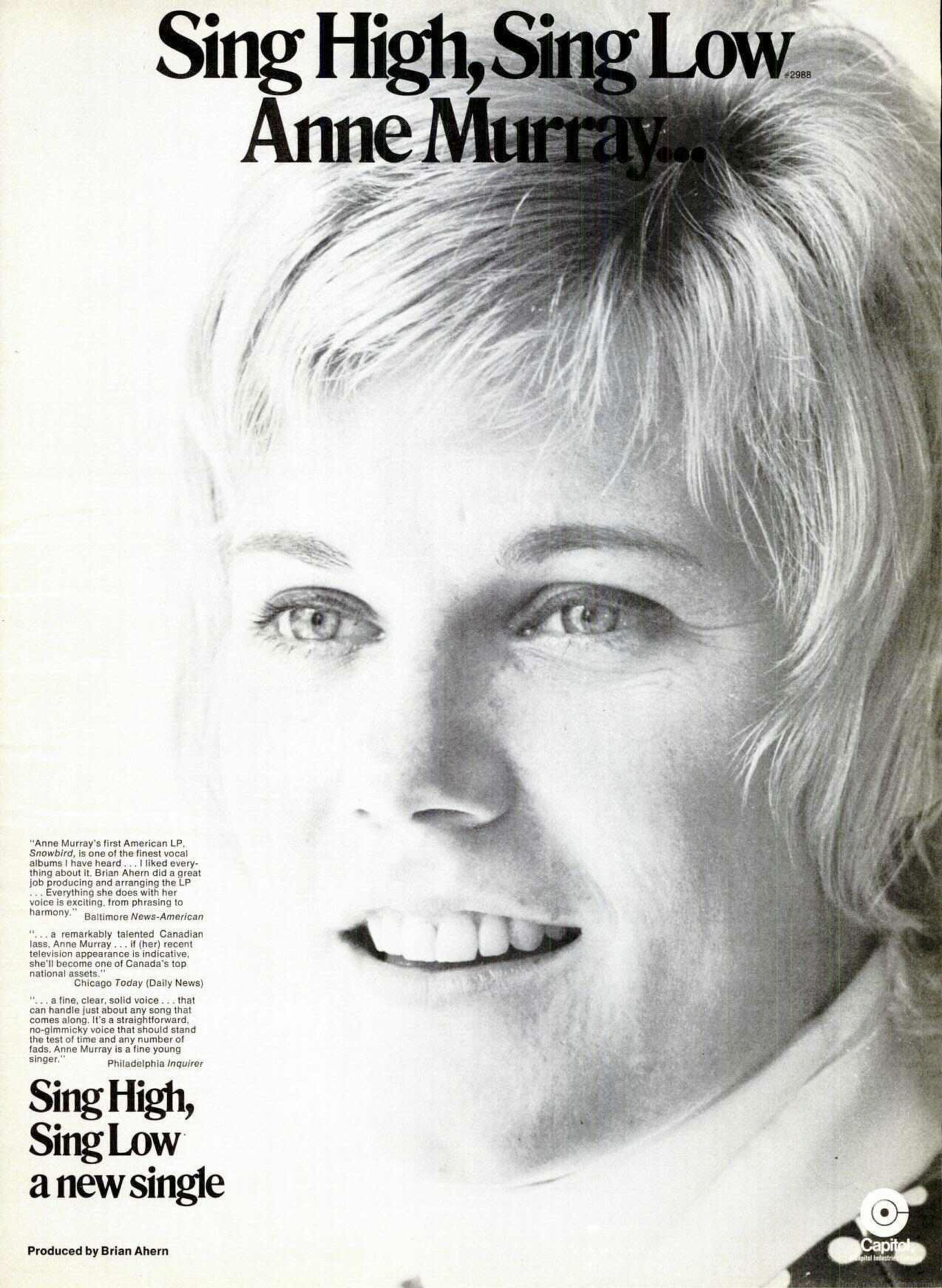
Anne Murray’s position at the end of 1972 was enviable and awkward at the same time. Snowbird, in 1970, had made her the first Canadian woman to earn a gold record in the United States, and she had followed it with a steady run of country and easy-listening hits — Sing High, Sing Low, Talk It Over in the Morning, Cotton Jenny. But the pop Top 10, the summit Snowbird had reached, had eluded her ever since. She needed the right song, and she knew it would not arrive by waiting.
“We had to search around, scrambled, and we found ‘Danny’s Song’ on a Loggins and Messina album,” Murray recalled. “And we just said, ‘Let’s record it.’” She was a fan of the duo’s recording, and she cut her version in 1972 with producer Brian Ahern, her longtime collaborator at Capitol Records. Murray’s reading is a model of intelligent editing: she trimmed two of Loggins’ verses, moved the song into a different key better suited to her warm contralto, and brought it in at just over three minutes against the original’s four and a quarter. What remains is the essence — the letter, the blessing, the lucky ones.

Number One in Canada, Top Ten Everywhere
Capitol released Murray’s Danny’s Song as a single on 23 December 1972, with Drown Me on the B-side, and it became the title track of her next album. Through the early months of 1973 it climbed every chart it touched. On the Billboard Hot 100 it reached No. 7 — her first appearance in the pop Top 10 since Snowbird — and it peaked at No. 6 on the rival Cash Box chart. On the Hot Country Songs chart it reached No. 10. On the Easy Listening chart, the format where her voice was most at home, it spent two weeks at No. 1 in March 1973. In Canada it did something cleaner still, topping the RPM pop, country and adult contemporary charts simultaneously — a hometown coronation.
The industry ratified what radio had decided. At the Grammy Awards of 1974, Murray’s performance was nominated for Best Female Pop Vocal Performance. She lost to Roberta Flack’s Killing Me Softly with His Song, which is rather like losing a footrace to a thoroughbred, but the nomination confirmed the comeback: Anne Murray was no longer the Snowbird girl. She was a fixture.

The Song That Grew Up With Her
The strangest part of the story is that the song was not finished with her. Murray had sung Danny’s Song as a young woman imagining a young family’s life from the outside. A few years later she married, and in 1976 her first child, William, was born — and the song she had recorded as an observer became a song she was living. She has said that she loved the original version, but that the song took on a deeper meaning for her after the birth of her first child. “Whenever I was singing that song,” she admitted, “it was very meaningful.”
She kept returning to it. In 2007, more than three decades after her hit, Murray recorded Danny’s Song again for her album Duets: Friends & Legends, this time as a duet with Martina McBride — one generation of country-pop singers handing the family letter to another. By then the song had long since escaped both of its makers: it has been covered by punk bands and jazz singers, used as a lullaby in television comedies, and sampled by rock musicians who grew up on their parents’ copies of Murray’s single.
Kenny Loggins was right, in the end, to keep the song out of his publishing deal. He just had the timeline wrong. Danny’s Song was a winner — it simply needed to travel, the way the letter inside it travelled: from a brother with nothing, to a singer looking for something, to everyone who has ever been told they were the lucky one and decided, on balance, to believe it.
Leave a Reply