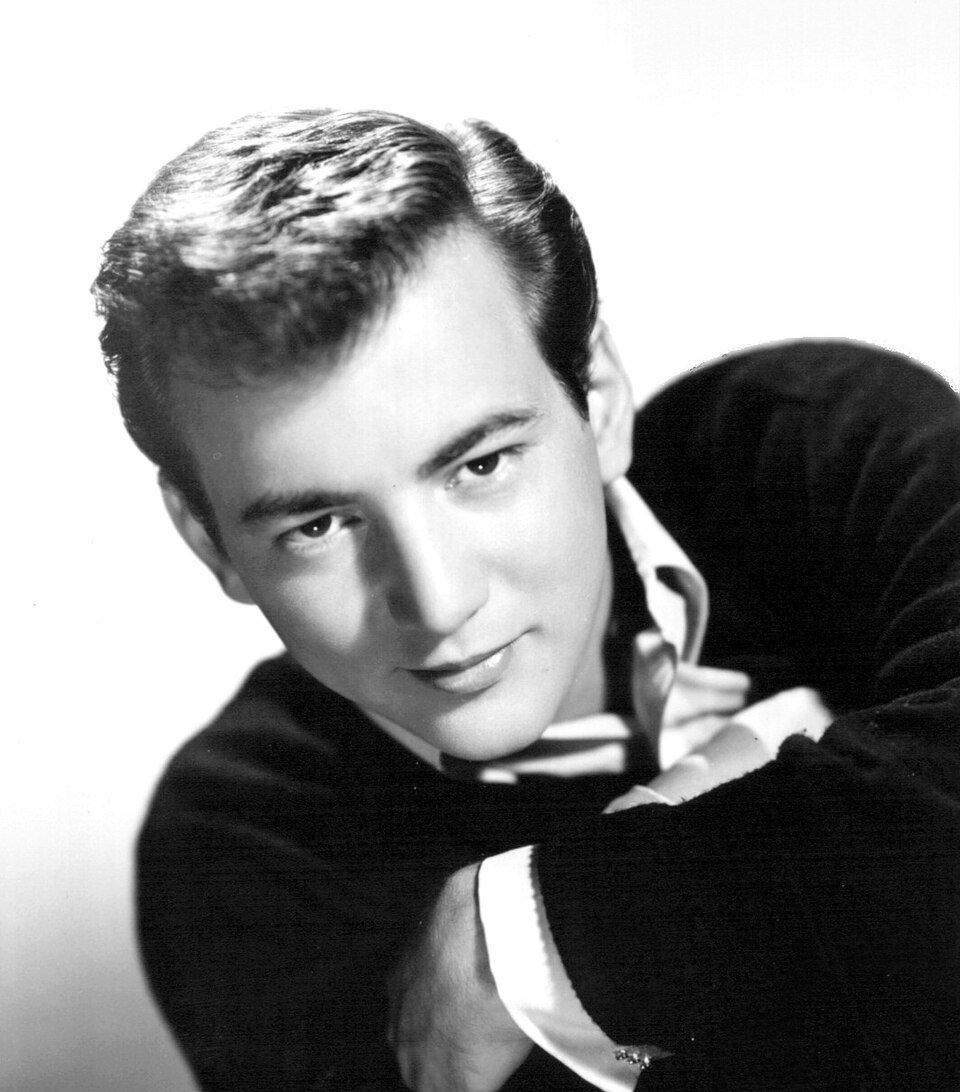
Bobby Darin did not find Dream Lover. He built it, at a piano, out of a handful of chord changes he could not stop playing — and then, in the studio, he did the thing that separated him from every other teen idol of 1959: he made it bigger. Strings, voices, a swaying, sophisticated arrangement wrapped around a song of pure teenage longing. The result was a record that stalled one place short of number one in America, conquered Britain outright, and proved that the kid who sang Splish Splash was not a novelty act. He was a songwriter, and he intended to be taken seriously.
A Teen Idol With a Songwriter’s Ambition
Darin arrived at 1959 in a rush. Born Walden Robert Cassotto in the Bronx, he had talked his way into the music business as a songwriter before he was a singer, and when his own recording career ignited in 1958 with Splish Splash — a novelty song he claimed to have written in minutes — followed by Queen of the Hop, the industry filed him under teen idol and expected the file to close quickly. Darin had other plans, and he also had a private urgency his audience knew nothing about: a childhood of rheumatic fever had damaged his heart, and doctors had told his family he might not live to adulthood. He worked like a man who believed them.
Dream Lover came out of that ambition. Darin was a genuine musician, at home on piano, guitar and drums, and the song began with his hands on the keyboard, exploring a chord sequence — the classic progression that underpins so much doo-wop and early rock and roll — and finding, as he stretched the changes out and slowed them down, that they could carry something more tender than a dance record. Over that foundation he wrote one of the simplest and most durable lyrics of the era: a young man asking, night after night, for a dream lover to appear so that he would not have to dream alone. It was not sophisticated poetry. It was something better: it was exactly what every teenager who heard it was already feeling.
The Session: 5 March 1959
Darin recorded Dream Lover on 5 March 1959 at Atlantic’s studios in New York, for the company’s Atco label. The session was supervised by two of the most important producers in American music, Atlantic’s founders Ahmet Ertegun and Jerry Wexler, and engineered by Tom Dowd, the technical genius behind much of the Atlantic catalogue. Darin was in elite company, and he behaved like a man determined to deserve it.
Two decisions in that room made the record. The first was at the piano. Darin wanted his hands free and his attention on the vocal, so the piano chair went to a young Brill Building songwriter who was just beginning his own climb: Neil Sedaka, whose light, rhythmic touch gives the track its gentle forward motion. The second decision was Darin’s own, and it was the gamble: where a standard teen record would have stopped at a small combo, Darin decided, while recording, to stretch out the chord changes he had found at the piano and to add strings and backing voices. The arrangement swells around his voice like a film score, but it never smothers him — Darin sings close and conversational, a young man confiding a wish rather than performing one. That tension, between the intimacy of the vocal and the lushness of everything around it, is the record’s signature, and it pointed pop music toward the sophisticated productions that would flower in the 1960s.
One Place Short in America, Number One in Britain
Atco released Dream Lover on 20 April 1959, with Bullmoose on the B-side and a picture sleeve carrying Darin’s portrait — itself a sign of how seriously the label now took him. The record was a multi-million seller and climbed to number two on the Billboard Hot 100, where it stayed for a week. It also reached number four on Billboard’s R&B chart, a crossover showing that testified to the record’s reach. The only thing standing between Darin and an American number one was Johnny Horton’s The Battle of New Orleans, a historical novelty song that no ballad on earth was going to dislodge that summer.
Britain had no such obstacle. There, Dream Lover reached number one on the New Musical Express chart and held it for four weeks in the summer of 1959, making Darin an international star and giving him his first British chart-topper. Coming on the heels of his American success, it transformed his position at Atlantic: he was no longer a singles act to be managed, but an artist whose judgement the label backed — the standing he would build on as he moved decisively toward the standards and swing that Mack the Knife would crown before the year was out. In that sense Dream Lover was the hinge: the teen idol’s biggest self-written hit, and the proof of seriousness that bought him his freedom.
There was money in it, too, and the money mattered to a young man in a hurry. Because Darin had written Dream Lover himself, the song paid him twice — as performer and as composer — and it announced to the whole industry that he was a publishing asset as well as a voice. Songwriting had been his way into the business in the first place, knocking on doors in the Brill Building era with his friend Don Kirshner; now his own biggest record was one of his own compositions, sitting near the top of the charts in two countries. Every ambitious young singer-songwriter of the next decade was watching that example, whether they knew it or not: write the song, own the song, and no label can make you a novelty act against your will.
The Song That Would Not Stay in 1959
A standard is a song that other singers cannot leave alone, and Dream Lover qualified quickly. Dion, Darin’s fellow Bronx Italian-American, recorded it; Ricky Nelson took a version into the charts in 1979; Billy “Crash” Craddock carried it to number one on the country charts in 1971, proving the song could wear a Nashville arrangement as easily as a New York one; Glen Campbell and Tanya Tucker later sang it as a duet. Each generation of singers found the same thing in it: a melody of almost folk-song simplicity and a lyric with not one wasted word.
Its glow reached even into Darin’s own family story. In 1994, his son Dodd Darin co-wrote a book about his parents’ brilliant, turbulent marriage and titled it after this song — Dream Lovers. Filmmakers kept borrowing it too: the record turns up in Barry Levinson’s Diner, in the 1974 film Stardust, and played through the end credits of the comedy Hot Shots! in 1991, each time carrying an instant cargo of late-fifties longing that no newly written score could fake. By then the record was more than thirty years old, and it was still the shorthand for everything people remembered about Bobby Darin at his most romantic: the piano, the strings, the young voice asking the dark for someone to love.
Listen to it now and what is striking is how modern its manners are. The strings-and-voices sophistication that Darin insisted on adding in that March session became the grammar of 1960s pop, and the song’s emotional directness — no irony, no hiding — has kept it permanently young. Dream Lover took one evening in an Atlantic studio, a borrowed pianist who became a star in his own right, and a singer stretching chord changes at the keyboard until they turned into a wish the whole world recognised. Darin asked not to dream alone. Seventy years of listeners have answered him.
Leave a Reply