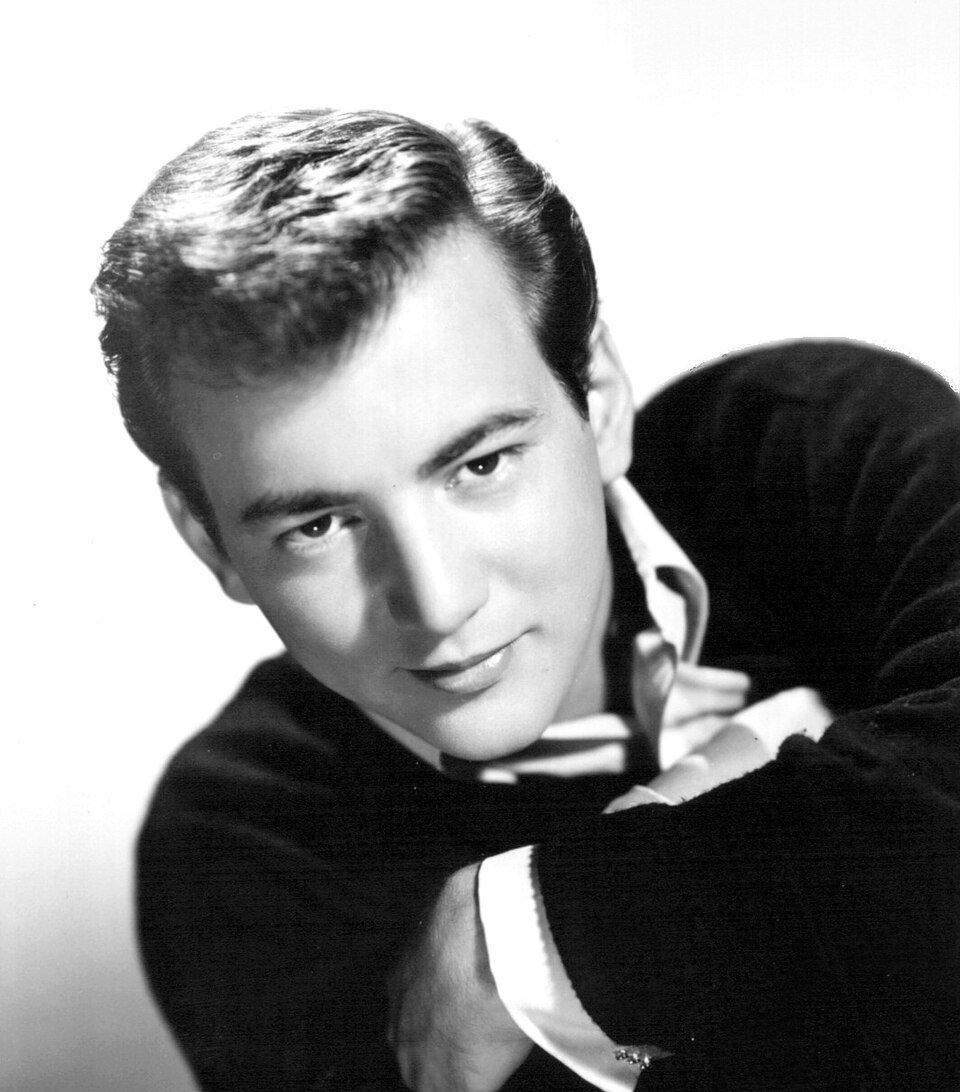
Some hit records are planned for months. Splish Splash was a bet, settled at a piano in what Darin liked to say was about twelve minutes. In the spring of 1958 Bobby Darin was twenty-one and running out of chances. He had already been signed and dropped once, and his new label was losing patience. What he needed was not another tasteful ballad radio could ignore. He needed a record nobody could ignore — and he got one about a man who steps out of the bath and finds a party in his living room.
The joke is easy; the desperation underneath it is not. Darin, born Walden Robert Cassotto in the Bronx in 1936, had been told as a child that a damaged heart might not give him a long life, and he worked like a man who believed it. He sang, played several instruments, and wrote songs around the Brill Building, talking as if stardom were a debt the world owed him. By 1958 the world was not cooperating — Splish Splash was the moment it started to.
Dropped Once, and Nearly Dropped Again
Darin’s first break ended the way first breaks often did in the 1950s. Signed to Decca Records in 1956, he cut records that went nowhere, and Decca let him go. He kept writing — he had begun as a songwriter, working on material associated with Connie Francis — and in 1957 landed at Atco, Atlantic Records’ subsidiary, run by label co-founder Herb Abramson. His early Atco sessions under Abramson produced no hit either, and by spring 1958, with his one-year contract running toward its end on May 1, Abramson was ready to drop him a second time. Two labels, two failures: for most young singers of the era, that was the whole career.
What saved him was Ahmet Ertegun, Atlantic’s other co-founder. Ertegun believed in Darin when the results gave him little reason to, overruled the plan to drop him, and decided to produce the next session himself. It was a hunch, not a business plan — and everything about Splish Splash would follow that pattern: instinct first, paperwork later.
A Mother, a Phone Call, and a Bet
The other lifeline came from radio. Murray Kaufman — Murray the K — was one of New York’s most influential disc jockeys, and Darin’s friend and champion at exactly the moment Darin had almost nothing to champion. The story, as Darin, Kaufman, and Darin’s official biography all tell it, begins with a phone call from Murray’s mother.
Jean Kaufman had been a piano player in vaudeville and still thought like a songwriter. After a celebrity softball game in Central Park, Darin and Murray had repaired to Murray’s apartment — in some tellings, soaking their aching feet in basins of water — when Jean called, as she did every day, to check on her son. Hearing about the game and the sore feet, she rang back with an idea she could not shake: a song beginning “Splish splash, I was takin’ a bath.”
Murray thought his mother’s suggestion was ridiculous, and said so in the most dangerous way possible: he bet Darin that he could not write a hit song starting with that line. Darin, who never met a dare he did not like — and who was weeks from unemployment — accepted on the spot.

Twelve Minutes at the Piano
What happened next grew in the telling, so it deserves care. The version Darin repeated most often — carried, give or take a few minutes, by his official website — is that the song was finished in roughly twelve minutes, Darin at the piano and Murray beside him, building the lyric on Jean’s opening line. Other retellings stretch it toward an hour. The honest summary is one short, feverish sitting, with nobody watching a clock.
However long it took, the construction was smarter than the premise. Darin did not write two minutes about a bathtub; he wrote a tiny one-act play. A man is soaking on a Saturday night, hears a sound, wraps a towel around himself, opens the door — and finds a party already raging in his own home, peopled by characters borrowed from the hit parade itself: Lollipop, Peggy Sue, and Good Golly, Miss Molly all walk through the lyric. The bath was the hook. The party was the record.
One piece of paperwork mattered. A hit co-written openly with New York’s most powerful DJ would have smelled of payola, even in 1958. So the song was credited to Darin and “Jean Murray” — a pseudonym fusing Jean’s first name with her son’s — and the Kaufmans quietly shared in one of the year’s most improbable copyrights.
The Night at Atlantic Studios
On the evening of April 10, 1958, Darin recorded the song at Atlantic Studios in New York, under Ertegun’s personal direction. The band was small, expert, and built for bounce: Jesse Powell on tenor saxophone — the honking solo voice on the record, not King Curtis, who played on Darin’s later sessions — Al Caiola and Billy Mure on guitars, Wendell Marshall on bass, Panama Francis on drums, and engineer Tom Dowd at the controls.
Three songs were cut that evening. Alongside Splish Splash came Judy, Don’t Be Moody, which became its B-side, and Queen of the Hop, which Atlantic held back and released later in 1958 as a hit of its own. In a single evening, Darin and Ertegun had recorded the foundation of a career.
The finished record lasts two minutes and twelve seconds, and wastes none of them. It opens in the bath itself, then kicks into a handclap-driven groove that never lets up. Darin sings like a man delighted with his own joke — relaxed, rhythmic, grinning through every line — while Powell’s saxophone answers like the party answering back.
A Single That Would Not Sit Still
Atco released Splish Splash, catalogue number 6117, on May 19, 1958, backed with Judy, Don’t Be Moody. It was Darin’s first hit, and it behaved like one everywhere at once: No. 3 on the Billboard pop chart in the United States, No. 2 on the R&B Best Sellers chart, No. 2 on the Cash Box Top 100, and No. 3 in Canada. It even gave Darin his only-ever entry on Billboard’s country chart, at No. 14, and reached No. 18 in Britain.
More importantly, the single sold more than a million copies — Darin’s first million-seller. A singer weeks from being dropped for the second time in two years was, by August, a national name. Darin later claimed, in a 1967 interview, that he was so happy about finally having a hit that a longstanding skin condition cleared up.

The Door It Opened
The real importance of Splish Splash is what it made possible, and how fast. Later in 1958 came Queen of the Hop, already in the can from that same April evening, and another million-seller. In 1959 came Dream Lover, written by Darin himself, and then Mack the Knife — a German cabaret murder ballad swung to No. 1 for nine weeks and a Grammy for Record of the Year.
None of that happens without the bathtub record. Splish Splash bought Darin the one thing talent alone had not: leverage. A singer with a million-selling hit could be indulged; with two, he could be trusted; when he then demanded an album of standards, he could be allowed. Darin’s reinventions of the 1960s — crooner, folk singer, protest writer — all trace back to the credibility a joke song earned him in 1958, even if it also fixed him, for years, as the grinning bath guy in the public mind. He kept singing it to the very end — still performing it on television in 1973, the year he died at thirty-seven, with the same snap it had in 1958.
Covers, Bathtubs, and a Long Afterlife
A song written to win a bet turned out to be built to last. In Britain in 1958, comedian Charlie Drake took a comedy version into the UK top ten, produced by a young George Martin, years before that name meant the Beatles. In 1979 Barbra Streisand remade it, with new lyrics, for her album Wet. Sha Na Na recorded it live in the 1970s, and it became a children’s standard too — sung, fittingly, by Elmo and friends on a Sesame Street bath-time album. On screen it turns up in You’ve Got Mail and in the 2004 Darin biopic Beyond the Sea.
Listen to it now, and it sounds nothing like an apology for a novelty record. The playing is tight, the vocal a small masterclass in rhythm, and the whole thing is over before it can wear out its welcome. It was written in minutes, on a dare, by a singer with no margin left — and it gave him the rest of his life. Jean Kaufman never wrote a bigger opening line. She never needed to.
Leave a Reply