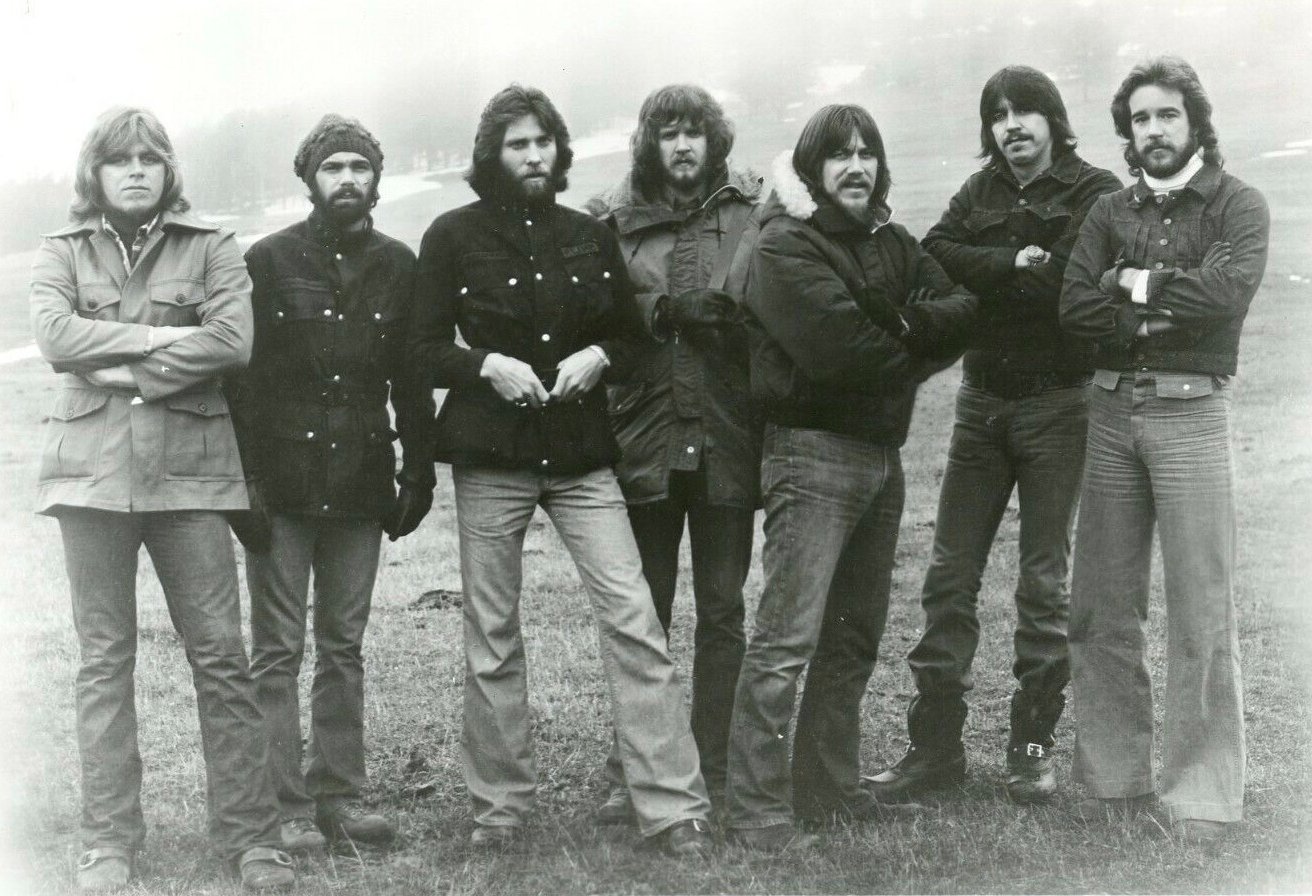
Some love songs are written at a piano in a quiet room, with a pot of coffee and a rhyming dictionary. Just You ‘n’ Me was written in the smoking aftermath of a lovers’ quarrel so fierce that James Pankow’s fiancée had locked herself in the bathroom to get away from him. Pankow, Chicago’s trombonist and one of its principal songwriters, was standing on the wrong side of that door with his fists clenched — and, by his own account, close to doing something stupid. “Rather than put my fist through the wall,” he recalled, “I went out to the piano and this song just kind of poured out.”
What poured out was three minutes and forty-two seconds of uncomplicated devotion: a promise that it would always be just the two of them, no matter what. The fight was real, the apology was real, and the song was so personal that when Pankow and Karen married, the couple had its lead sheet embossed with a photograph and sent it to their guests as the wedding announcement. In the space of one bad evening, Chicago had acquired the greatest love song in its catalogue.
A Fight, a Piano, and a Wedding Announcement
Pankow was not the band’s most obvious candidate to write its defining ballad. He was the trombone player, the man who wrote the intricate brass charts that gave Chicago its signature sound, and the composer behind hard-driving album pieces. But he had ballads in him too — he had written Colour My World, the gentle waltz tucked inside his Ballet for a Girl in Buchannon suite — and he wrote the way he arranged, quickly and from the gut.
Just You ‘n’ Me came faster than any of them. There was no labouring over the lyric, no second-guessing the melody; the quarrel had done the emotional work already, and the song arrived essentially whole. “It’s the purest song I’ve ever written,” Pankow has said, calling it “a musical snapshot of the emotion I was feeling at the time.” That purity is precisely what the band’s producer heard when the song was brought into the sessions for the group’s sixth album. Chicago did not need to build a hit around it. They only needed to not get in its way.
Up the Mountain to Caribou Ranch
By February 1973, Chicago’s producer and manager James William Guercio had built himself a studio in a converted barn at Caribou Ranch, his property near Nederland, Colorado, some 8,500 feet up in the Rockies. The band decamped there to record Chicago VI, breathing thin mountain air and living with the isolation Guercio believed kept musicians honest. The ranch would become famous — Elton John would name an album after it — but Chicago were among the first major acts to test it, and the change of scenery loosened something in the band. Chicago V, the previous album, had been cut in New York; at the ranch, the seven members lived where they worked, and the sessions took on a warmth the records had not always had.
Chicago VI was released in June 1973 and spent five weeks at No. 1 on the Billboard 200. Its first single, Feelin’ Stronger Every Day, had already kept the band on the radio through the summer. But the song the album would be remembered for was the one Pankow had written to end a fight. On 7 September 1973, Columbia released Just You ‘n’ Me as a single, with Critic’s Choice — Robert Lamm’s pointed reply to the band’s detractors — on the B-side, and the quiet little apology began its climb.

Cetera Sings, Parazaider Soars
The recording is a masterclass in restraint from a band not always known for it. Peter Cetera takes the lead vocal and sings it straight — no showboating, just a man making a promise in a soft, high tenor that sounds like it is being offered rather than performed. Underneath him, Terry Kath’s guitar murmurs through a wah-wah pedal with a phase shifter, a texture closer to a sigh than a solo.
The record’s crowning moment belongs to Walter Parazaider, whose soprano saxophone lifts the middle of the song into something almost hymnal. For a band built on three horns blowing in unison, the choice to let one horn speak alone was inspired: the solo sounds like the reconciled couple’s first deep breath. Pankow later said simply that “Peter Cetera sings his butt off” on the record — but the whole band plays like men who understood the song had been entrusted to them.
The performance attached to this article shows what that looked like up close. In July 1974 the band filmed a television special at Caribou Ranch itself, and Just You ‘n’ Me — played on the same ground where it had been recorded, by the original seven members in their prime — is its tender centrepiece. Terry Kath is there, guitar slung low; Pankow is on trombone in the horn line, singing along to a song he wrote in the worst ten minutes of his engagement. It is the closest thing the song has to a home movie.

Number One on Cash Box, Gold on the Wall
America agreed with the wedding guests. Just You ‘n’ Me climbed steadily through the autumn of 1973, reaching No. 1 on the Cash Box Top 100 on 15 December and peaking at No. 4 on the Billboard Hot 100 in the week of 22 December. It reached No. 7 on Billboard’s Easy Listening chart and No. 3 in Canada, and it earned a gold disc from the RIAA. Decades later, in a 2019 ranking of the band’s catalogue, Billboard’s Bobby Olivier named it Chicago’s greatest love song outright — no small verdict for a group that would build a second career on ballads.
There is a historical irony folded into that verdict. The Chicago of 1973 was still a horns-first rock band with a jazz streak, suspicious of softness, and Just You ‘n’ Me was meant to be an exception — one man’s apology that happened to be released as a single. But its success mapped the road the band would eventually take: within a decade, Cetera’s tenor and the love-song format would carry Chicago to a second, enormous career. Just You ‘n’ Me was the prototype, recorded before anyone knew a prototype was needed, and it has accordingly become a fixture of wedding first dances ever since — which is only fitting for a song that once served as a wedding announcement itself.
The Last Song on WLS
The song’s strangest honour came in 1989, when Chicago’s hometown station WLS-AM — the mighty 890 signal that had beamed rock and roll across the Midwest for a generation — abandoned music for talk radio. The final song played before the switch was Just You ‘n’ Me: a hometown band, a homegrown love song, chosen to close the door on an era.
The room where it was recorded has its own melancholy footnote. The Caribou Ranch studio, in the converted barn where Chicago, Elton John and a parade of seventies giants made their records, was destroyed by fire in 1985. The tapes survived in memory if not in fact: what remains of those February 1973 sessions is the sound itself, mountain air and all, pressed into an album that has never gone out of circulation.
Pankow still performs the song he wrote in a rage more than fifty years ago, long after the marriage it announced has passed into history. The quarrel is forgotten. The bathroom door, one assumes, forgave him. What remains is the snapshot he described — three minutes and forty-two seconds in which anger went looking for a wall and found a piano instead, and in which a trombone player accidentally wrote the love song his band will never escape, and never should.
Leave a Reply