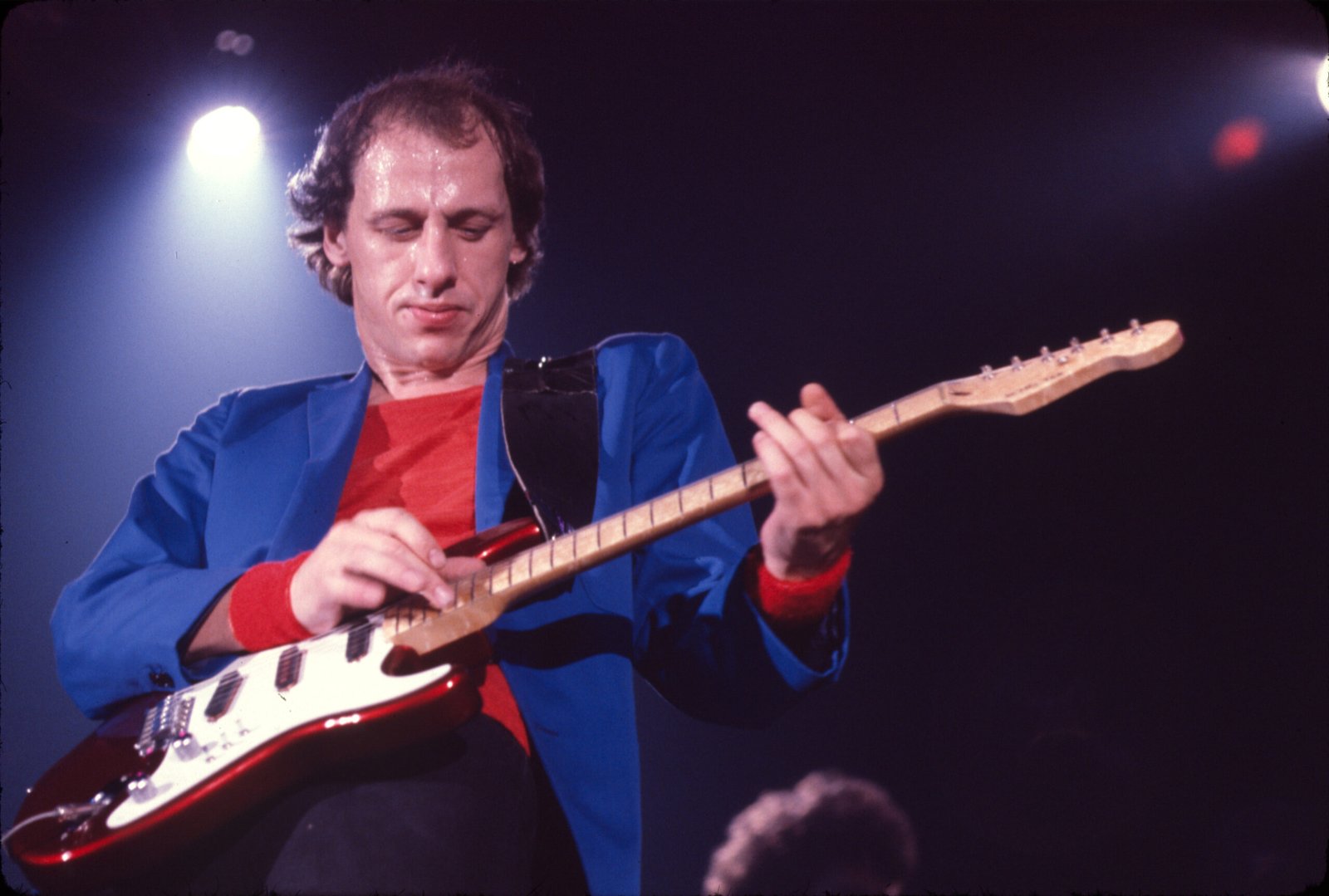
In 1982, the music industry had a simple formula: short songs, big videos, synthesizers, hair. Dire Straits responded with an album of five songs, one of them over fourteen minutes long, full of fingerpicked guitar, marimbas, and literary references. “Love Over Gold” should have been commercial suicide. Instead it became the band’s first British number one — and the most artistically daring record they ever made. This is the story of how Mark Knopfler bet everything on ambition, and won.
After the Movies
By 1982, Dire Straits were already stars. Their first two albums had established them, and 1980’s “Making Movies” — with “Romeo and Juliet” and “Tunnel of Love” — had made Mark Knopfler one of the most respected songwriters and guitarists in rock. But Knopfler was restless. During the “Making Movies” tour, he had begun composing film music, writing the score for the Scottish comedy “Local Hero” — a project that would become one of the most beloved soundtracks ever recorded and earn him a BAFTA nomination. He had also played guitar on Bob Dylan’s “Infidels” sessions, holding his own alongside one of his heroes.
The road had changed his writing. Night after night, in soundcheck after soundcheck, Knopfler and keyboardist Alan Clark had been working out long, unfolding musical ideas — pieces that needed time to breathe. The three-minute single format felt like a cage. Knopfler wanted to make a record without cages — no three-minute limits, no radio formulas, no compromises. The result would be “Love Over Gold”: five tracks, no compromises, and a running time that treated the listener like an adult. In the neon eighties, it was an act of beautiful defiance.
The Power Station Sessions
The band recorded at the Power Station in New York City — the legendary studio where Bruce Springsteen, Madonna, and countless others had made history — from March 8 to June 11, 1982. Three months for five songs: that alone tells you how seriously Knopfler was taking this record. He produced the album himself, a role he was growing into with increasing confidence and control. Engineering was handled by Neil Dorfsman, beginning one of the great partnerships in rock production; Dorfsman would go on to work with Knopfler for decades, becoming his most trusted sonic collaborator.
The lineup was in transition. The sessions featured Knopfler, bassist John Illsley — the band’s quiet anchor, the only other constant besides Knopfler — keyboardist Alan Clark, making his recording debut with the band, and drummer Pick Withers, playing his final sessions with Dire Straits before departing. Guest musicians included marimba player Mike Mainieri, whose contribution to one track would become unforgettable. The atmosphere was serious, focused, perfectionist. Knopfler knew exactly what he wanted: a record of long-form storytelling, cinematic in scope, played by musicians at the top of their game. What he got was even better than he’d hoped.
“Telegraph Road”: Fourteen Minutes, One Bus Ride
The album’s opening track and centerpiece is “Telegraph Road” — fourteen minutes and twenty seconds of slowly building, devastatingly beautiful rock music. It began, of all places, on a tour bus in Michigan. Rolling down US Highway 24 — Telegraph Road — Knopfler watched the landscape of small towns and shuttered businesses roll past the window, and the image lodged in his mind: the story of a road, and the people who lived and lost along it.
He had also been reading Knut Hamsun’s novel “Growth of the Soil,” the Nobel Prize-winning story of a pioneer carving a life from the wilderness — a tale of building something from nothing, and of what progress costs. The two ideas fused: a song about the building of America and the unbuilding of it, about progress and decay, told through the life of one road. Knopfler wrote it bit by bit during soundchecks on the “Making Movies” tour, testing sections live before committing them to tape, letting the piece grow the way Hamsun’s pioneer grew his farm: patiently, deliberately, from the ground up.
Recording it was an ordeal. The band tracked it in two parts, and during the session drummer Pick Withers’ snare drum lost its tension, subtly changing the sound midway through. Rather than re-record, engineer Neil Dorfsman spliced the two halves together — a painstaking edit that holds the epic together seamlessly. The result is one of the great side-long achievements in rock: a song that starts as a whisper and ends as a storm, Knopfler’s fingerpicked guitar telling a story no lyric sheet could fully contain.
“Private Investigations”: Noir in Seven Minutes
If “Telegraph Road” was the album’s epic, “Private Investigations” was its hit — though “hit” hardly describes a seven-minute noir meditation released unedited as a single. The song is pure Raymond Chandler: a detective’s weary monologue set to one of the most atmospheric arrangements Dire Straits ever recorded. Knopfler’s spoken-sung verses drift over Mike Mainieri’s haunting marimba, classical guitar figures, and a rhythm section playing with almost jazz-like restraint — all shadows, cigarette smoke, and rain on empty streets.
The record company wanted it cut down for radio. Knopfler refused — he insisted the song be released at its full length, atmosphere intact, no compromises. The full-length version went out as the lead single — and the public, astonishingly, embraced it. “Private Investigations” reached number 2 on the UK Singles Chart, becoming one of the longest singles ever to become a major hit. It was proof of something Knopfler had always believed: audiences are smarter than the industry thinks. Give them atmosphere, intelligence, and patience, and they will follow you anywhere — even into a seven-minute detective story with a marimba.
The Ones That Got Away
“Love Over Gold” is famous not only for what’s on it, but for what isn’t. During the sessions, the band recorded “Private Dancer” — a slinky, after-hours song that didn’t quite fit the album’s mood, all smoke and midnight regret. Knopfler shelved it. Then Tina Turner came calling, looking for material for her comeback — and Knopfler, with characteristic generosity, gave her “Private Dancer.” It became the title track of her 1984 album — the record that resurrected her career and sold millions, one of the great comebacks in music history. One of the biggest hits of the eighties was a Dire Straits outtake, and Knopfler never seemed to mind at all.
Similarly, “The Way It Always Starts” — another song from the same fertile period — found its home in Knopfler’s “Local Hero” film score, sung by Gerry Rafferty of “Baker Street” fame. The “Love Over Gold” sessions were so rich that the leftovers became other people’s career-defining moments. It’s a measure of just how inspired Knopfler’s writing was in this period: he was producing masterpieces faster than his own band could use them, and his generosity with the surplus changed lives.
The Sound of Ambition
Part of what makes “Love Over Gold” so enduring is how it sounds — and that sound was built by the new partnership between Knopfler and engineer Neil Dorfsman. It was the first of many collaborations between the two men, and Dorfsman understood exactly what Knopfler was after: warmth, space, and clarity. Recorded at the Power Station, the album has a deep, unhurried richness — every fingerpicked note given room to breathe, every silence as carefully placed as every chord. In an era when most rock records were being compressed into radio-friendly brightness, “Love Over Gold” sounded like it was recorded in a cathedral.
The deeper cuts reward the patience the album demands. “Industrial Disease,” at nearly six minutes, is Knopfler’s wry, weary look at modern Britain — all strikes, recessions, and bureaucratic absurdity, delivered with a reporter’s eye and a poet’s shrug, the most overtly political song he had written to that point. “It Never Rains” is a slow-burning meditation on disappointment and resilience. These aren’t songs that grab you by the collar; they’re songs that invite you to sit down and stay a while. Knopfler’s fingerstyle guitar — that unmistakable touch, learned on a warped-neck acoustic in Newcastle — had never sounded more expressive, more patient, more sure of itself. The album trusted its listeners completely. It remains a masterclass in the art of taking your time.
Triumph and Goodbye
“Love Over Gold” was released in September 1982, and the gamble paid off spectacularly. It became Dire Straits’ first number one album in Britain, was certified double platinum, and reached number 19 in America — remarkable for a record with five songs and no obvious radio fodder. For a band that had started in a tiny London pub, it was vindication: the world would follow them into the deep end. The critics were admiring, the fans devoted. The subsequent tour was a triumph, with the long epics unfolding even further on stage, Knopfler’s guitar stretching into the night. It remains, for many serious listeners, the band’s finest hour: the moment when ambition and execution aligned perfectly, before the stadiums got bigger and the songs got shorter.
But it was also an ending. The sessions marked drummer Pick Withers’ farewell — the last of the original rhythm section to go, replaced by Terry Williams, a powerhouse player who would drive the band through its biggest years. The band that had recorded “Sultans of Swing” in a tiny London studio was gone; what remained was Knopfler’s vehicle, heading toward the colossal commercial triumph of “Brothers in Arms” and, eventually, dissolution. “Love Over Gold” stands as the bridge between the two eras: the last record of the hungry band, and the first of the conquering one — the moment Dire Straits grew up, stretched out, and proved they could do anything.
The Record That Trusted Its Audience
In an era of three-minute singles and synthesizer sheen, Mark Knopfler made a five-song album with a fourteen-minute opener and a seven-minute detective story — and took it to number one, against every rule in the book. “Love Over Gold” endures because it was built on a radical belief: that listeners want to be challenged, that a song can be as long as the story it tells, that atmosphere is as powerful as hooks. It remains the record where Dire Straits were at their most fearless — before the world tours got bigger, before the videos took over, when five musicians in a New York studio simply played the music they heard in their heads. More than forty years later, when “Telegraph Road” builds from that first quiet guitar figure to its thunderous climax, it still feels like a journey worth taking. Knopfler trusted his audience. The audience, to its eternal credit, trusted him back — and “Love Over Gold” remains the proof that it was right to do so, then and now and always. Some records entertain. This one endures.
Leave a Reply