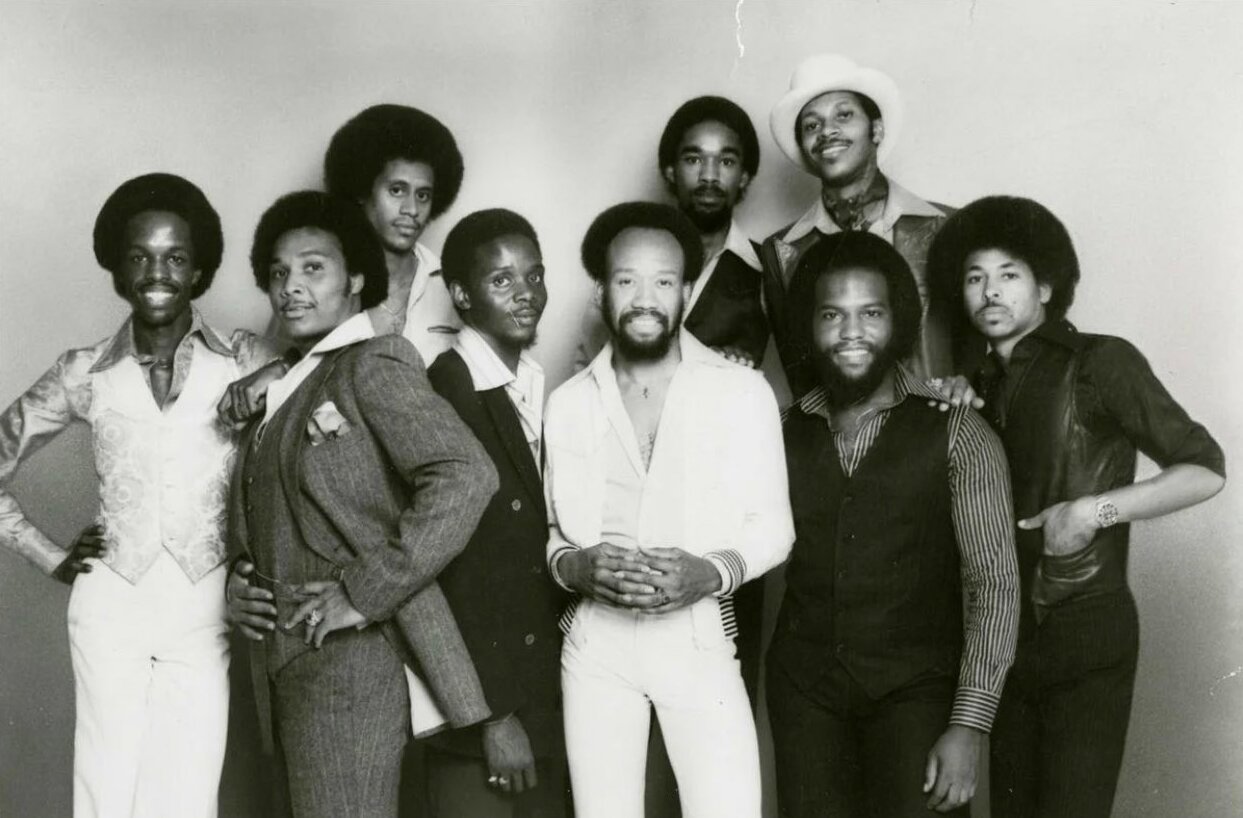
“Fantasy” took about three months to finish, and nearly all of that time was spent stuck. The music came together in the studio, layer upon layer, exactly as Maurice White planned it. The words would not come at all — until the band’s leader walked into a cinema, watched a film about visitors from the stars, went back to his hotel and wrote the entire lyric in a single night. It is the most Earth, Wind & Fire story imaginable: a song about escaping this world for a better one, unblocked by a movie about leaving this world for the unknown, and sung, when it finally arrived, by a man with a dislodged front tooth.
It was never the biggest single from its own album — “Serpentine Fire” had gone before it, and “September” was still a year away from rewriting the band’s history. Yet “Fantasy” is the song that explains Earth, Wind & Fire to anyone who only knows the hits: not the fireworks, but the philosophy underneath them, pressed into four and a half minutes of ascending calm.
The Album From South America
The song belongs to All ‘n All, the band’s eighth studio album, released on November 21, 1977. Maurice White, the band’s founder, producer and presiding spirit, had spent a month travelling in Argentina and Brazil, and the album breathes South American air — Brazilian rhythms run through it, surfacing openly in the “Brazilian Rhyme” interludes. Recorded that August at Hollywood Sound Recorders, the Burbank Studios and Sunset Sound, All ‘n All topped Billboard’s soul albums chart, reached number three on the Billboard 200, went triple platinum, and won the Grammy for Best R&B Vocal Performance by a Duo, Group or Chorus. It is the record of a band consciously turning itself into a world-music universe, and “Fantasy” — credited to Maurice White, his brother Verdine White and the Argentine-born keyboardist Eduardo “Eddie” del Barrio — was its most weightless creation.
Maurice described the band’s studio method as construction: “We built it like a pyramid — we had an orchestra behind us, then we had a rhythm section.” Engineer George Massenburg layered the parts on tape and separated them with equalisation until the track had air inside it, while Tom Tom Washington’s string and horn arrangement, in Maurice’s words, “gave the song lots of colour.” The reported division of labour had Verdine and del Barrio shaping the music — del Barrio’s piano is all over the album — while Maurice took responsibility for the words. Which is where the construction stopped.
Underneath the construction sat a deliberate strategy Maurice never hid: “Basically we were a jazz band, and we converted a jazz band into a pop band, because we wanted to be universal. Universal means appealing to everyone.” “Fantasy” is that conversion at its most complete — jazz harmony and Brazilian rhythm folded so completely into a pop ballad that the sophistication disappears, leaving only the sensation of rising. The song was designed, quite consciously, to be entered by anybody. The album around it collected honours of its own, including a second Grammy for “Runnin’,” named Best R&B Instrumental — the same “Runnin’” that would shortly turn up on the B-side of the “Fantasy” single.
Three Months of Music, One Night of Words
“We got the music down first,” Maurice recalled, “and then it was time to write the lyrics, and it took me a long time to write those lyrics. Nothing was coming.” Weeks passed. Then, in November 1977, Steven Spielberg’s Close Encounters of the Third Kind opened — a film about ordinary people seized by visions of somewhere beyond the sky, which is, not coincidentally, the very territory of the album Maurice was trying to finish. He went to see it. “I was so inspired after seeing it,” he said, “that I came back to the hotel and wrote all the lyrics, and it happened in one night, and it all just came out — it was like someone was talking to me.”
The lyric he brought back is a guided tour out of the world: every man for himself becomes one shining community, sorrow is left on the launch pad, and the traveller is told to take a ride in the sky. Maurice explained the philosophy to Melody Maker with unusual directness. The song, he said, was about escapism — the recognition that we live in a world that can be unjust, selfish and envious, and that everyone needs a place of their own to escape to. His fantasy was that place, and writing the song was his way of “sharing this place with people.” For a band whose whole stage show was a pyramid, a spaceship and a promise, it was practically a mission statement set to music.

The Tooth and the Falsetto
The voice assigned to deliver that invitation was Philip Bailey’s — his alone. “Fantasy” belongs to the select group of Earth, Wind & Fire songs Bailey sang as sole lead, alongside “Reasons,” “Devotion” and “Keep Your Head to the Sky,” floating the melody in the falsetto that gave the band its second, airborne register against Maurice’s earthier baritone. The four-octave range made it sound effortless. Bailey has since revealed what the session actually cost him: on the day he was due to record the vocal, a game of basketball ended with a friend’s elbow dislodging his front tooth. He skipped the dentist, went to the studio, and sang one of the most serene vocals of the decade with his tooth hanging loose. Nobody listening to that weightless chorus would ever guess — which is, in its way, the song’s philosophy performed as well as written.
An Escape Mechanism, Released
Columbia issued “Fantasy” as a single in January 1978, trimmed from the album’s four minutes thirty-eight to three forty-six, with the instrumental showcase “Runnin’” on the American B-side and “Be Ever Wonderful” on the British. Its chart numbers were respectable rather than imperial: number thirty-two on the Billboard Hot 100, number twelve on the Hot Soul Singles chart, number fourteen in Britain and number four in Ireland. Rolling Stone‘s Joe McEwen, reviewing the album, judged the music “as close to elegance as any funk song has come,” while AllMusic’s Alex Henderson simply called the song “dreamy” — and elegance has proved a durable quality. The writers were nominated for the Grammy for Best R&B Song at the 1979 awards, losing to Paul Jabara’s “Last Dance,” and the song settled into the band’s permanent repertoire — the quiet, glowing moment in a show built on fire. It also began the long second career of the truly durable album track, turning up on the soundtracks of Private Lessons, The Sixth Man and Be Cool, and carrying Maurice’s invitation to a generation of gamers in Grand Theft Auto: Vice City Stories.

The Song Other Singers Keep Finding
Like the place it describes, “Fantasy” keeps being rediscovered by travellers. In 1990 the Italian group Black Box remade it for their album Dreamland, with Martha Wash — pop’s most borrowed voice — singing lead without credit; their version reached number five in Britain, far out-charting the original there. In 2007 Meshell Ndegeocello contributed a radically slowed, meditative “Fantasy” to Interpretations, the tribute album executive-produced by Maurice White himself, and her reading was nominated for a Grammy for Best Urban/Alternative Performance. Most beautifully of all, in 2019 Herb Alpert recorded the song as an instrumental — and hired Eduardo del Barrio, its co-writer, to arrange it, closing a forty-year loop. One clarification the song’s afterlife demands: it has nothing to do with Mariah Carey’s “Fantasy,” beyond a shared title and a shared instinct for escape.
Three months of block, one night of cinema, one loosened tooth. “Fantasy” was never the band’s biggest single, but it may be their purest statement — the escape mechanism, as Maurice called it, still running exactly as designed.
Leave a Reply