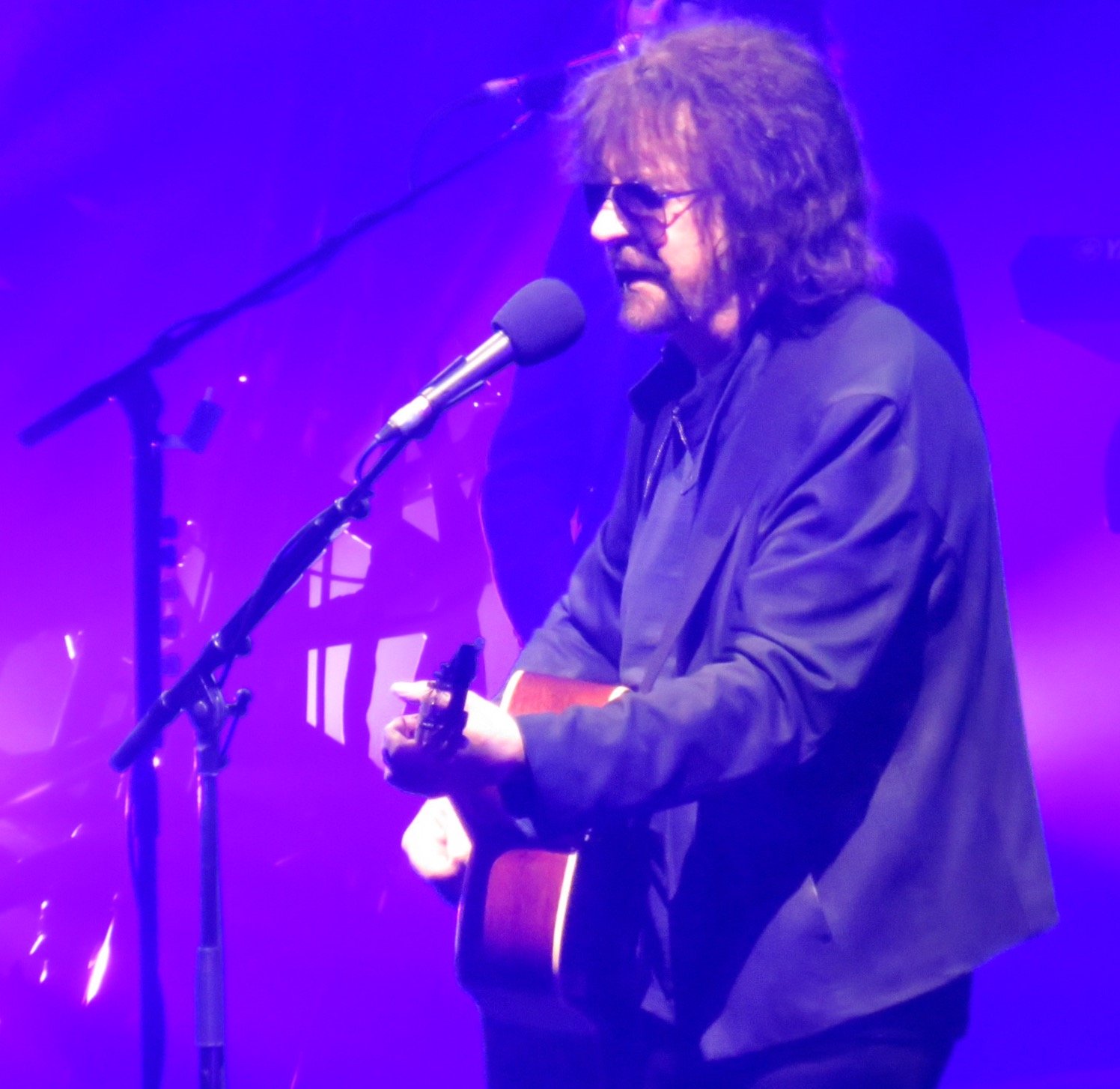
It is the biggest American hit Electric Light Orchestra ever had, and almost everything about it breaks the band’s own rules. Don’t Bring Me Down was written at the last minute, in the studio, by a man who usually arrived with every note finished. It was the first ELO song with no string section at all — this from a band whose entire identity was strings. Its thundering drum track is not a performance but a loop of tape, borrowed from another song on the same album. Its most famous sound is a shouted nonsense word that half the world still hears as “Bruce.” And when it was released, in the summer of 1979, it was dedicated to a space station that was about to fall out of the sky.
The setting mattered. ELO had spent 1977 and 1978 conquering the world behind the double album Out of the Blue and a tour staged inside a giant glowing spaceship. For the follow-up, Jeff Lynne — singer, songwriter, producer and, as ever, the band’s one-man government — wanted something leaner and more rhythm-driven. The result was Discovery, recorded at Musicland Studios in Munich in March and April 1979 with engineer Reinhold Mack: a sleek, dance-tinged record on which the core four of Lynne, drummer Bev Bevan, bassist Kelly Groucutt and keyboardist Richard Tandy laid down the backing tracks within a couple of days. The album was nearly finished when Lynne decided it was missing something.
The Loud One the Album Was Missing
Lynne said it himself in the liner notes to the 2001 remaster of Discovery: “I wrote it at the last minute, ’cause I felt there weren’t enough loud ones on the album. This was just what I was after.” He called the song “a great big galloping ball of distortion.” Mack remembers the moment slightly differently, and his version is the one the engineers tell: Lynne had run out of road, unsure what to record next, and Mack suggested they simply have some fun for one night — “let’s do away with the strings, let’s do away with the choirs and let’s just boogie out for a night.”
Either way, the decision was radical for this band. The string trio who had been ELO’s visual trademark — violinist Mik Kaminski and cellists Hugh McDowell and Melvyn Gale — appear in the promotional videos for Discovery but did not play a note on the album, a sign of how far Lynne’s thinking had moved. Don’t Bring Me Down made the break explicit. “This was the first song I did without any strings,” Lynne later said. No orchestra, no choir of cellos — just piano, guitars, synthesizer, massed voices and the hardest backbeat the band ever put on record.
The gamble worked at album scale, too. Discovery became the first ELO album to top the British chart and reached the American Top 5, spinning off a run of hit singles — Shine a Little Love, The Diary of Horace Wimp, Confusion — each of them built on rhythm and keyboards rather than orchestral sweep. Lynne had spent a decade proving that a rock band could sound like an orchestra. In Munich in the spring of 1979, he set out to prove the songs could survive with the orchestra sent home — and the last song he wrote for the album would be the purest test of the idea.
A Drum Track Made of Tape
The backbeat itself was an act of studio recycling. By Mack’s account, he asked Bevan whether he wanted to jam something up on the spot, and the drummer declined — “Nah, I don’t want to jam around for no reason.” So Mack reached for the tape machine instead. He took two bars of Bevan’s drumming from On the Run, another track recorded for Discovery, cut a tape loop from it and slowed it down, giving the new song a lurching, heavier-than-life pulse that no live take could have matched. Lynne, describing the process to Rolling Stone, said he made the song up in the studio: it starts with that drum loop from On the Run, heavily compressed, and he built everything else on top of it.
The music came first. Lynne worked out the song at the piano, riding the loop — he later told Rolling Stone the track was made up on the spot in the studio, heavily compressed, with the instruments piled on by hand — and the words came last, a lyric, as Mack recalled, about a girl who thought herself better than her boyfriend, sung with a sneer that was new for ELO’s resident romantic. Even the ending is a piece of the building: the record closes with the slam of a metal fire door at Musicland, a full stop recorded as found. A song assembled from a borrowed drum loop, an improvised lyric and a door — and it sounded like a tank coming through the wall.
The Word That Isn’t “Bruce”
Then there is the shout. Between the title lines of the chorus, Lynne yells a single guttural syllable — and for more than four decades, listeners have sworn he is yelling “Bruce.” He is not. In interviews, including a Rolling Stone conversation and a VH1 Storytellers appearance, Lynne has explained that while singing he came to a gap in the vocal and simply shouted a made-up placeholder word: “grooss.” It meant nothing. But Mack, his German engineer, pointed out that it sounded like “Gruß” — German for “greeting.” Lynne liked the accident and left it in.
The public had other ideas. Fans besieged him with the same question — who is Bruce? — until, as he told Best Classic Bands, he surrendered: audiences at concerts were all singing “Bruce,” so he started singing “Bruce” as well. Mack, characteristically, remembers even this differently: he claims the song was briefly titled “Don’t Bring Me Down, Bruce” as a joke ahead of an Australian tour, on the grounds that so many Australian men are called Bruce, before the joke was replaced by “Gruss,” from the Bavarian greeting “Grüß Gott.” Two men, two versions, one nonsense syllable. What is certain is that a throwaway grunt became the most famous misheard lyric in the ELO catalogue — a mondegreen so powerful it eventually rewrote the song in concert.
Dedicated to a Falling Space Station
Released as a single in the summer of 1979 — the second single from Discovery in America, and rush-released in Britain after The Diary of Horace Wimp — Don’t Bring Me Down did what no ELO single had done in the United States. It climbed to No. 4 on the Billboard Hot 100, still the band’s highest-charting hit in America, reached No. 1 in Canada and No. 3 in Britain, the band’s biggest home hit to that point. The throwaway track, sequenced last on the album, had outperformed every meticulously orchestrated epic Lynne had ever made.
The band marked the moment with the strangest dedication in their history: the song was dedicated to NASA’s Skylab space station, which re-entered Earth’s atmosphere and burned up over the Indian Ocean and Western Australia on July 11, 1979. A song called Don’t Bring Me Down, toasted to a falling spacecraft, by a band that performed under a flying saucer — nobody at Jet Records had to work very hard on that publicity. The space connection stuck: years later, the song was played as a wake-up call to astronauts aboard a space shuttle Columbia mission, the spaceship band supplying the alarm clock for the real thing.
What endures is the paradox. Don’t Bring Me Down is ELO with everything stripped away — no strings, no suite, no concept, written in a rush on a loop of somebody else’s drumming — and it became the record America loved most. Lynne re-recorded it in 2012 for his solo revisiting of the catalogue, Mr. Blue Sky: The Very Best of Electric Light Orchestra, and it remains a guaranteed detonation in the live show, the moment the whole arena shouts along with a word that does not exist. The perfectionist’s greatest hit was the one he barely had time to perfect.
Leave a Reply