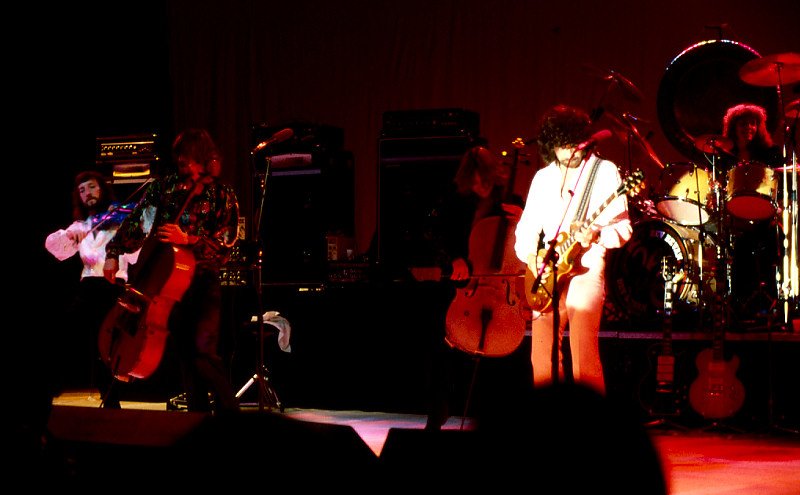
In July 1976, Jeff Lynne took his band down into a basement in Munich and emerged a few weeks later with the record that made them immortal. “A New World Record” was only thirty-six minutes long and contained just nine songs — but it turned Electric Light Orchestra from a cult curiosity into a global phenomenon, gave Britain its first real taste of the spaceship, and produced some of the most perfectly constructed pop ever recorded. This is the story of the album where everything clicked.
The Band Britain Ignored
To understand the triumph, you have to understand the frustration. By 1976, ELO had released five albums and were genuine stars in America — “Face the Music” had cracked the US Top 10 — but back home in Britain, they were being roundly ignored. Their previous three studio albums had failed to chart in the UK at all. Imagine that: a Birmingham band, singing in English accents, unable to get arrested in Birmingham.
Lynne had also made a strategic decision that would define the record. After years of side-long suites and orchestral epics, he was shifting toward shorter pop songs — three and four-minute marvels instead of twenty-minute journeys. It wasn’t selling out; it was focusing. He had spent half a decade proving a rock band could sound like an orchestra. Now he wanted to prove the orchestra could fit on a seven-inch single. And he had just signed to a new label — manager Don Arden’s Jet Records — which meant a clean slate and everything to prove.
The Basement in Munich
The laboratory was Musicland Studios, a basement beneath a grand Munich hotel with a famously tight, dry drum sound. It was the same room where Led Zeppelin had cut “Presence” and Queen had made “A Day at the Races,” and Lynne loved it so much that this was ELO’s second album in a row recorded there. His partner in the control room was the German engineer Reinhold Mack, a sonic perfectionist who would later shape Queen’s eighties sound.
Lynne’s method was unusual and absolute. He arrived with the songs already written — he always did — and taught them to the band in a rehearsal hall before anyone saw a studio. “I had a tune in my head but I never told anybody what it was,” he later recalled. “It was always a mystery to everybody. I saved the words until the very last minute.” The band learned the music blind, the lyrics arrived at the eleventh hour, and then Mack and Lynne layered everything with obsessive precision: drums EQ’d to hit like a punch, strings stacked like architecture, vocals multiplied into choirs. The whole album was cut in July 1976, in a matter of weeks. Lynne always insisted he worked fast. The results suggest he worked fast the way a comet moves fast — with total commitment and no wasted motion.
The Holiday in Spain That Became “Livin’ Thing”
The album’s opening single has one of the great backstories in pop. “Livin’ Thing” began life with completely different lyrics — Jeff Lynne had written it about a holiday in Spain. Then he listened back, hated what he’d written, and did something drastic: he erased the vocals and harmonies entirely and wrote new lyrics in roughly half an hour.
What emerged was one of the most exhilarating singles of the decade. Mik Kaminski’s violin slashes the song open, the strings swoop in like swallows, and the chorus — built on one of Lynne’s most inventive chord sequences, including an augmented chord so strange he later joked it made the song nearly unplayable by anyone else — explodes into pure joy. It became the band’s highest-charting British single to date, reaching number four in the UK, and made the American Top 15 as well. All from a song that had been about a Spanish holiday until half an hour of inspiration rewrote it. Sometimes the best production decision is the delete key.
“Bad Salad Telephone”
If “Livin’ Thing” was lightning, “Telephone Line” was the slow, aching thunder that followed. The ballad — track two on the album, and arguably the finest song Lynne ever wrote — began as a joke: its working title in the studio was “Bad Salad Telephone,” a pun on the sad ballad it was becoming.
The making of it was pure Lynne perfectionism. He wanted the song to open with the sound of an American telephone ringing — ELO were now far bigger in the States than at home, and he wanted that specific transatlantic loneliness. So the band placed a call from England to an American office number they knew nobody would answer, just to listen to the ring. Then, back in Munich, Lynne recreated the exact pitches on a Moog synthesizer, tuning the oscillators to match the ringing notes. The orchestra was recorded later at De Lane Lea Studios in Wembley, and the final touch — the narrow, mono “telephone” effect on Lynne’s voice at the start, as if you’re hearing him through the receiver — was added at the very last minute at Cherokee Studios in Los Angeles, when engineers were instructed to manually degrade the finished stereo master. The mix then blooms gloriously into stereo, like a heart opening.
Released as a single in May 1977, “Telephone Line” reached number seven in America — ELO’s first gold-certified US single — and the Top 10 in Britain. It remains the definitive long-distance love song, and every detail of its construction serves the ache: a man staring at a plastic receiver, willing it to ring.
Opera Meets Rock ‘n’ Roll
The album’s third single was its strangest and most delightful. “Rockaria!” is exactly what the title promises: a full-blooded opera aria crashing into a Chuck Berry-style rock ‘n’ roller. The session featured real opera singer Mary Thomas on the soaring vocal — and session lore has it that she hit a wrong note during the first take, but Lynne loved the energy so much that the human imperfection survived into the final mix. It reached the UK Top 10, proving that British audiences would buy just about anything if the tune was strong enough — even Puccini with a backbeat.
Then came “Do Ya,” and with it a delicious piece of history. The song wasn’t new at all — it was a muscular remake of a 1972 single by the Move, Lynne’s old band, and recording it with ELO let him reclaim a piece of his own past with the full orchestral firepower he’d always imagined for it. It reached the American Top 25, and in hindsight it plays like a bridge: the last echo of the Move, rebuilt as the future of ELO. Between “Livin’ Thing,” “Telephone Line,” “Rockaria!,” and “Do Ya,” the album yielded four hit singles — a strike rate most bands would kill for across an entire career.
The Five Songs You Might Have Missed
With four singles hogging the spotlight, it’s easy to forget that “A New World Record” is only nine tracks long — which means the remaining five are doing quiet, essential work. “Tightrope” opens the album with a deep, doomy synthesizer that gives way to strings and massed vocals before drummer Bev Bevan and bassist Kelly Groucutt kick the whole thing into motion; it’s the sound of a band walking out onto a high wire and grinning about it.
“Mission (A World Record)” and “Shangri-La” are the album’s dreamers, both reaching for mythical elsewheres — the latter a gentle, almost lullaby-like closer that plays like a deliberate echo of the “Eldorado” days, a reminder of where the spaceship came from. “So Fine” is pure propulsion, two and a half minutes of joy, while “Above the Clouds” floats exactly where its title promises, all weightless harmonies and silvered strings. None of them was a single. All of them are why the album plays like a world rather than a playlist. Lynne sequenced the record like a journey — tension, release, wonder, rest — and the deep cuts are the landscape the hits travel through.
Five Million in a Year
The numbers, when they came, were staggering. Released in America on October 15, 1976, and in Britain on November 19, “A New World Record” finally gave Jeff Lynne what he’d been chasing for six years: a British Top 10 album, peaking at number six, after three straight records had failed to chart at home at all. In America it climbed to number five on the Billboard 200 and stayed on the chart for sixty-nine weeks — seven of them in the Top 10. It went to number one in Australia, Sweden, and Canada. Within its first year it had sold five million copies worldwide, earning platinum certifications on both sides of the Atlantic. It was the first of four consecutive million-selling ELO albums.
Think about what that meant for a band that had been ignored at home. The spaceship had finally landed in Britain. Kids who had never heard of Roy Wood or the Move were buying a record with cellos on it because the songs were undeniable. Lynne’s great gamble — that shorter pop songs could carry the full weight of his orchestral ambition — had paid off beyond anyone’s dreams. In 2026, the album celebrated its fiftieth anniversary, and it sounds less like a relic than a transmission from a future we’re still catching up to.
The Record That Proved the Impossible
What “A New World Record” proved, once and for all, was that Jeff Lynne’s founding idea wasn’t madness — it was prophecy. A rock band could sound like an orchestra. An orchestra could play three-minute pop songs. A basement in Munich could produce music that filled stadiums on five continents. Every contradiction in the premise resolved into thirty-six minutes of pure, gleaming certainty.
It also proved something about Lynne himself. The perfectionist in the basement, the man who erased a finished vocal because the lyrics weren’t good enough, who phoned America to get a dial tone right, who saved his words until the last possible minute — he wasn’t fussy. He was faithful: faithful to the idea that a pop record could be as carefully made as a watch and as joyful as a funfair. “A New World Record” is the sound of that faith rewarded.
Put it on and listen for the details: the violin slash that opens “Livin’ Thing,” the Moog-precise ring of the telephone, the opera singer’s gloriously human wobble, the moment the mono blooms into stereo and your chest opens with it. Nine songs, thirty-six minutes, one basement. It was, as the title promised, a new world record — and fifty years later, we’re all still living in the world it made.
Leave a Reply