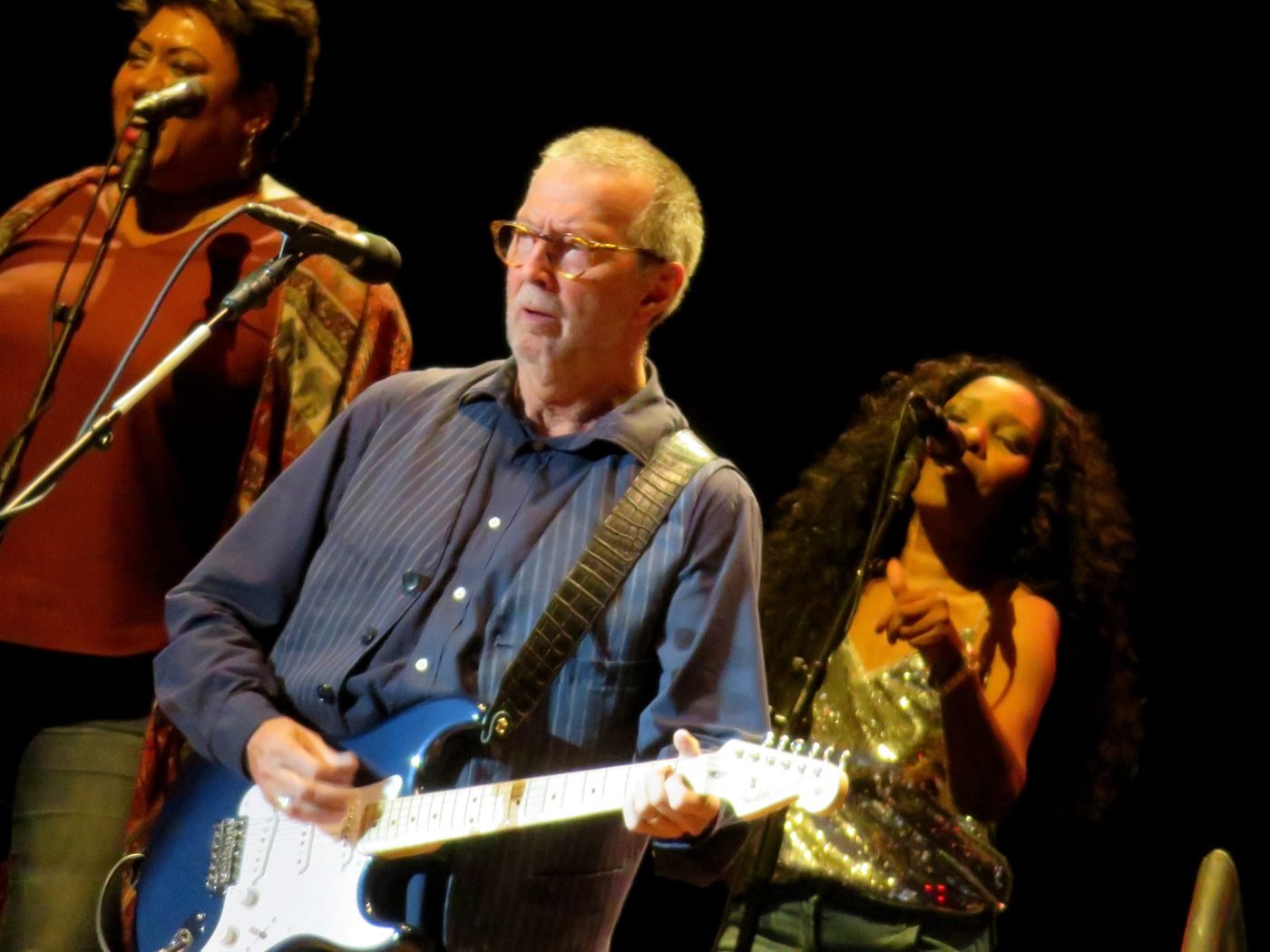
Ask a room of rock fans who wrote Cocaine and most will name Eric Clapton without a second’s hesitation. The song is his signature as surely as the riff that opens it: that sly, loping guitar figure, the half-whispered promise that “she don’t lie, she don’t lie, she don’t lie.” Yet Clapton did not write a note of it. Cocaine came from one of the most deliberately un-famous men in American music, the Oklahoma singer-songwriter J.J. Cale — and it was written not as an anthem to the drug, but as a warning about it, disguised so cleverly that much of its audience never noticed.
Clapton has spent nearly fifty years both celebrating the song and wrestling with it. It opened the biggest album of his solo career, became a hit only in a live version recorded in Tokyo, and then spent years banished from his stage because its composer-performer feared the message was being misread. Few cover versions carry so much history in three and a half minutes.
The Oklahoman in the Cocktail Lounge
J.J. Cale wrote Cocaine in the mid-1970s, and by his own account he first imagined it in the style of Mose Allison, the Mississippi-born pianist whose blend of jazz, blues and dry wit Cale adored. In the documentary To Tulsa and Back, Cale recalled that he had written the song “in a Mose Allison bag, kind of cocktail jazz kind of swing” — a loping, after-hours number for a man watching temptation work its way around a bar. His producer, Audie Ashworth, heard the potential in it and told him it was a good song that deserved a harder edge; sped up and toughened, it became the taut blues-rock track Cale recorded for his fourth album, Troubadour, in 1976.
Cale’s own recording, just two minutes and forty-eight seconds long, keeps everything bone-dry: a crack band of Nashville session men — Reggie Young taking the guitar solo, Kenny Buttrey on drums — behind Cale’s murmured vocal and chunking rhythm guitar. It sounds less like a warning than a shrug, which is precisely the ambiguity Clapton would later talk about. Shelter Records released Cale’s Cocaine as the flip side of his single Hey Baby in 1977, and in most of the world that is where it stayed. In New Zealand, improbably, it climbed all the way to number one for a week and finished among the country’s best-selling singles of the year. Everywhere else, the song was waiting for its second life — and second lives of Cale songs had a habit of running through the same English guitarist. In 1970, Clapton had taken Cale’s After Midnight as his very first solo single and turned it into a hit. When he went looking for material for a new album in 1977, he went back to the same well.

Slowhand Opens With It
The album was Slowhand, recorded at Olympic Studios in London in May 1977 with producer Glyn Johns, the engineer behind records by the Rolling Stones, the Who and Led Zeppelin. Johns favoured discipline and live feel, and Clapton’s band — George Terry on rhythm guitar, Dick Sims on Hammond organ, bassist Carl Radle and drummer Jamie Oldaker — cut the record quickly. Of all the songs they taped, it was Cocaine that Clapton chose to open the album, its riff the first thing any listener heard. The recording is a model of restraint: where a lesser band might have swaggered, Clapton’s group simmers, Sims’ organ bubbling under a groove that never hurries, while Clapton delivers the lyric in an almost conversational murmur that makes its hook more insinuating, not less.
During the Slowhand period, Clapton and his band went to see Cale in concert, and Cale brought his English admirer on stage to duet on Cocaine — the recluse and the superstar sharing the song for one night. It was the beginning of a long, respectful friendship between two men with opposite relationships to fame: Cale, who disliked touring and celebrity alike, was happy to let his songs travel the world in other people’s voices, with the royalties from Clapton’s versions helping to finance a career run entirely on his own terms back in Oklahoma; Clapton, meanwhile, could not escape the spotlight if he tried.
A Hit by the Back Door
For all its later stature, Cocaine was never pushed as a Clapton single in its studio form. RSO released it in November 1977 as the B-side of Lay Down Sally, another Slowhand track. The song’s chart life came three years later and an ocean away. In December 1979 Clapton recorded a run of concerts at the Budokan in Tokyo, released as the double live album Just One Night. The live Cocaine, all stretched solos and crowd heat, was issued as the B-side of the live Tulsa Time — and this time it charted on its own momentum, reaching number 30 on the Billboard Hot 100 in 1980 and number 3 in Canada. A live version also earned a place on his 1982 hits compilation Time Pieces, the record through which much of America first owned the song. AllMusic’s Richard Gilliam would later call it “among [Clapton’s] most enduringly popular hits,” adding that “even for an artist like Clapton with a huge body of high-quality work, ‘Cocaine’ ranks among his best.” In the streaming era it has kept selling quietly, collecting a Silver certification in Britain and triple Platinum in New Zealand — the country, fittingly, where Cale’s original had already been a number one.
“Quite Cleverly Anti-Cocaine”
The trouble was the applause. Night after night, crowds roared the title back at the stage as if the song were a celebration, and Clapton — who knew the subject from the inside, having beaten a heroin addiction in the early seventies only to slide into heavy drinking and cocaine use of his own — grew uneasy. His reading of the song was always the opposite of the crowd’s. “It’s no good to write a deliberate anti-drug song and hope that it will catch,” he explained. “So the best thing to do is offer something that seems ambiguous — that on study or on reflection actually can be seen to be ‘anti’ — which the song ‘Cocaine’ is actually an anti-cocaine song. If you study it or look at it with a little bit of thought… it just sounds like a song about cocaine. But actually, it is quite cleverly anti-cocaine.”
There were exceptions — his performance of the song at the Montreux Jazz Festival in 1986, with a lean band and his guitar turned up, is still passed around by fans as a definitive one — but for long stretches Clapton simply left Cocaine out of his concerts, unwilling to lend his voice to what he feared was being heard as an endorsement. Sobriety changed the equation. Clapton got clean in the late eighties, and in 1998 he founded the Crossroads Centre in Antigua, a treatment facility for the addictions he had survived, funding it in part through auctions of his own guitars and his Crossroads Guitar Festivals. When Cocaine returned to his set lists for good in 2006 — the Associated Press marked the occasion with a wire story headlined “Eric Clapton Returns to Playing ‘Cocaine’” — he had altered the delivery to remove all doubt, spitting the words “that dirty cocaine” into the chorus. The warning, at last, was audible over the applause.

Two Careers, One Song
The story ends with the debt repaid in full. Clapton kept returning to Cale’s catalogue — Travelin’ Light on the 2001 album Reptile among others — and in 2006 the two men finally recorded an entire album together, The Road to Escondido, which won the Grammy Award for Best Contemporary Blues Album. Cale, characteristically, stayed home in Oklahoma and let the record speak for him. When he died in 2013, Clapton led the tributes and later recorded The Breeze, an album of Cale songs with friends, to honour him.
Cocaine remains the strangest entry in Clapton’s catalogue: a song he did not write, was barely released as a single, and spent years refusing to sing — and yet the one audiences would list among his defining performances. Its composer built the trap into the lyric; Clapton, who had lived the trap, spent a career making sure listeners understood it was one.
Leave a Reply