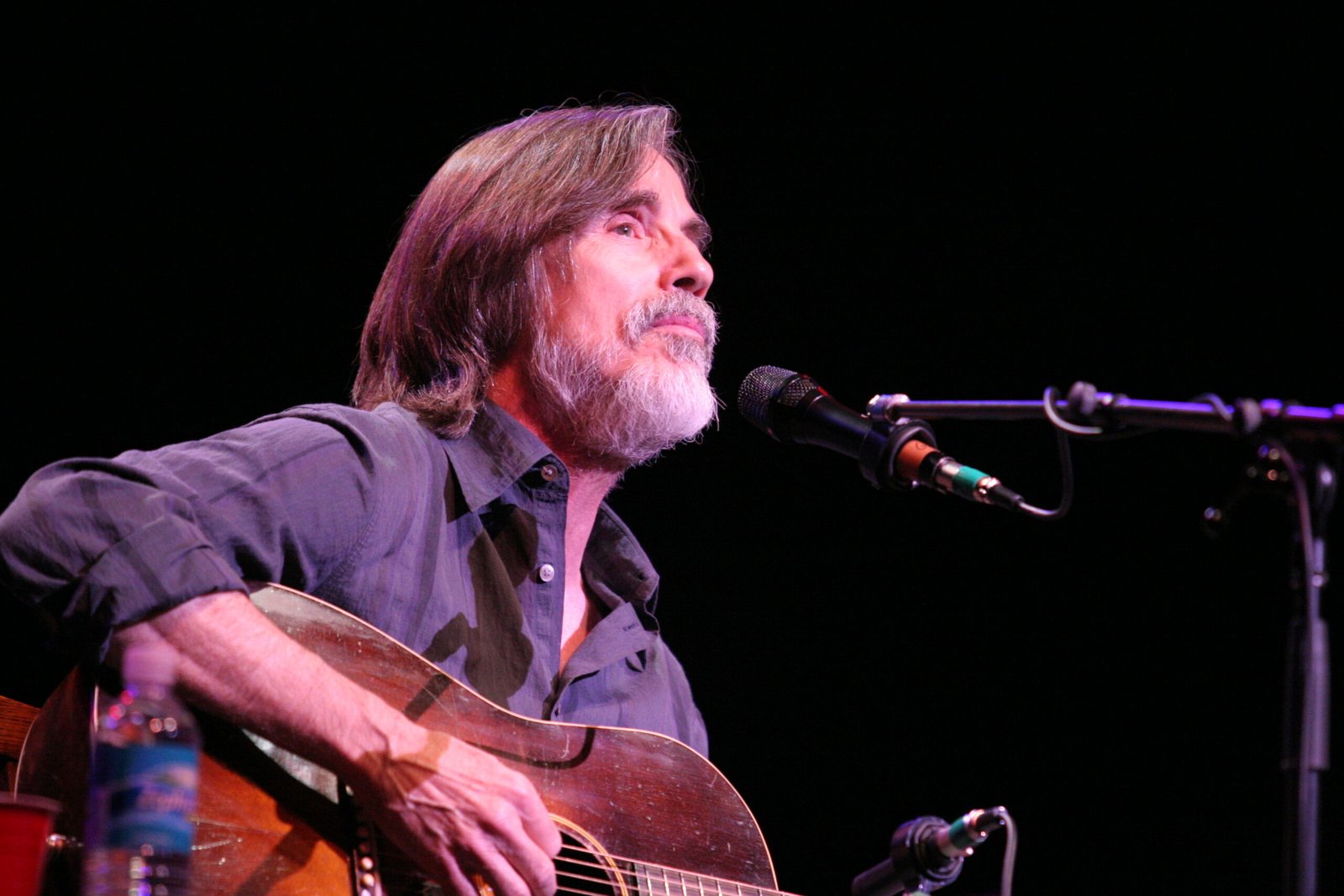
Most live albums are souvenirs — familiar songs taped in concert to squeeze one more product out of a tour. Jackson Browne had a stranger idea. In 1977 he took a tape machine on the road and recorded an entire album of brand-new songs about life on tour, capturing them wherever the life actually happened: on stage, backstage, in hotel rooms, and on the bus rolling through the night. The title track, Running on Empty, began in the most mundane way imaginable — behind the wheel of a car whose gas gauge its owner never bothered to check.
A Few Blocks on an Empty Tank
The song was written in 1976, while Browne was commuting to the sessions for his fourth album, The Pretender. The studio was close to his home, and that closeness bred a peculiar habit. “I was always driving around with no gas in the car,” Browne told Rolling Stone. “I just never bothered to fill up the tank because — how far was it anyway? Just a few blocks.” Running on empty was not a metaphor he went looking for; it was his dashboard, every day.
But Browne was also a new widower — his wife, Phyllis Major, had died in March 1976, leaving him to raise their young son — and The Pretender had turned his grief into some of the most searching writing of his career. The driving song grew beyond the joke of the fuel gauge. Its verses take stock of a life measured in years and ages: seventeen in 1965 and running up Highway 101, twenty-one in 1969, looking back at friends who had settled and wondering what he was still running for. It was a road song, but the road led inward.
An Album with No Studio
For his next record, Browne decided the form should match the subject. Running on Empty would be a live album with two twists: every song would be new, never previously released in a studio version, and the album would document the whole ecology of touring, not just the two hours under the lights. So the mobile recording gear followed the band everywhere. Some tracks were cut on stage. Others were recorded backstage or in hotel rooms. Nothing But Time, a song about the dead hours of the road that Browne wrote with his tour manager Howard Burke, was recorded on the band’s Continental Silver Eagle tour bus as it drove — if you listen closely, you can hear the engine underneath the performance, rising and falling with the road.
It was a risky conceit. Live albums banked on hits; Browne was offering audiences a full set of songs they had never heard, recorded in rooms never designed for recording. The project was captured and mixed by engineer Greg Ladanyi, whose job was to make a hotel room and a concert hall sound like chapters of the same book. What made it work was that the material formed a single sustained meditation — the stage, the bus, the hotel, the homesick hours between — and the playing of his band, the finest road unit in Los Angeles rock. The album closes with its thesis statement: The Load-Out, Browne’s tender tribute to the roadies who build the show every night, flowing into Stay, Maurice Williams’s 1960 doo-wop hit, repurposed as the encore plea of a band that has to drive all night to do it again in another town. The whole record, in other words, is one long night of a tour, and the title track is its engine.
One Night in Maryland
The title track was captured where it belonged: in front of an audience. On August 27, 1977, at the Merriweather Post Pavilion in Columbia, Maryland, Browne and his band cut the definitive Running on Empty live. You can hear the machinery of the performance in the record’s bones: Browne’s piano driving the tempo, and sailing over it, David Lindley’s lap steel guitar — a keening, vocal-like solo that became one of the most celebrated instrumental breaks of the decade. Lindley was famous for never playing a solo the same way twice; what you hear on the record is what happened that night, once, unrepeatable by design. Behind them were the crack session players collectively known around Los Angeles as the Section: Russ Kunkel on drums, Leland Sklar on bass, Craig Doerge on keyboards, and Danny Kortchmar on guitar, with Rosemary Butler and Doug Haywood lifting the choruses. The recording has everything a studio version would have polished away: momentum, sweat, and a crowd hearing a classic for the first time without knowing it. Rolling Stone‘s Paul Nelson caught its doubleness when the album appeared, hearing in the song a “tenacious, win/lose duality” — the sound, he wrote, of what daydreamers have nightmares about.
No. 11 and the Long Run
The album Running on Empty was released in December 1977 and became the biggest success of Browne’s career, reaching No. 3 on the Billboard 200 and earning a Grammy nomination for Album of the Year. The title track, issued as a single in February 1978, climbed to No. 11 on the Hot 100 and stayed on the chart for seventeen weeks; a second single pairing The Load-Out with Browne’s ebullient take on Stay — the album’s closing onstage medley — reached No. 20. The record that was supposed to be a stopgap experiment became his commercial peak, eventually certified seven-times platinum in the United States alone.
Why did a song about exhaustion connect so widely? Partly timing: by 1978, the generation that had come of age with 1960s rock was doing Browne’s arithmetic in its own life, counting the years between seventeen and now. And partly honesty: Browne never pretended the running was glorious. The song admits its singer doesn’t know where he’s running, or why he can’t stop.
Still Running
Here is the final, fitting oddity of the Running on Empty story: there is no studio version. Browne never took the song into a recording studio, before the tour or after it. The performance taped in Maryland in August 1977 — one night, one crowd, a band at full stretch — is not the live souvenir of a record made elsewhere. It is the record, the sole and definitive text, exactly as the album’s concept demanded. The experiment folded in on itself perfectly: a song about the road that exists only because a road crew pressed “record” at the right moment.
There is a quiet irony in the song’s chart history. Running on Empty was never Jackson Browne’s biggest hit — Doctor My Eyes had reached No. 8 in 1972, and Somebody’s Baby would climb to No. 7 in 1982. Yet it is the song his name now summons first, the one that outlasted the higher-charting records because it said something the others didn’t: not a moment, but a whole way of living, measured out in motel rooms and mile markers. Signature songs are not always the biggest ones. Sometimes they are simply the truest ones.
Rolling Stone placed Running on Empty on its list of the 500 Greatest Songs of All Time, and the song long ago escaped its album to become a permanent fixture of American driving culture. A new generation met it in Forrest Gump, where it soundtracks Forrest’s run across America — a literal-minded use Browne’s commuters-in-spirit could only applaud. In concert it remains the moment Browne’s audiences have waited all night for, sung by a man now decades past the ages in the lyric, which somehow makes it truer rather than less.
Jackson Browne set out to make an album about the road, and he made it the honest way — on the road, in the bus, in the hotel rooms, on the stage in Maryland. And its title song began on a drive of a few blocks, in a car that was always about to run dry. He just never bothered to fill up the tank. Neither, in the end, did the song.
Leave a Reply