
Every great love song has a moment where the feeling escapes the plan, and on My Love you can hear the exact second it happens — a guitar solo that was never supposed to exist. Paul McCartney had written the solo himself, as he usually did. Moments before the take, his guitarist Henry McCullough leaned in and asked whether he might try something else instead. McCartney, in front of a fifty-piece orchestra being paid by the hour, said yes. What McCullough played — improvised, aching, entirely his own — became the signature of the record: a piano ballad for Linda McCartney that spent the whole of June 1973 at number one in America and turned Wings, at last, into the band McCartney had been promising.
A Song From the Beginning of a Marriage
McCartney wrote My Love at the piano early in his relationship with Linda, around 1969 or 1970 by his biographer Luca Perasi’s dating — which is to say it predates Wings, the band it would eventually rescue. “It’s a pure love song to Linda, a reaffirmation of my love for her,” he said simply. The style is that of his late-Beatles ballads, in the line of The Long and Winding Road: a slow, hymn-like melody over shifting chords, verses that admit absence and empty cupboards, and a chorus that keeps returning to the one certainty.
When McCartney formed Wings in the summer of 1971, with Linda on keyboards, the song went straight into the working repertoire. It was there at the band’s public debut, at Nottingham University on 9 February 1972, with Linda singing answering lines against her husband’s lead — and, by Perasi’s account, the live arrangement was already almost identical to the record they would make a year later. The song had been road-tested long before it was recorded; what it needed was a setting grand enough to match it.
It also needed an audience willing to meet it halfway. Wings’ first records had been received as a Beatle’s hobby — charming, slight, defiantly unpolished — and the critics who had shrugged at Wild Life were not obviously waiting for a lush orchestral ballad. My Love was McCartney’s wager that they were wrong: that the directness the counterculture read as simplicity was the same directness that had carried Yesterday, and that a love song sung plainly to one person could still stop a chart full of glam and hard rock.
Cut Live With a Fifty-Piece Orchestra
The setting, in January 1973, was Abbey Road Studios — and the method went against every convention of the business. McCartney invited Richard Hewson, an arranger he had worked with in Beatles days, to score the song for orchestra, and then recorded the band and a fifty-piece orchestra together, live, in the same room at the same time. Studio musicians were paid by the hour, and the usual practice was to cut the band track first and layer the strings later, safely and cheaply. McCartney wanted a feeling that only a live performance could give. Hewson recruited, as he recalled, the best jazz musicians he knew for their warm sound, and the session ground through take after take — around twenty performances across three hours — until the exhausted players had to assure McCartney that what they had could not be improved.
McCartney played Fender Rhodes electric piano, with Denny Laine covering bass. Everything about the enterprise announced that this was no stopgap Wings single: it was a full-scale production built around a love song, made by a man determined to prove that his post-Beatles band could carry the biggest record he had in him.
“Would It Be Alright If I Try Something Else?”
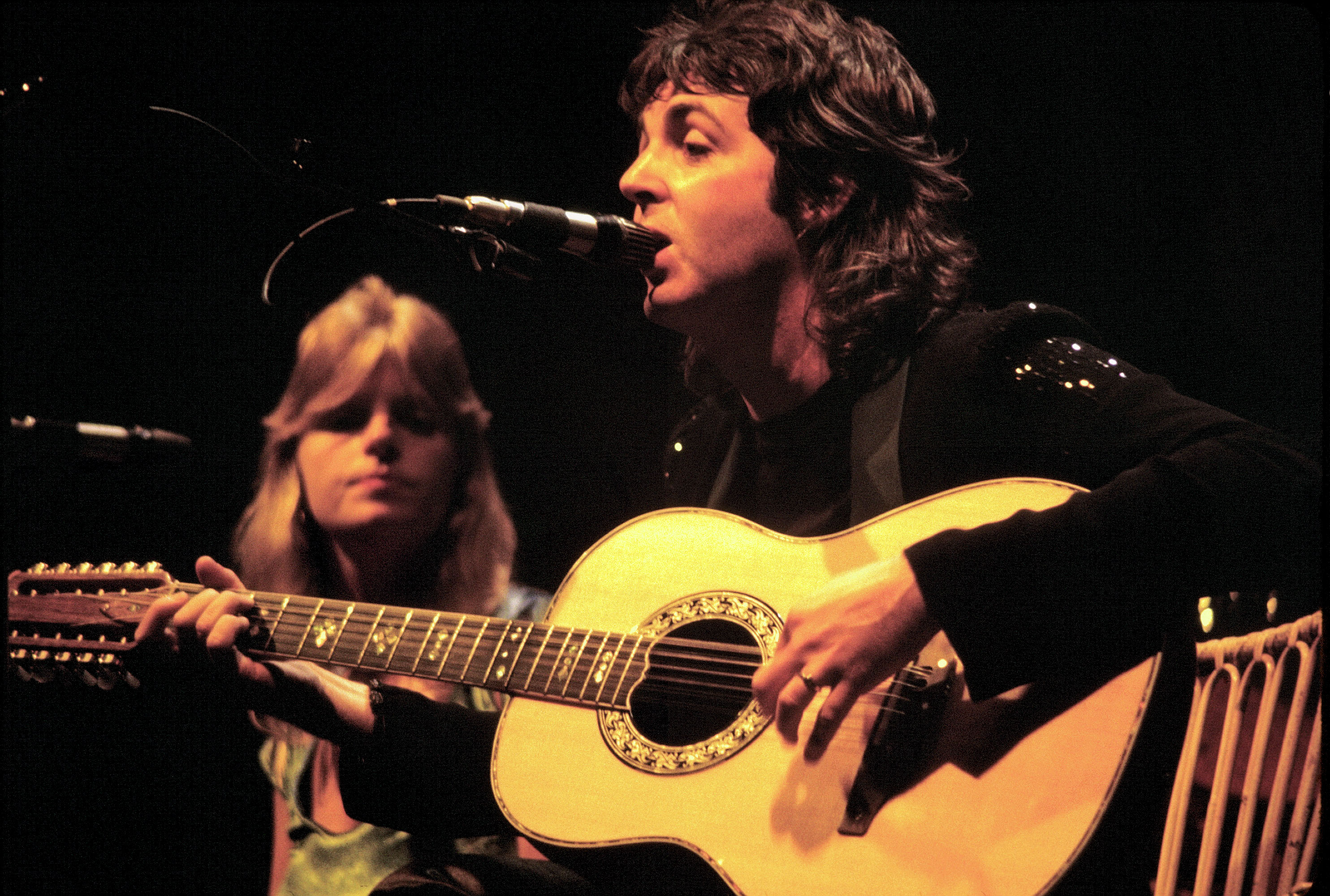
And then there is the solo. McCartney had composed one, as was his habit — he liked to write the guitar parts and have them played as written, a discipline the Northern Irish bluesman Henry McCullough had been chafing under. McCullough later said it had reached the point where he achingly wanted to be the guitar player in the band rather than a sideman executing instructions. Just before a take, he went to McCartney and asked, in McCartney’s own retelling: “Hey, would it be alright if I try something else?” McCartney hesitated — “Er … yeah” — and wondered, as he put it, whether he believed in the guy.
He did, and he was right to. The solo McCullough improvised on the spot is the emotional peak of the record, a slow, vocal line that bends and breathes where a composed part would have behaved. “It came right out of the blue,” McCartney said, “and I just thought, fucking great.” It was reportedly the first time anyone in Wings had challenged McCartney’s instructions, and the others in the band encouraged it precisely because it made Wings a real band. In his book The Lyrics, McCartney called the solo absolutely beautiful and said he was proud he had given McCullough the freedom. When McCullough died in 2016, McCartney singled it out again: a classic, made up on the spot in front of a live orchestra.
The Name Change and the Summer of 1973
Apple released My Love on 23 March 1973, with the live recording The Mess on the B-side, and the label carried a quiet revolution: for the first time the artist credit read “Paul McCartney & Wings”. The group’s earlier records had gone out under Wings alone, and their modest sales — Wild Life above all — were blamed in part on the public simply not knowing McCartney was in the band. The name went on the front, and the market responded.
The single topped the Billboard Hot 100 for four weeks, the whole of June 1973 — no love song spent longer at number one that year; in fact nothing did — reached number nine in Britain and number one on the Easy Listening chart, and was certified gold in July. At the end of June it was displaced by George Harrison’s Give Me Love (Give Me Peace on Earth), so that for the first time since April 1964 two Beatles held the top two places on the American chart — as solo artists, the only time it has ever happened. The album it led, Red Rose Speedway, became the first of five consecutive Wings albums to top the American chart; in the words of author Bruce Spizer, My Love was the song that sold it.
Promotion had its farces. Wings filmed a performance for Top of the Pops shown in April — after which McCullough, drunk and nauseated by the studio’s smoke effects, was sick on the stage, an incident that did his already fractious relationship with McCartney no good at all. And there was a deeper irony waiting on the road: the improvised solo that had been born from one spontaneous act of freedom now had to be reproduced, note for note, at every show, because McCartney insisted the hit sound exactly as it did on the record. The guitarist who had rebelled against playing written parts found his own rebellion had become the written part — one more strain in a partnership that would not long survive the band’s rise.

The Song After Linda
The critics were not all kind — Robert Christgau sneered, and John Lennon, in the slagging-off season of their feud, joked about it — but the song outlasted the sneers, covered by Tony Bennett, Nancy Wilson, Brenda Lee, Mariah Carey, Andy Williams and Harry Connick Jr. among many others, and installed permanently in McCartney’s concerts. After Linda’s death in 1998 it changed its meaning in public: McCartney performed it as a tribute to her, and included it in the programmes for her memorial services in London and New York, where it was played by a string quartet. A song written at the very start of a marriage had become the way he closed it — and at its centre, still, is the few seconds where a guitarist asked for trust, and got it.
Leave a Reply