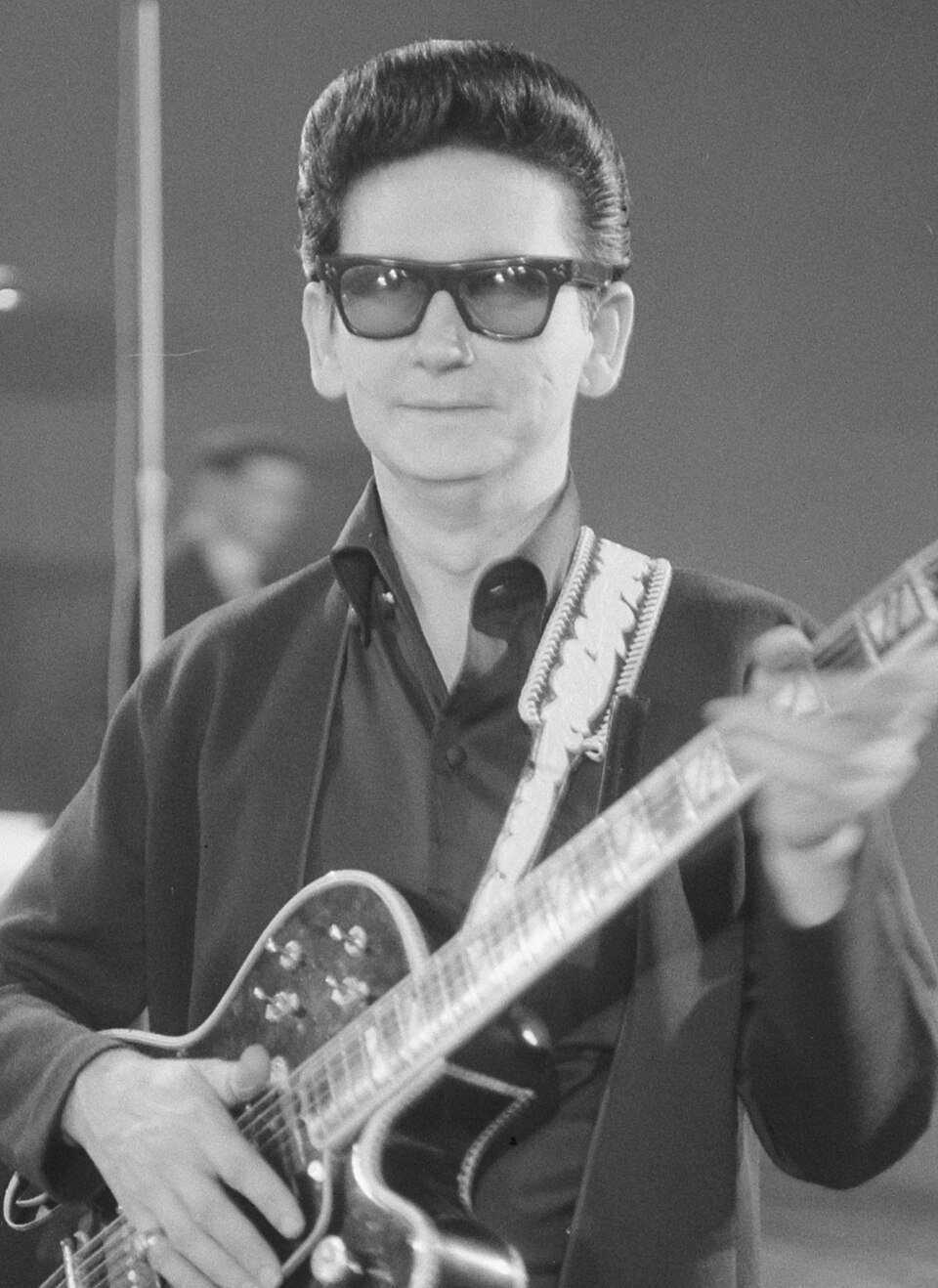
It begins with a guitar riff so famous that most listeners can hum it before they can name the song. Dum, dum, dum, dum, dum, dum, dum, dum. Then Roy Orbison’s voice arrives, playful, confident, and utterly unmistakable, telling the story of a man who sees a pretty woman walking down the street and wonders if she might just turn around. Oh, Pretty Woman is one of the most joyful records ever made, and also one of the most perfectly constructed. Its story, from a casual writing session to a worldwide number one, shows how a great song can be both simple and brilliant at the same time.
A Song That Started With a Joke
Oh, Pretty Woman was written by Roy Orbison and Bill Dees in 1964, and legend has it that the song began with a light-hearted moment. Roy’s wife Claudette was heading out shopping, and Roy asked if she needed money. Bill Dees joked that a pretty woman never needs money, and Roy replied, pretty woman, before the two songwriters realised they had the start of something special. Whether every detail of that story is exact, it captures the song’s spirit: it was written quickly, with humour, and with a sense of fun that shines through every second of the finished record.
Bill Dees and a Perfect Songwriting Partnership
Bill Dees was a frequent collaborator of Roy’s, and their partnership worked because they understood each other’s strengths. Roy brought a singer’s sense of drama and a remarkable melodic instinct, while Dees brought a lyricist’s eye for everyday detail. Together they wrote songs that felt both personal and universal. For Oh, Pretty Woman, they kept the lyric simple and direct. There is no complicated poetry, no obscure metaphor, just a man, a woman, a street, and a hope. That simplicity is the song’s genius. Anyone who has ever watched someone walk by and wished for a second glance understands it instantly.
The Riff That Changed Everything
The guitar riff at the start of Oh, Pretty Woman is one of the most recognisable in rock history. Played with a crisp, rhythmic attack, it sets the scene immediately, like footsteps on a pavement. Roy and his musicians knew they had something special when they heard it. The riff does not just introduce the song; it becomes a character in it, returning throughout the record, driving the rhythm forward, and giving listeners something to sing along to even before the first lyric. It is a reminder that in pop music, a great riff can be as memorable as a great chorus, and this one has never been forgotten.
Recording in Nashville With the Finest Musicians
Oh, Pretty Woman was recorded in Nashville in August 1964, with producer Fred Foster and a group of superb session musicians. Nashville’s studios were famous for their efficiency and their feel, and the session for this song was no exception. The band played with a lightness and a swing that suited the material perfectly. Drums, bass, guitars, and piano locked together into a groove that was both tight and relaxed. Roy, as always, was meticulous about his vocal, but he also knew when to let the band’s energy carry the record. The result sounds live, spontaneous, and joyful, even though every detail was carefully crafted.
Roy’s Vocal: Playful, Powerful and Perfectly Controlled
What makes Roy’s vocal on Oh, Pretty Woman so special is its balance of playfulness and power. In the verses, he sings conversationally, almost teasingly, as if he is talking directly to the woman in the song. In the chorus, his voice opens up, soaring with a confidence that turns a simple flirtation into a celebration. The famous growl near the end, where Roy sings mercy, is a moment of pure theatre, a singer enjoying himself and inviting the listener to enjoy it too. It is a performance that shows Roy was not only a great ballad singer; he was a great rock and roll singer, with a sense of humour and timing to match his range.
A Story With a Twist at the End
One reason Oh, Pretty Woman endures is its clever twist. For most of the song, the pretty woman walks on by, seemingly uninterested, and the singer is left hoping. Then, in the final verse, she turns around and walks back to him, and the song ends in triumph. That twist gives the record a narrative arc that many pop songs lack. It is not just a catchy chorus; it is a tiny romantic comedy, told in under three minutes. Listeners love that ending because it rewards their attention. They have followed the story, they have hoped along with the singer, and they get the happy ending they wanted.
Number One Around the World
When Oh, Pretty Woman was released in September 1964, it became Roy’s biggest hit, reaching number one in the United States, Britain, and many other countries. It sold millions of copies and became the defining record of his career, even though Roy had already made many other classics. Its success was well deserved. The song appealed to teenagers, to adults, to rock fans, and to pop fans, because it was both cool and warm, both exciting and funny. It also proved that Roy, who was often associated with heartbreak ballads, could make a record that made people dance, laugh, and sing along at full volume.
A Song That Never Left Popular Culture
Oh, Pretty Woman has never really gone away. It was the inspiration for the title of the 1990 film Pretty Woman, and its riff has been heard in countless advertisements, television shows, and covers. Musicians from Van Halen to countless pub bands have played it, and each new version reminds listeners of the original’s perfection. The song’s staying power comes from its construction: a riff you cannot forget, a story you can follow, a vocal you cannot imitate, and a feeling you cannot resist. It is pop music at its most democratic, a record that belongs to everyone who hears it.
Why Roy’s Version Remains Untouchable
Many artists have covered Oh, Pretty Woman, but none have replaced Roy’s version in the public imagination. That is because Roy’s performance is inseparable from the song itself. His voice, with its unique combination of warmth, power, and playfulness, gives the lyric a sincerity that other versions struggle to match. He sounds like a man who genuinely believes the pretty woman might turn around, and that belief is infectious. Roy did not just sing Oh, Pretty Woman; he lived inside it for three minutes, and he invited us to live inside it too. That is why, sixty years on, we still turn it up.
Listening Again: A Masterclass in Joy
Put Oh, Pretty Woman on today and listen as if for the first time. Notice the riff, the band, the way Roy’s voice moves from conversation to celebration, and the little growl that still makes listeners smile. Notice, too, how the song makes a simple moment, a woman walking down the street, feel like a story worth telling. That is the art of Roy Orbison at its brightest. He made Oh, Pretty Woman not by trying to be clever or fashionable, but by trusting a great riff, a simple story, and a voice that could make anything sound like a miracle. It remains, quite simply, pretty wonderful.
Leave a Reply