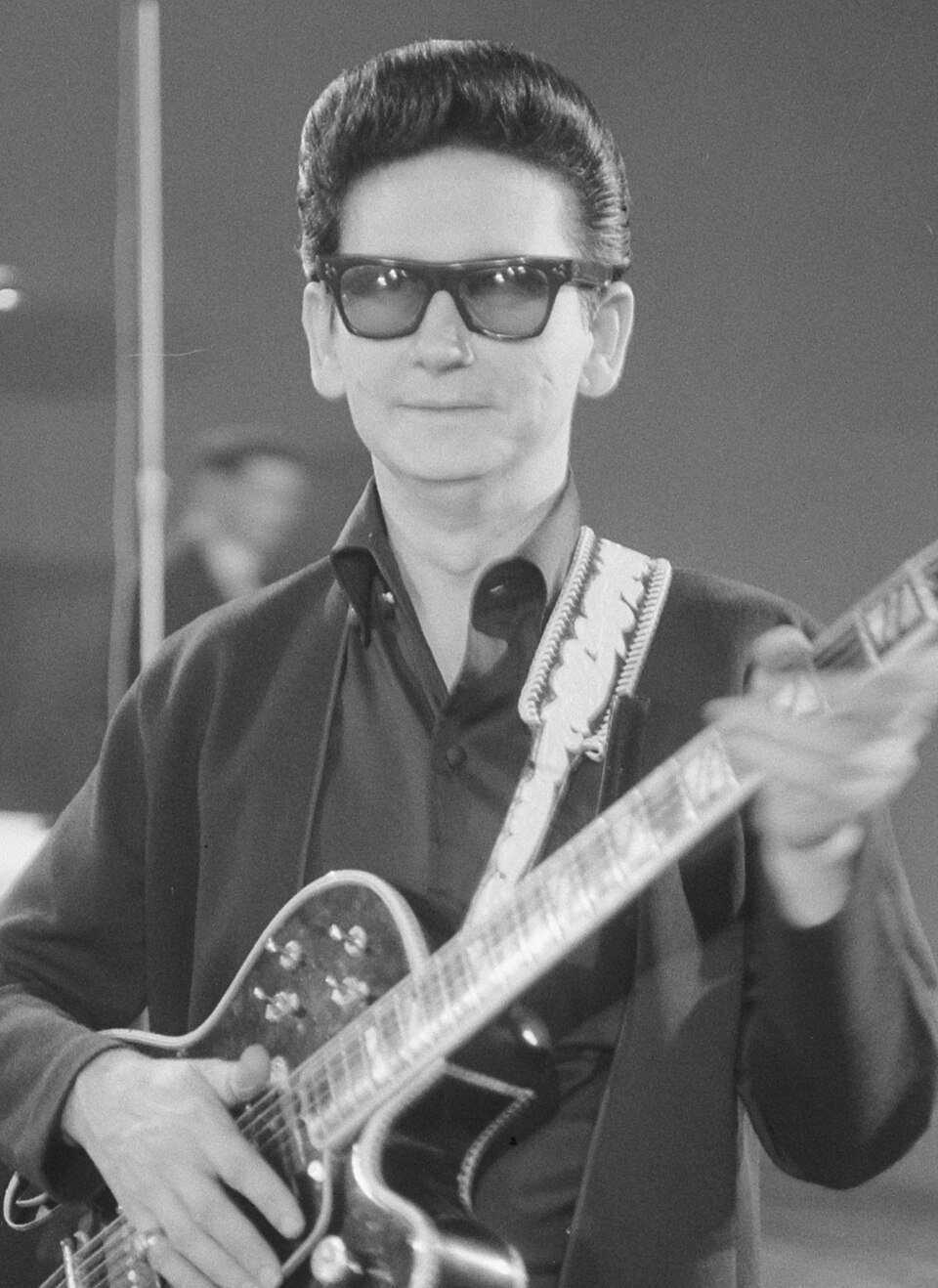
There is a moment, near the end of Running Scared, when Roy Orbison’s voice climbs to a note so high and so full that it seems to leave the song behind altogether. For two minutes the record has done nothing but tighten — verse upon verse, each one louder and more desperate than the last, with no chorus to release the pressure. Then comes the final line, the story resolves in a single breath, and Orbison holds that astonishing note like a man who has just won everything. It remains one of the most dramatic two minutes in pop history, and it was built, quite deliberately, to break every rule of how a hit single was supposed to work.
Orbison and his writing partner Joe Melson did not set out to write a conventional love song. They set out to write a small opera about fear — the fear of a man who has finally won the woman he loves and cannot stop imagining the moment her old flame walks back into the room and takes her away. Every second of the record serves that dread. And the most remarkable thing about it is that the dread very nearly included the singer himself, who had to stand in front of a full Nashville orchestra and find out, in real time, whether his voice could do the thing the song demanded of it.
A Song Built Like a Staircase
By the beginning of 1961, Orbison and Melson had established a working method that was quietly revolutionizing the pop ballad. Where other writers built songs from repeating blocks — verse, chorus, verse, chorus — the Orbison-Melson team wrote in a continuous emotional climb. Only the Lonely had proven the approach could produce a hit. Running Scared, written for Orbison’s sessions in early 1961, pushed it to its logical extreme: a song with no chorus at all.
The lyric is a single unfolding scene. A man walks with his love, proud and happy — and then he sees him, the rival from her past, standing there. Each verse adds a turn of the screw. What if she chooses him? The drums, playing a slow bolero rhythm, keep a steady, heartbeat-like pulse beneath the verses, an idea Orbison is credited with importing into rock and roll from the Latin bolero tradition. Nothing repeats, because fear does not repeat; it only grows. The arrangement grows with it, instruments entering one by one, the backing voices rising, until singer and listener alike have nowhere left to go but the final line — in which the woman, after this long agony of doubt, simply walks away with the singer. The whole drama turns on that ending, and the ending turns on one note.
The Note at the Top of the Stairs
The session took place on February 27, 1961, at RCA Victor’s Studio B in Nashville, with Monument Records owner Fred Foster producing and the gifted engineer Bill Porter behind the glass. Foster had strong opinions about how the record should end. The climactic note, as the song had been written, could easily have been taken the safe way, flipped into falsetto, the airy head-voice Orbison could produce at will. Foster refused. He wanted the note sung in full, natural voice — chest voice, at full power — so that the triumph of the final line would be physical, something the listener felt in the body rather than merely heard.
That was an enormous thing to ask. The note in question sits at the very top of a tenor’s range, and it does not arrive in isolation: it comes at the end of two minutes of continuous climbing, with no chorus in which a singer might rest. Accounts of the recording differ on the exact pitch — Foster himself described it as a G above high C, while later analysis puts it at a tenor high A — but everyone agrees on the essential fact: Orbison delivered it, in full voice, in front of the assembled orchestra and singers, and the take was so complete that the song needed nothing else. Dave Marsh and other critics have since singled out that ending, sung entirely without vibrato, as the purest demonstration of the power and clarity of Orbison’s voice ever captured on tape. In just over two minutes — the single runs a mere 2:10 — the record goes from a whisper of insecurity to one of the great climaxes in popular music.
Porter deserves a share of the credit for how that climax lands. He was the most respected engineer in Nashville, a perfectionist famous for coaxing an unusually clear, present sound out of Studio B, and his recording of Running Scared places Orbison’s voice so far forward that the orchestra seems to surge behind him like weather. On most records of the period, the singer rides on top of the arrangement. On this one, the arrangement quite literally chases the singer up the staircase — strings, voices, and drums piling in behind a vocal that keeps rising just out of their reach, until, on the final note, the whole studio seems to arrive at the summit at once. It is engineering as drama, and it has rarely been bettered.
Number One, and a B-Side That Made History Too
Monument released Running Scared in March 1961, and it climbed steadily to No. 1 on the Billboard Hot 100, Orbison’s first American chart-topper. It reached No. 9 in Britain and sold more than a million copies in the United States alone. Coming immediately after Only the Lonely and I’m Hurtin’, it confirmed that Orbison was not a curiosity but a major new kind of pop singer: a still, shy, black-clad figure whose records behaved less like singles than like three-act plays.
Even the flip side made history. The B-side of Running Scared was Love Hurts, written by Boudleaux Bryant. In Australia, disc jockeys played both sides so heavily that the single charted there as a double A-side, both songs peaking together at No. 5 — which makes Orbison’s Love Hurts the first version of that much-covered song ever to become a hit, fourteen years before Nazareth took it around the world. Few singles in the era can claim to have launched two standards at once. Running Scared was later placed as the closing track of Orbison’s 1962 album Crying, a fitting position for a song that ends everything it touches on a held breath.
The Record That Never Stopped Climbing
The covers tell their own story about the song’s peculiar construction. Del Shannon, a contemporary with a famous high voice of his own, recorded it in 1965 and sang the finale exactly as Orbison had, in full voice rather than falsetto. Glen Campbell cut it in 1973. The Fools took it back onto the Hot 100 in 1981, reaching No. 50 — no small feat for a two-minute bolero with no chorus, twenty years after its release. Nick Cave and the Bad Seeds dragged it into the shadows on their 1986 covers album Kicking Against the Pricks, proving the song could survive being slowed into a gothic dirge. Jeff Lynne, who would help engineer Orbison’s late-1980s comeback, recorded his own version in 2012. When the great British DJ John Peel died in 2004, Running Scared was on the list of songs he had chosen to be played at his memorial service. In 2017, nearly six decades after the session, the record’s slow-building menace was used to soundtrack the trailer for the horror film Jigsaw — Hollywood recognizing what Nashville had built: two minutes of dread with a detonation at the end.
What endures about Running Scared is the audacity of its design. Orbison and Melson wrote a hit with no chorus, no repetition, and no safety net, a song that is all staircase and no landing, and then Orbison stood in Studio B and climbed it in a single, full-voiced ascent. Pop songs are usually built to be comfortable. This one was built to be survived — by the man in the story, and by the man singing him.
Leave a Reply