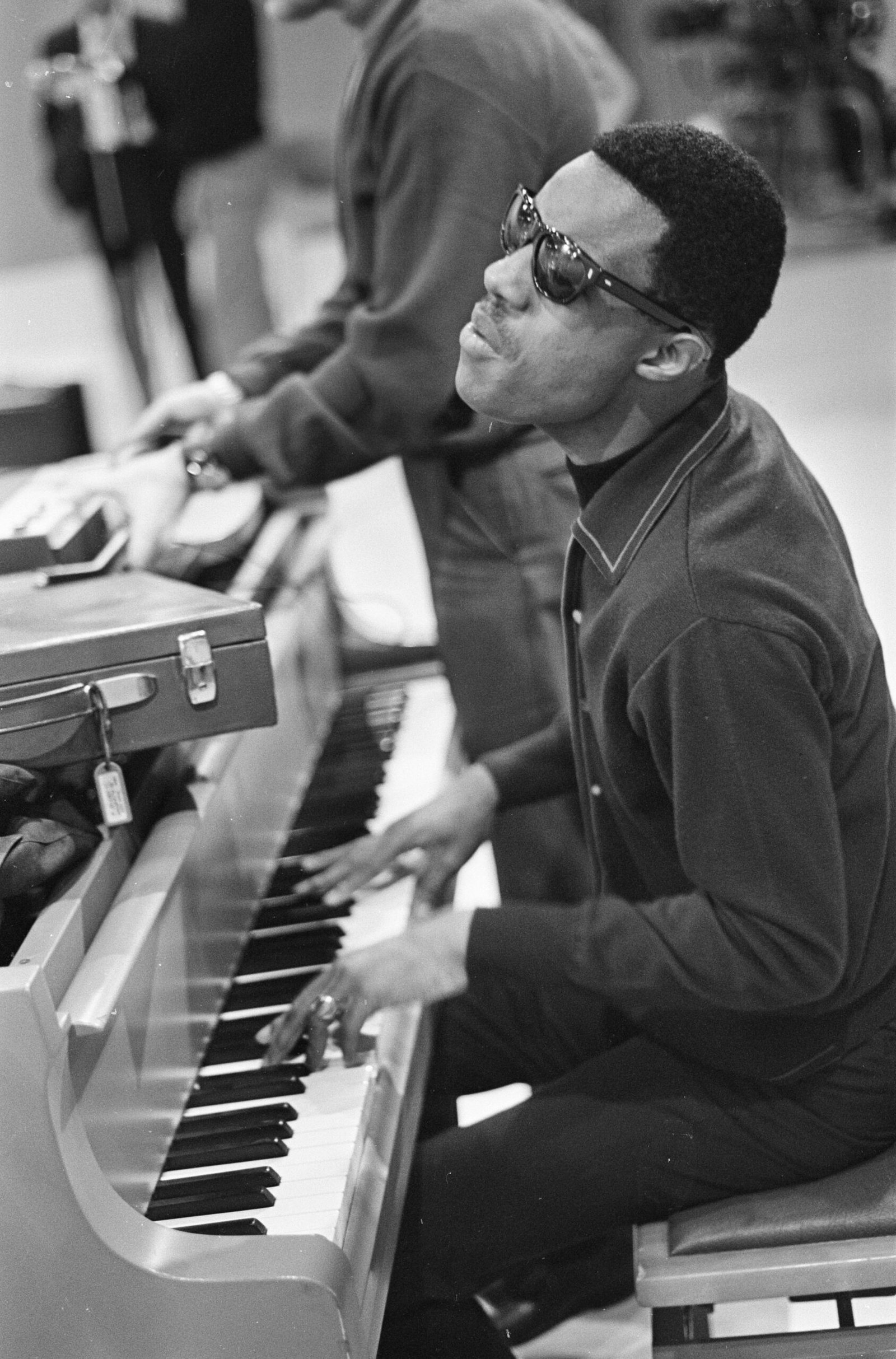
When Signed, Sealed, Delivered I’m Yours hit the shops in June 1970, Stevie Wonder had just turned twenty. He had been a professional musician for nine years — a third of his life spent as “Little Stevie,” the harmonica-playing prodigy inside Berry Gordy’s hit machine, singing other people’s songs under other people’s supervision. This record was different. The song was written in his own home, with his mother, his best friend, and the woman he was about to marry. And for the first time in his career, the man in the producer’s chair was Stevie Wonder himself. The single that resulted — No. 3 on the pop chart, six weeks atop the R&B chart — is the sound of a child star picking up the keys to his own career.
The Night in the Basement
The song was built by a household, not a hit factory. In 1969 and 1970, Wonder was writing constantly at home in Detroit, working most often with two partners. Lee Garrett was a singer-songwriter and former disc jockey, blind like Wonder, a friend from their schooldays at the Michigan School for the Blind whom Wonder had persuaded to relocate to Detroit. Syreeta Wright was a Motown secretary with a singer’s voice and a songwriter’s gift, by then Wonder’s girlfriend. The three of them were a unit: around the same sessions they wrote It’s a Shame, which Wonder produced for the Spinners and took into the Top 20.
Garrett, looking back decades later for author Adam White, remembered exactly how the song ignited. Wonder had brought them another track; they listened and listened. “And Syreeta and I went into the basement and, it was kinda funny, we both started singing ‘signed, sealed, delivered,’” Garrett recalled. “Stevie said, ‘Shut up, shut up!’ because I guess it hit us all three at the same time. From then on, we just bounced around with lyrics.” One of Garrett’s lines — “like a fool, I went and stayed too long” — was knowingly borrowed from Wonder’s own earlier hit I’m Wondering. “It felt good there,” he said.
Each of the three brought something the others lacked. Garrett was the craftsman of the crew, a working songwriter who knew how a lyric sits on a melody. Syreeta was the discovery waiting to happen: she had joined Motown as a secretary, and the company had already tried her once as a singer, issuing a 1968 single under the name Rita Wright that went nowhere. Writing with Wonder, she finally had a collaborator who heard her properly. And Wonder himself was the engine, arriving with music fully formed in his head, testing phrases aloud until the room caught fire. The trio’s basement method — no assignments, no quality-control meeting of the kind Motown institutionalized, just three people following a phrase — was a quiet rebellion against the factory system that had raised all of them.
Four Names on the Label
The fourth writing credit went to a woman who never called herself a songwriter: Lula Mae Hardaway, Wonder’s mother. Wonder’s own account of the division of labor was simple: “I write the melody and music, and might come up with the main idea… On ‘Signed, Sealed, Delivered,’ for example, I came up with the music, and Syreeta came up with the lyric. And my mother came up with some ideas on that one, too.” In a 2008 appearance on Friday Night with Jonathan Ross, he went further, crediting his mother with the title itself — Lula, listening to her son experiment with the melody across the room, exclaimed the words that became the chorus. Garrett, for his part, quietly maintained that the credit was partly Stevie’s gift to her. Both stories can be true at once, and the royalties were real either way: Hardaway’s name also appears on I Was Made to Love Her, You Met Your Match, and I Don’t Know Why I Love You — a mother woven through her son’s catalogue.
Stevie Takes the Wheel
The bigger revolution was in the control room. According to the liner notes of The Complete Motown Singles Vol. 10, the backing track was recorded in August 1969, and it marked Wonder’s debut as his own producer — the first single he would produce by himself. Berry Gordy, by most accounts, initially bristled at the twenty-year-old seizing that authority, then relented. Consider what that meant inside Hitsville: for nine years, every Stevie Wonder record had passed through the hands of staff producers and the company’s famous quality-control meetings, where executives voted on releases like a politburo. Now the artist was writing with his family at home, walking into Studio A with the song finished, and calling the shots himself. He was simultaneously doing the same for others — producing the Spinners’ It’s a Shame in the same period — functioning, at twenty, as a one-man songwriting and production department. What Wonder did with the freedom announced the coming decade. With arranger Paul Riser, he built the record around a then-exotic electric sitar — a nod to the Beatles’ influence — that snakes through the introduction, punched up by a full brass section. And he placed a trio of female backing singers where Motown usually kept them decorative: Syreeta Wright, Lynda Tucker Laurence (later a member of the Supremes), and Venetta Fields, the first appearance of the backing group that would shadow his classic records. Syreeta’s own fingerprints are on the record’s most irresistible hook, the “here I am, baby” refrain.
Weeks after the single’s release, the household became official: Wonder and Syreeta Wright married in September 1970. The marriage lasted eighteen months; the creative partnership, and the friendship, lasted the rest of her life.
Delivered
Released on Tamla on June 3, 1970, Signed, Sealed, Delivered I’m Yours became the title track of the album that followed in August and one of the defining soul records of the year. The album around it showed the breadth of the new regime: the same LP carried Wonder’s storming cover of the Beatles’ We Can Work It Out, itself a hit single the following year — the sitar colors and the Lennon-McCartney cover two sides of the same omnivorous curiosity. It spent six weeks at No. 1 on the Billboard R&B chart, peaked at No. 3 on the Hot 100, and sold more than a million copies. It also brought Wonder his first Grammy nomination — the industry beginning, belatedly, to treat the former child star as an artist in full. Within a year he would renegotiate his Motown contract on the strength of exactly this kind of proof, winning the complete artistic control that produced Music of My Mind, Talking Book, and Innervisions. This single was the hinge: the last great record of the factory years and the first one the factory didn’t control.
Still Being Delivered
The song refused to sit still. Peter Frampton covered it in 1977 for his album I’m in You and took it back into the American Top 20. Syreeta recorded her own version in 1980. And in 2008 the title became political shorthand: Signed, Sealed, Delivered I’m Yours was a fixture of Barack Obama’s presidential campaign, blaring over rally crowds and the election-night celebration — the song a country sang to itself about a promise being kept — a journey that ended, fittingly, with Obama presenting Wonder the Library of Congress Gershwin Prize for Popular Song in 2009.
But its deepest legacy is personal. Every element of the mature Stevie Wonder is present in embryo in this two-minute-and-forty-five-second record: the self-production, the family of collaborators, the sitar and synthesizer curiosity, the songwriter credits shared like a household budget. A song about delivering yourself, completely and irrevocably, to someone else — made by a young man delivering himself, for the first time, into his own hands. Here I am, baby, indeed.
Leave a Reply