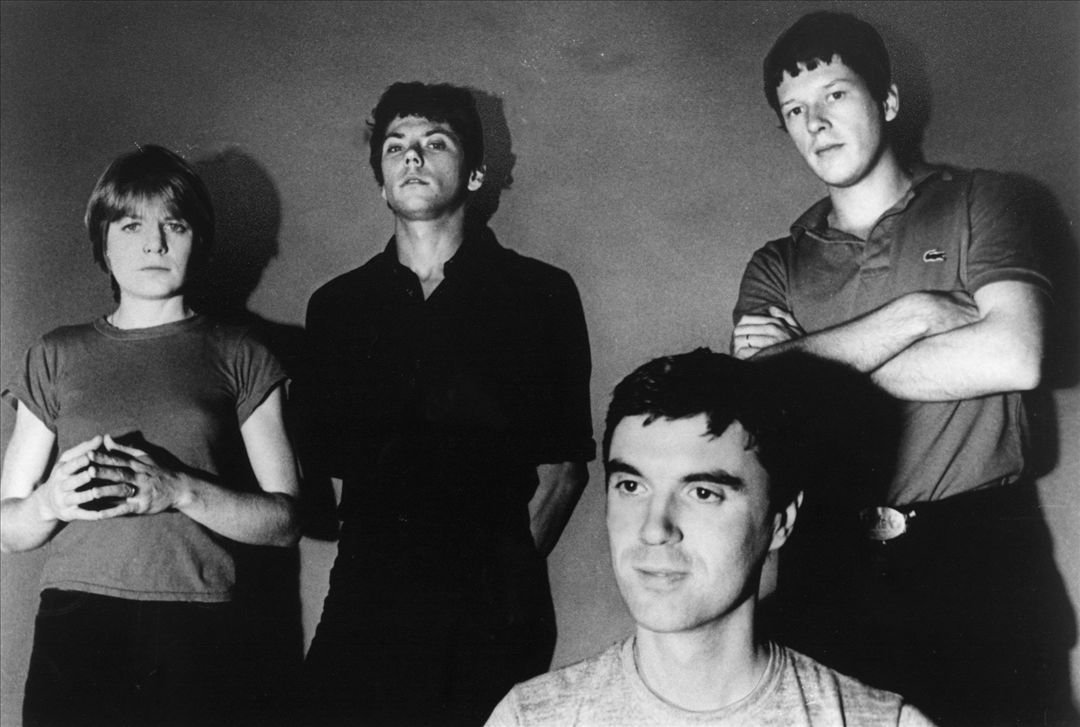
It may be the most joyful three and a half minutes Talking Heads ever recorded: a bright, bouncing pop song about a young woman who rises up from her backyard, floats over the houses and highways of her neighbourhood, and drifts away into the sky while the man who loves her watches from below. It sounds like pure weightlessness. What almost nobody hearing it on the radio in 1985 could have guessed is that the woman in the song was real, that David Byrne had known her back in Baltimore, and that her method of leaving the ground was a tab of acid taken in a field beside a factory that bottled Yoo-hoo chocolate soda.
“And She Was” opens Little Creatures, the band’s sixth album, and it announced a deliberate change of direction: after the layered funk of Remain in Light and Speaking in Tongues, Talking Heads had made a straightforward American pop record, and this was its front door. Released as a single in August 1985, it climbed only to number 54 in America — and then simply refused to disappear, outlasting bigger hits to become one of the most played and best loved songs the band ever made.
The Girl by the Yoo-hoo Factory
Byrne grew up in the suburbs of Baltimore, and decades later, writing the liner notes for the 1992 compilation Once in a Lifetime: The Best of Talking Heads, he explained exactly who the floating girl had been. “I used to know a blissed-out hippie-chick in Baltimore,” he wrote. “She once told me that she used to do acid (the drug, not music) and lay down on the field by the Yoo-hoo chocolate soda factory,” flying out of her body as the world went by beneath her. What fascinated him was the setting: transcendence achieved not on a mountaintop but amid industrial sprawl. He called it “such a tacky kind of transcendence… but it was real” — a new kind of religion, he wrote, being born out of heaps of rusted cars and fast-food joints, with the girl somehow above the whole scene and inside it at the same time.
In concerts in recent years, Byrne has introduced the song with a simpler version of the same memory: the girl was a school classmate who seemed happy all the time, and when he finally asked her why, the answer was LSD and that field. The song he built from her story keeps the drug itself tactfully offstage — there is no mention of acid in the lyric — and turns her trip into literal flight. She lies down in the grass, feels the world pulling away, rises past the lights of her neighbour’s house, and keeps going, over factories, highways and “the world of the privileged few,” while the narrator stands underneath her, half in awe and half in longing.
Drummer Chris Frantz read the song the same way Byrne wrote it — as a love song to someone the singer cannot follow. He described it as the story of “a woman who has the power to levitate above the ground and to check out all her neighbors from a kind of bird’s eye view,” whose admirer wishes she would “come on back down to the ground” — but she doesn’t. That tension, between the girl rising and the boy rooted below, is the whole emotional engine of the record: ecstasy observed by somebody left on earth.
A Band Learning to Be Simple
The song arrived at a turning point. Talking Heads had spent the early eighties getting bigger and denser — African polyrhythms on Remain in Light, sleek funk on Speaking in Tongues, and then the 1983 concert film Stop Making Sense, which had made them, improbably, one of the most celebrated live acts in the world. For the follow-up, they chose to go the other way. Little Creatures turned toward Americana and country music, toward verses and choruses, steel guitar and singalong melodies, and the method changed with the material: instead of building songs communally from studio jams, as they had since Remain in Light, Byrne came to the sessions with finished demos of songs he had written alone. “And She Was” was one of them, and it is credited to him outright — one of only a handful of tracks on the album with a single writer.
The band recorded the album themselves, producing it as a group at Sigma Sound in New York between October 1984 and March 1985, with Eric Thorngren engineering. The album appeared on 10 June 1985 wrapped in a sleeve painted by the Georgia outsider artist Howard Finster, which Rolling Stone named its album cover of the year. Critics approved of the new simplicity: Little Creatures was voted album of the year in The Village Voice‘s Pazz & Jop poll, and it went on to become the band’s best-selling studio album, certified double platinum in the United States, peaking at number 20 on the Billboard 200 and topping the chart in New Zealand.
Three Minutes of Lift
As the album’s opening track, “And She Was” had a job to do: reassure old fans and welcome new ones in under four minutes. It does it with the sunniest machinery the band ever assembled. Tina Weymouth’s bassline bounces with a Motown gait; Lenny Pickett, the saxophonist from Tower of Power who had joined the band’s touring ranks, threads saxophone through the record; a trio of backing singers — Gordon Grody, Lani Groves and Kurt Yahjian — lifts the choruses. Underneath the cheer, the harmony is quietly doing the song’s real work: the music keeps modulating upward, shifting key at the bridges rather than merely repeating itself, so the record seems to rise the way its heroine does, each chorus arriving a little higher than the last.
Cash Box, reviewing the single, praised Byrne’s “discreet pop ingenuity” and the band’s “inimitable rhythmic pump,” and noted the “strangely surrealistic lyric and a singalong chorus” — a fair summary of a song that smuggles an out-of-body experience into a melody children can shout. Spin‘s John Leland went further about the extended mix, calling it “the vibrantly upbeat pop party record the B-52’s have spent a lifetime trying to make.”
The Video That Let Her Fly
MTV completed the illusion. The band had been sent a surreal short film called Suspicious Circumstances by Jim Blashfield, a Portland filmmaker whose partner, Melissa Marsland, mailed it to them; its cut-out, photocopied collage animation, openly indebted to Terry Gilliam’s work for Monty Python, struck Byrne as the visual equivalent of the song. Blashfield was given carte blanche and roughly twenty-eight days. Working in Portland, he built the video from Xeroxed images animated frame by frame: houses, highways and factories sliding past beneath the floating girl, Byrne’s photocopied face singing up at her from the ground.
The clip became an MTV staple and earned two nominations at the 1986 MTV Video Music Awards, for Best Group Video and Best Concept Video. It also launched Blashfield, who spent the rest of the decade making celebrated videos for Paul Simon, Peter Gabriel, Joni Mitchell and Michael Jackson — whose “Leave Me Alone” won him a Grammy. The girl from the Yoo-hoo field had, in a sense, floated him upward too.
The Song That Never Came Down
The bare chart numbers undersell what happened next. “And She Was” entered the Billboard Hot 100 at number 94 in September 1985 and took two months to reach its modest peak of number 54 — then held on for twenty weeks in total, a slow-burning run powered by radio and MTV rather than any opening splash. It did considerably better almost everywhere else: number 11 on Billboard’s Mainstream Rock chart, number 17 in Britain, number 10 in Australia, number 9 in Ireland, number 16 in New Zealand, where it eventually went platinum. An early version of the song, recorded before the album sessions settled it, surfaced as a bonus track on the 2005 reissue of Little Creatures, letting listeners hear the flight being learned.
By then the song had long outgrown its chart peak. It became one of the most frequently played Talking Heads songs on radio and in films, a permanent fixture of Byrne’s solo concerts, where he still tells the Yoo-hoo factory story before singing it — the shy Baltimore schoolboy now an old man, still looking up. That is the quiet miracle of “And She Was”: a song about somebody else’s escape became the band’s most durable invitation to joy — a girl above it all yet somehow still in it, and a song that learned to fly the same way.
Leave a Reply