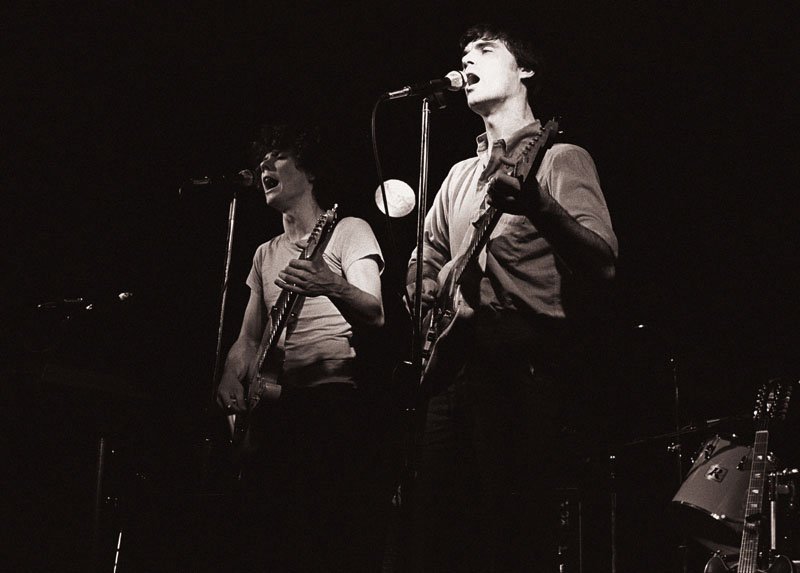
In the spring of 1979, Talking Heads did something no major-label band was supposed to do: they recorded the basic tracks of their third album in two days, in a rented loft in Queens, with a mobile recording truck parked outside and cables running through the windows. No producers’ polish, no studio gloss — just four musicians, a visionary in Brian Eno, and the courage to capture lightning. The result — “Fear of Music,” co-produced with Eno — was a dark, twitchy, visionary record that turned a Swiss Dada poem into a dance hit and pointed the way to the band’s masterpiece. This is the story of the strangest album the mainstream ever embraced.
The Loft on 44th Drive
The setting tells you everything. Drummer Chris Frantz and bassist Tina Weymouth — married, grounded, the band’s rhythmic engine — lived in a loft at 9-01 44th Drive in Long Island City, Queens. It was a raw industrial space in a raw industrial neighborhood, the kind of place where artists lived because it was cheap and loud and nobody minded the noise. In April 1979, instead of booking a fancy Manhattan studio, Talking Heads brought the studio to the loft — a decision that saved money, but more importantly captured something no studio could: the sound of a band at home, relaxed, dangerous.
The Record Plant’s mobile recording truck parked outside, cables snaked through the windows, and the band played live on the loft floor. The basic tracks for the entire album were cut in just two sessions — April 22 and May 6, 1979. Two days. The overdubs came later, at the Hit Factory, Atlantic Studios, RPM, and the Record Plant proper — layers of Eno’s treatments, Fripp’s guitar, and backing chants added with surgical care. But the heart of “Fear of Music” — its nervous energy, its live-wire tension — was captured in that loft, in those two days, by four musicians playing together in a room. It was punk in spirit and avant-garde in execution: the sound of a band trusting its instincts completely.
Eno’s Laboratory, Part Two
Behind the glass — or rather, behind the makeshift control setup — was Brian Eno. “Fear of Music” was the second of three consecutive albums the former Roxy Music keyboardist would co-produce with Talking Heads, and the partnership was deepening into something extraordinary. Eno brought his arsenal of creative provocations: the Oblique Strategies cards with their cryptic instructions, the tape loops, the treatments, the insistence on accidents and the war on habit.
The method was radical. Many tracks began as full-band improvisations — long, uncredited jams from which songs were carved like sculptures from stone, the band playing for hours while the tapes rolled. The band played; Eno listened, manipulated, and shaped, finding songs inside the noise. David Byrne has described the process as a kind of organized chaos, with Eno pushing the musicians out of their habits and into strange new territory. It was the opposite of how rock records were supposed to be made — no demos polished to perfection, no verse-chorus-verse safety net, no producer sanding off the edges. Just four brilliant musicians, a visionary producer, and the courage to see what happened when the tape rolled.
“I Zimbra”: A Dada Poem Set to Afro-Funk
The album’s wildest stroke of genius was its opening track. “I Zimbra” took as its lyric a 1916 Dada sound-poem by the Swiss writer Hugo Ball — “Gadji beri bimba,” a cascade of invented syllables first performed at Zurich’s Cabaret Voltaire, the birthplace of Dada. Sixty-three years later, David Byrne chanted Ball’s nonsense syllables over a churning Afrobeat-disco groove, with none other than Robert Fripp — the legendary King Crimson guitarist — contributing searing guest guitar, and assistant engineer Julie Last adding backing chants from behind the mixing desk.
It should have been unlistenable. It was irresistible. “I Zimbra” became a dance-floor favorite and one of the band’s signature songs — Dadaism you could move to, nonsense syllables riding a groove so deep it didn’t need meaning. Guitarist Jerry Harrison later said the track pointed directly toward the band’s next album, “Remain in Light,” with its deep immersion in African rhythms. In a single song, Talking Heads had connected Zurich 1916 to New York 1979 to West Africa — and made it funky. No other band on earth could have done it.
“Life During Wartime”: The Hit That Saw the Future
If “I Zimbra” was the album’s wildest moment, “Life During Wartime” was its most prophetic. Written by Byrne alone, it was one of his first solo-written singles — a paranoid, propulsive vision of urban collapse, inspired by the edgy energy of Avenue A in Manhattan’s East Village, where the band lived among the squats, the clubs, and the beautiful decay. Over one of the great basslines in rock history — Tina Weymouth at her absolute peak, all muscle and menace — Byrne sang of a future where the party was over and survival was the only game. It was catchy enough for the radio and dark enough for the underground, and it announced Byrne as a songwriter who could see around corners. Decades later, its vision of a fractured, fearful America feels less like a song and more like a dispatch.
The song’s famous refrain became one of the most quoted lines of the era, a perfect summary of the album’s mood: the seventies dream curdling into eighties anxiety. It was catchy enough for the radio and dark enough for the underground, and it announced Byrne as a songwriter who could see around corners. Decades later, its vision of a fractured, fearful America feels less like a song and more like a dispatch.
The Dark Mirror
“Fear of Music” is, song for song, one of the darkest albums ever to flirt with the mainstream. “Heaven” imagined the afterlife as a place where nothing ever happens — a bar with no beer, a joke with no punchline — set to one of the most beautiful, lilting melodies the band ever wrote, the sweetness making the bleakness hit harder. It was the album’s great trick: wrapping existential dread in music so lovely you almost missed the abyss. “Memories Can’t Wait” was pure dread, all lurching rhythms and apocalyptic imagery, Byrne sounding like a man watching the world end in real time. “Drugs” explored altered consciousness with queasy precision, its woozy groove mirroring its subject. Even “Animals,” with its twitchy funk, carried an undercurrent of menace. The album’s genius was making paranoia danceable — wrapping its fears in rhythms so compelling you almost missed how frightened the songs were.
The cover matched the mood: an embossed black pattern designed by Jerry Harrison, photographed by Jimmy Garcia — abstract, tactile, faintly menacing, like a topographical map of some inner darkness. There were no band photos, no friendly faces, no smiles. Just the pattern, and the title, and the feeling that something was coming — the most unsettling sleeve of the band’s career, and the most honest. The original LP credited all the songs to Byrne alone — except “I Zimbra” — a decision that rankled the other members, who had contributed so much to the jams the songs were built from. The credits were later corrected, but the tension it revealed was real, and it would grow.
The Credits Fight
For all its brilliance, “Fear of Music” carried the seed of the band’s eventual undoing — and it was printed right on the label. The original LP credited all the songs to David Byrne alone, with the sole exception of “I Zimbra.” The other three members, who had contributed so much to the full-band improvisations from which the songs were carved, were furious. The credits were eventually corrected, but the damage to trust was real.
In hindsight, the dispute revealed the central tension of Talking Heads: a band that worked as a collective but was increasingly perceived — and increasingly behaved — as one man’s vehicle. Byrne was the visionary, the lyricist, the face the cameras loved. But Frantz, Weymouth, and Harrison were not sidemen; they were co-creators, and the loft sessions had proved it — the grooves, the textures, the strange alchemy of those two days in Queens belonged to all four of them. The music on “Fear of Music” was the product of four people in a room, feeding off each other. The credits fight was the first public sign that the question of who Talking Heads belonged to would one day tear them apart. For now, though, the music was bigger than the argument — and the argument, in its way, was proof of how much the music mattered to everyone involved.
Reception and Aftermath
“Fear of Music” was released on August 3, 1979, on Sire Records. It reached number 21 on the Billboard 200 — a strong showing for a record this strange, proof that the mainstream had room for the avant-garde after all — and was eventually certified gold in 1985, its audience growing steadily as its legend spread. Critics were ecstatic; many named it among the best albums of the year, and its reputation has only grown with time. It stands now as the crucial bridge in the Talking Heads catalog: the record where the art-school nerviness of the early albums met the rhythmic expansiveness that would flower on “Remain in Light,” the moment the band found its true size.
More than that, it was proof of concept. A major-label band had recorded an album in a Queens loft in two days, built songs from Dada poetry and full-band jams, hired a prog-rock guitarist for a disco track, put an abstract black pattern on the cover instead of their faces — and made it all cohere into something thrilling. “Fear of Music” didn’t just predict the future of Talking Heads. It predicted the future of adventurous pop music itself.
The Beautiful Paranoia
Listening to “Fear of Music” today is like opening a time capsule from a future that arrived early. Its anxieties — about cities, about technology, about the fragility of normal life — are our anxieties now, sharper than ever. Its solutions — rhythm, community, art, the willingness to be weird — are still the best ones anyone’s found. Talking Heads made a record about fear in a Queens loft in two days, with cables running through the windows, and it turned out to be an act of courage. Nearly half a century later, it still sounds like tomorrow — and like a reminder that the bravest records are often made the fastest, by people who trust each other completely. Play it loud. Play it often. Some records don’t age; they ripen, growing stranger and truer with time. This is one of them.
Leave a Reply